Zing Forum

Reading

MindVault: Building a Persistent, Structured, and Token-Efficient Memory Layer for Large Language Models

This article introduces MindVault, a desktop knowledge management platform that provides a persistent, structured, and token-efficient memory layer for large language models (LLMs) through a multi-agent collaborative reinforcement learning (MACRL) routing mechanism and a hierarchical graph architecture. It addresses core pain points of current LLM interfaces, such as statelessness, context window waste, and privacy leaks.

大型语言模型知识管理记忆层多智能体强化学习MACRL隐私保护RAG知识图谱本地AIToken优化
Published 2026-05-01 04:39Recent activity 2026-05-01 04:57Estimated read 7 min
MindVault: Building a Persistent, Structured, and Token-Efficient Memory Layer for Large Language Models
1

Section 01

MindVault: Building a Persistent, Structured, and Token-Efficient Memory Layer for LLMs (Introduction)

MindVault is a desktop knowledge management platform designed to address core pain points of current LLM interfaces: statelessness, context window waste, privacy leaks, and knowledge fragmentation. Through a hierarchical graph architecture and multi-agent collaborative reinforcement learning (MACRL) routing mechanism, it provides LLMs with a "better context shape" instead of simply expanding the window, while ensuring privacy control through a local-first design.


2

Section 02

Background: Core Pain Points in Current LLM Memory Management

Current LLM memory management has three core issues:

  1. Context window waste: Large windows are costly; flat RAG is prone to hallucinations and relies on semantic alignment;
  2. Privacy leak risk: Sensitive data sent to the cloud may be leaked, which is unacceptable to professionals;
  3. Knowledge fragmentation: Knowledge is scattered across different conversations/platforms, lacking unified management and retrieval. These stem from the "stateless" nature of LLM interfaces—each conversation starts from scratch and cannot remember past interactions.
3

Section 03

Core Architecture: Hierarchical Graph and Specialized Vaults

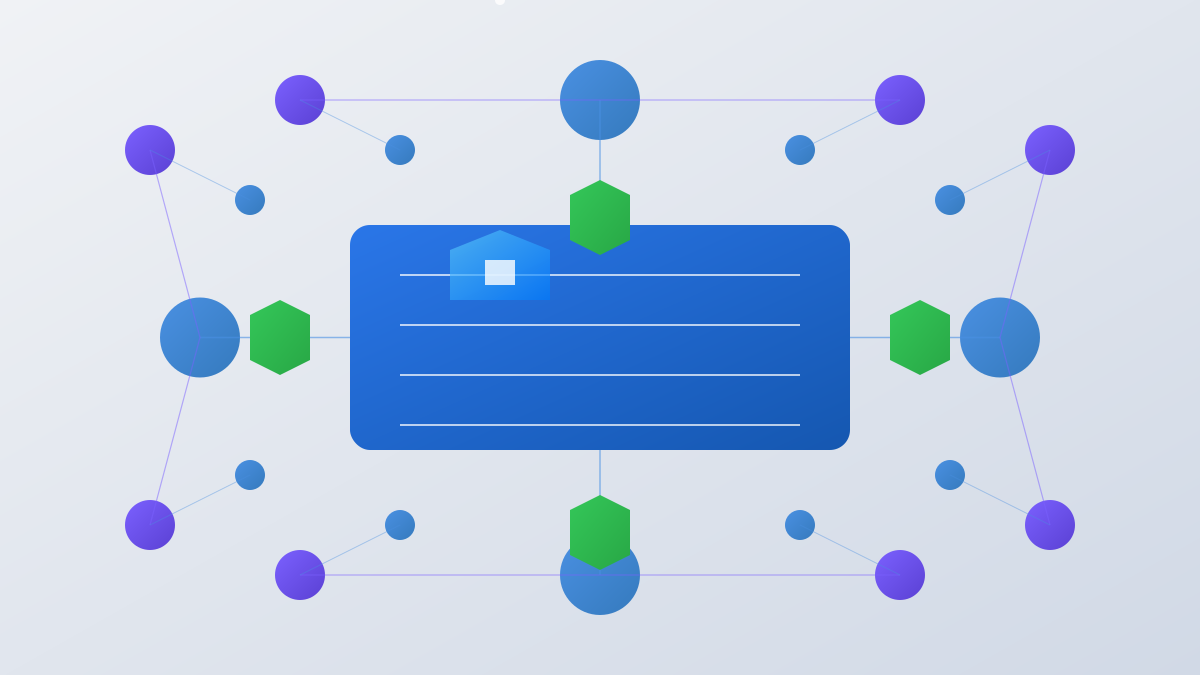
MindVault uses a hierarchical graph architecture to organize knowledge:

  • Root Graph: Resides in memory, containing core high-frequency knowledge nodes;
  • Scope Vaults: Domain-specific (e.g., programming, academia) to reduce retrieval scope;
  • Cross-Vault Portals: Establish semantic links between domains to enable cross-domain knowledge fusion. This architecture accurately activates relevant knowledge and improves retrieval efficiency.
4

Section 04

MACRL Routing Mechanism: Intelligent Intent Recognition and Context Retrieval

MACRL routing is a core innovation, with multi-agents working collaboratively:

  • Intent Classifier: Analyzes query objectives (facts/tasks/comparisons, etc.) and triggers corresponding strategies;
  • Routing Agent: Calculates relevance scores for each vault to determine retrieval priority;
  • Context Assembler:
    • Decay Pruner: Eliminates low-value nodes to optimize token usage;
    • Privacy Filter: Replaces sensitive nodes with pointer stubs to protect privacy in cloud requests.
5

Section 05

Hybrid Inference Architecture: Local and Cloud Collaboration

MindVault supports flexible inference configurations:

  • Cloud Path: Sends secure context with pointer stubs to cloud LLMs, outputting reference placeholders;
  • Local Path: Injects full context into local LLMs (e.g., Llama3) for offline inference;
  • Hybrid Parsing: Pointer stubs in cloud outputs are parsed locally, integrating sensitive data to balance capability and privacy.
6

Section 06

Continuous Memory Loop: Knowledge Extraction and Human Decision-Making

A continuous memory loop is activated after a conversation:

  • Memory Agent: Analyzes conversations in the background, extracts new facts, and removes duplicates;
  • Memory Difference Panel: Displays new knowledge change sets, allowing users to review, accept/edit/reject; Following the "human-in-the-loop" principle, users hold decision-making power over knowledge storage.
7

Section 07

Technical Advantages and Application Scenarios

Advantages of MindVault:

  • Token Efficiency: Reduces token consumption by 40-60% in actual tests;
  • Controllable Privacy: Users fully control data sovereignty;
  • Structured Knowledge: Models conceptual relationships in graph form to improve retrieval accuracy;
  • Continuous Learning: Enriches the knowledge base from interactions, becoming more user-aware over time. Application Scenarios: Researchers (literature management), developers (tech stack retrieval), medical professionals (privacy-compliant case integration), enterprise workers (multi-source information hub).
8

Section 08

Future Outlook and Conclusion

Future Outlook:

  • Multimodal Support: Extend to non-text knowledge such as images and audio;
  • Collaboration Features: Team-shared vaults for collaboration under privacy protection;
  • Intelligent Summarization: Automatically generate knowledge summaries and concept graphs;
  • Cross-Device Sync: End-to-end encryption for multi-device synchronization. Conclusion: MindVault transforms LLMs from "stateless interfaces" to "stateful knowledge partners", proving that AI capabilities and privacy can coexist, providing a new paradigm for LLM applications.

