Zing Forum

Reading

MetaMorph: Transforming Chaotic Metadata into Structured Machine Learning Features Using LLM Agents

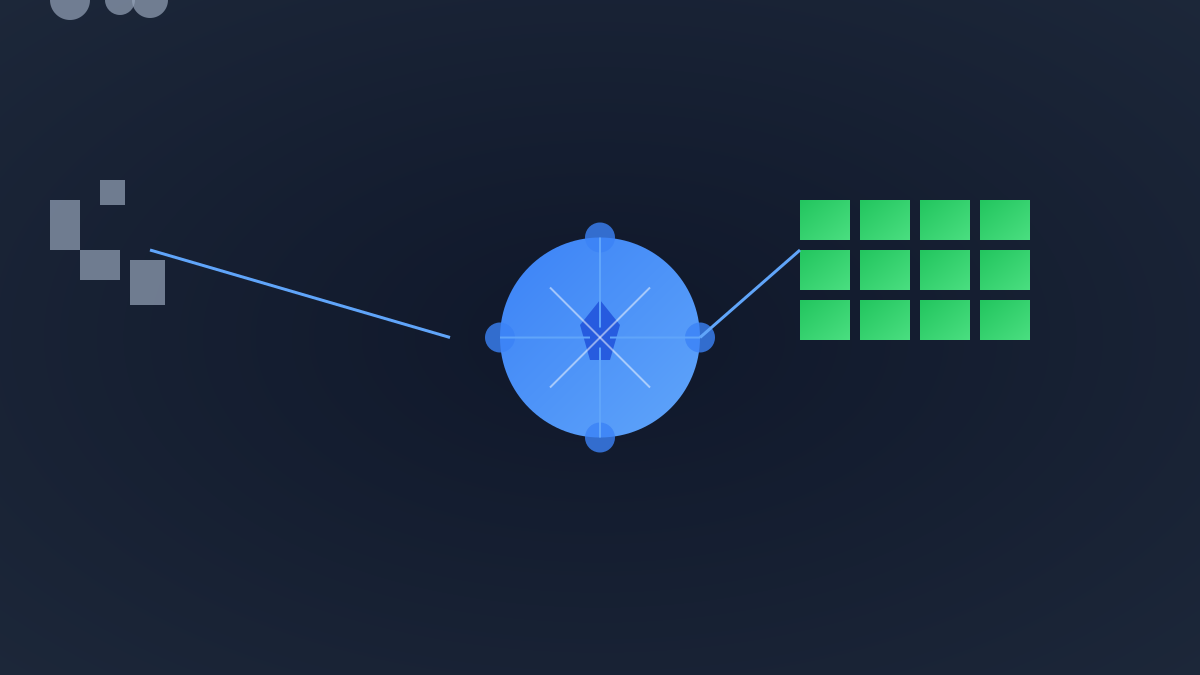
MetaMorph is an open-source LLM-driven agent framework specifically designed to solve one of the most frustrating problems in data science—converting disorganized metadata into machine-readable structured features. Through a multi-step agent pipeline, it can automatically parse free text, standardize unit formats, extract domain entities, and generate complete traceability reports.

LLM智能体元数据数据清洗特征工程LangGraph结构化输出MCP机器学习流水线
Published 2026-05-29 07:29Recent activity 2026-05-29 07:49Estimated read 4 min
MetaMorph: Transforming Chaotic Metadata into Structured Machine Learning Features Using LLM Agents
1

Section 01

MetaMorph: Introduction to the Open-Source LLM Agent-Driven Metadata Structuring Framework

MetaMorph is an open-source LLM-driven agent framework focused on solving the problem of metadata chaos in data science. Through a multi-step agent pipeline, it automatically parses free text, standardizes units, extracts entities, and generates traceability reports, transforming chaotic metadata into machine-readable structured machine learning features.


2

Section 02

Pain Points of Metadata Cleansing: The Invisible Killer of ML Projects

In real-world ML projects, metadata often exists in forms like free text, inconsistent formats, and chaotic classification labels, leading to fragile models, low reproducibility, and slow iteration. Traditional rule engines and regular expressions struggle to handle these variable and semantically rich data, while LLMs excel at such tasks.

3

Section 03

Core Capabilities and Agent Architecture of MetaMorph

MetaMorph uses a multi-step agent pipeline, including nodes for parsing, schema/type inference, refinement and standardization, validation, error handling, and retries. Each processing column maintains a tracker that records event paths, node reasoning reasons, uncertainty markers, etc., supporting traceability and ensuring repeatability and robustness.

4

Section 04

Practical Conversion Examples and Typical Application Scenarios

Example: Various formats in the height column (e.g., 5ft10in, 170cm) are processed into unified centimeter values. Application scenarios cover fields such as environmental science, clinical biomedicine, drug discovery, materials informatics, and RAG analysis preparation.

5

Section 05

Technical Highlights and Quick Start Guide

Design principles: Dependency-free modularity (environment managed by Pixi), multi-backend support (LLM provider decoupling in v1.2), cost-aware routing, complex-to-structured conversion. Quick start: Clone the repository → Install → Run the example command (git clone https://github.com/Michael000777/MetaMorph.git && cd MetaMorph && pixi install && pixi run python metamorph/mainConcurrent.py --input examples/data1.csv -d testRob -o examples/ -l gpt-5-mini).

6

Section 06

Conclusion: The Pragmatic Value of MetaMorph

MetaMorph focuses on solving the specific problem of metadata chaos, representing a pragmatic direction for combining data engineering with LLM agents. It is suitable for data scientists and ML engineers dealing with real-world messy data and is worth paying attention to.