Zing Forum

Reading

MemoraAI: A Personalized Learning Platform Integrating Generative AI and Machine Learning

MemoraAI is a full-stack personalized learning system that combines generative AI and traditional machine learning. It helps users learn efficiently and retain knowledge long-term through forgetting detection, adaptive quizzes, and automated MLOps pipelines.

个性化学习生成式AI机器学习MLOps教育科技遗忘曲线自适应测验FastAPIReact
Published 2026-05-25 01:08Recent activity 2026-05-25 01:21Estimated read 8 min
MemoraAI: A Personalized Learning Platform Integrating Generative AI and Machine Learning
1

Section 01

MemoraAI Introduction: A Personalized Learning Platform Integrating Generative AI and ML

MemoraAI is a full-stack personalized learning system that combines generative AI and traditional machine learning. It aims to help users learn efficiently and retain knowledge long-term through forgetting detection, adaptive quizzes, and automated MLOps pipelines. This project is maintained by srishanthreddy456789 and published on GitHub (link: https://github.com/srishanthreddy456789/MemoraAI-Personalized-Learning) on 2026-05-24. Its core goal is to address the pain point of easy learning but difficult retention in the information explosion era, and build an intelligent learning ecosystem that understands users' memory status.


2

Section 02

Background: The Common Problem of Forgetting in Learning

In the era of information explosion, it's easy to learn new knowledge, but retaining it long-term is a challenge. Studies show that humans have a 'forgetting curve', where most content is forgotten quickly in a short time. Traditional learning platforms only focus on content delivery, ignoring memory consolidation and forgetting prevention. MemoraAI is designed for this purpose—it is not just a learning tool, but an intelligent system that can understand users' memory status, predict forgetting risks, and intervene proactively. By combining the conversational capabilities of generative AI with the predictive power of ML, it creates a closed-loop learning ecosystem.

3

Section 03

System Architecture and Core Working Mechanism

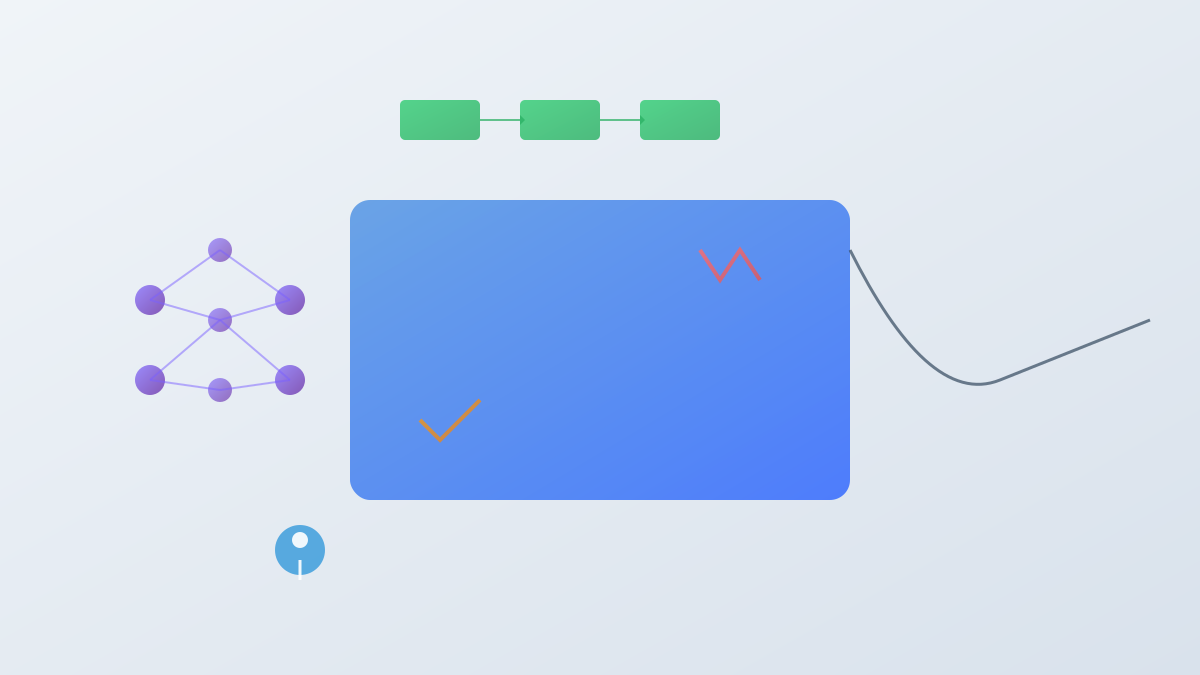
System Architecture: Adopts a full-stack architecture, integrating user experience, intelligent dialogue, data analysis, and model training.

  • Frontend: Built with React to create a chat-style interface, lowering the barrier to use;
  • Backend: Uses FastAPI framework to provide high-performance REST APIs, supporting automatic document generation;
  • Intelligent Core: Generative AI module (dynamically adjusts explanation depth and quizzes) + ML prediction module (analyzes learning behavior and identifies forgetting risks);
  • Data Layer: Uses SQLite for data storage, DVC for version control, and MLFlow for experiment tracking, enabling automated model retraining.

Workflow: Registration and login → Conversational learning → Multi-dimensional data collection (messages, session duration, interaction mode, quiz performance) → Forgetting behavior analysis → Adaptive quiz generation → Performance feedback → Automatic model retraining.

4

Section 04

Detailed Technical Stack

The technical stack selection reflects best practices for modern AI applications:

  • Frontend: React (component-based UI), chat-first interaction design;
  • Backend: FastAPI (asynchronous high performance), RESTful API, Swagger/OpenAPI (automatic documentation);
  • AI/ML: Generative AI (dynamic content generation), custom ML models (forgetting prediction/performance evaluation), MLOps pipeline (automated training/version control);
  • Data and DevOps: SQLite (lightweight database), DVC (data versioning), MLFlow (experiment management), Docker (containerization), CI/CD (continuous integration).
5

Section 05

Deployment Challenges and Practical Considerations

Challenges faced during deployment:

  1. Resource Intensive: The combination of generative AI and ML models requires high memory, CPU/GPU resources;
  2. Storage Requirements: Reliable storage is needed for chat records, quiz history, training data, and model versions;
  3. Free Platform Limitations: Most free hosting services lack persistent storage, do not support long-running background processes, and have limited resource quotas, making it impossible to handle both AI workloads and database persistence simultaneously.

Solutions: Currently, it is mainly designed to run locally or be deployed on paid cloud infrastructure.

6

Section 06

Practical Significance and Application Value

The application value of MemoraAI is reflected in multiple aspects:

  • Individual Learners: Efficient learning (avoid repeating already mastered content), long-term memory (scientific spaced repetition), personalized path (adapting to learning pace);
  • EdTech Field: Closed-loop feedback (data-driven improvement), AI integration (collaboration between generative AI and predictive ML), MLOps example (reference for educational AI implementation);
  • Developer Community: Full-stack architecture reference, open-source code and documentation for learning and expansion.
7

Section 07

Summary and Outlook

MemoraAI is an ambitious project to solve the problem of long-term learning retention. By combining generative AI and ML, it builds an intelligent system that understands users' forgetting patterns. Although deployment challenges limit its immediate availability, its architectural design and implementation ideas provide a reference for the development of personalized learning systems. With the advancement of edge computing and model compression technologies, such full-stack AI learning systems are expected to become more popular. For developers, MemoraAI provides a complete reference implementation from UI to MLOps.

