Zing Forum

Reading

LLM Layer-0 Functional Compliance Specification: Defining the Six Core Roles of Large Language Models

A formal mathematical theorem that defines the six functional roles contemporary large language models must instantiate, providing a common language for LLM auditing, regulation, and architectural discussions.

LLM大语言模型规范合规架构人工智能Transformer数学定理审计监管
Published 2026-05-25 08:14Recent activity 2026-05-25 08:19Estimated read 9 min
LLM Layer-0 Functional Compliance Specification: Defining the Six Core Roles of Large Language Models
1

Section 01

Introduction: LLM Layer-0 Functional Compliance Specification—Defining the Six Core Roles of Large Language Models

This article introduces the LLM Layer-0 Functional Compliance Specification project on GitHub, published by gatchimuchio on 2026-05-25. The project uses formal mathematical theorems to define the six core functional roles that contemporary large language models must instantiate, providing a unified foundation and common language for LLM auditing, regulation, and architectural discussions. Any system missing any of these roles cannot be called a contemporary LLM.


2

Section 02

Background: Why Do We Need Layer-0 Specification?

The technology of large language models has developed explosively, but the lack of a unified foundational definition leads to communication confusion and inconsistent judgment standards in regulatory audits, developer architectural discussions, and researcher model comparisons. This open-source project proposes a solution: defining the six core functional roles that an LLM must satisfy in the form of mathematical theorems, which is a formal "functional necessity theorem"—any system missing any role is not a contemporary LLM.

3

Section 03

Core Theorem: The Six Functional Roles of LLM

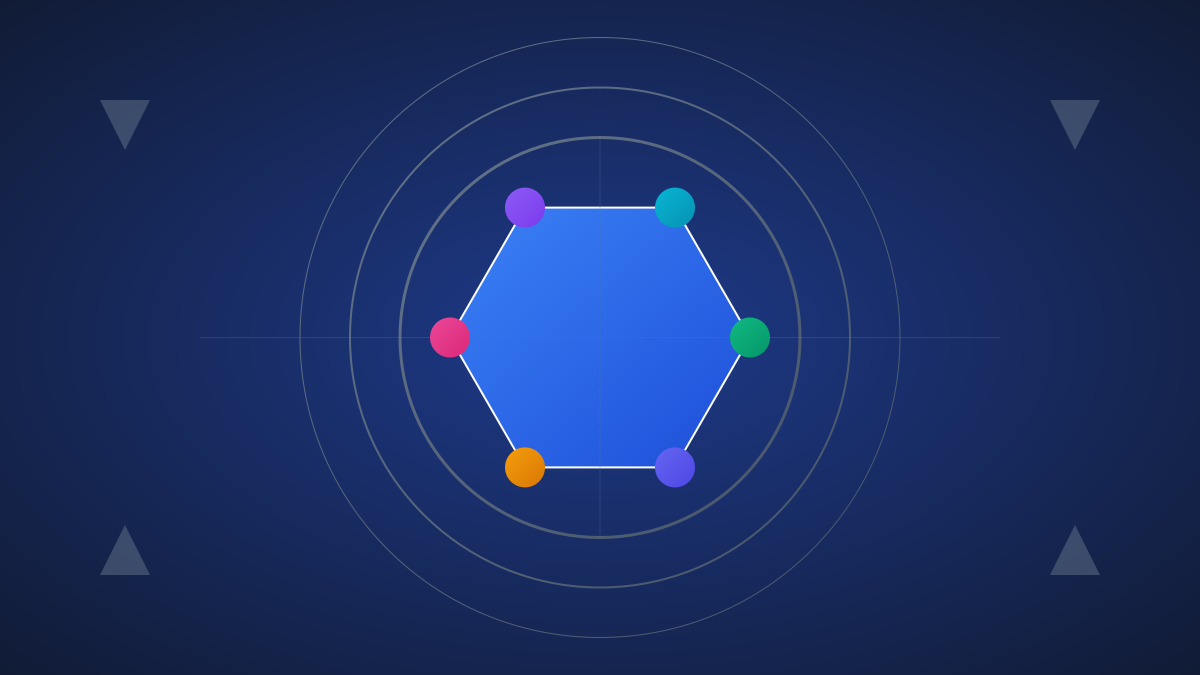
The Layer-0 specification includes six functional roles that must be instantiated:

  1. TOKEN_OR_SYMBOL_SPACE: The boundary of basic unit representation for model input and output;
  2. CONTEXT_CONDITIONING_STATE: The boundary of reasoning states that affect predictions (e.g., key-value cache in Transformers);
  3. LEARNED_PARAMETERIZED_TRANSFORM: A parameterized transformation function obtained through training (distinguished from traditional rule-based systems);
  4. CONDITIONAL_LINGUISTIC_OUTPUT_SURFACE: The boundary of the output space considering conditional probability distributions;
  5. SEQUENCE_MODELING_OBJECTIVE_OR_EQUIVALENT_FITTING_CRITERION: The optimization objective driving model learning (e.g., next-token prediction);
  6. DECODING_OR_EMISSION_INTERFACE: The mechanism to convert internal states into observable outputs (e.g., greedy decoding, sampling).
4

Section 04

Proof Method and Architecture Independence

Proof Method: Uses finite exhaustive method to verify 64 (2^6) role subsets; only the complete set passes, all proper subsets fail. This can be reproduced via make audit and make verify. Architecture Independence: Applies to architectures like Transformer, Dense, MoE, SSM/Mamba, RWKV, etc. The six roles remain unchanged, only the implementation methods differ, providing a stable foundation for discussions.

5

Section 05

Practical Application Scenarios

  1. Audit and Compliance: make audit returns deterministic results and executable certificates, avoiding ambiguous judgments;
  2. Regulation and Standard Setting: Provides a formal boundary definition for "whether a system is an LLM", unaffected by architectural evolution;
  3. Common Language for Architectural Discussions: Separates "what an LLM is" from "how to implement an LLM". Specific technologies (e.g., attention mechanism, RoPE) are under Layer-0;
  4. Counterexample Protocol: Critics need to provide a more rigorous decomposition or valid LLM counterexample; "it depends on the definition" is not a valid refutation.
6

Section 06

Industry Practice Alignment and Multi-Layer Verification

Industry Alignment: Cites official descriptions from OpenAI, Anthropic, xAI, Meta, Mistral, etc., to ensure consistency between theory and practice. Multi-Layer Verification System:

Layer Content Established Verification Support Boundary
Layer0 Mathematical necessity of the six roles Term boundary axioms + role separation argument Formal theorem domain
LayerA Finite obligation graph theorem Exhaustive enumeration of 64 subsets Formal executable certificate
LayerB Public LLM family mapping Official references and witnesses Public witness mapping
Layer1+ Architectural branch positioning Public architecture descriptions Implementation branches under Layer0
7

Section 07

Technical Implementation and Limitations

Technical Implementation: Provides a fully reproducible environment. The main artifact is llm_minimal_architecture_groups_v3_0.py, and the LayerA certificate is located at appendices/layer_a_obligation_graph_enumeration_v0_5/layer_a_executable_certificate.json. Verification commands include make audit, make verify, make test-all. The expected results are: main audit passes, count of passing proper subsets is 0. Limitations: The six role labels are not the only possible English labels; merging five components hides responsibility boundaries, while seven+ components enter implementation refinement; the counterexample protocol has strict requirements (need to prove that the candidate system is an LLM and lacks a role or equivalent function).

8

Section 08

Conclusion

The LLM Layer-0 Functional Compliance Specification establishes a mathematically rigorous definition foundation for LLMs through formal definitions and exhaustive proof, providing a common language for auditing, regulation, and architectural discussions. Its value lies in stabilizing the communication foundation without restricting innovation, and it provides a valuable theoretical basis for AI governance organizations, enterprises auditing third-party systems, and technical personnel to understand the essence of LLMs.

