Zing Forum

Reading

llm-interface: An NPM Library for Unified Access to 36 LLM Providers

A unified interface library supporting 36 LLM providers and hundreds of models, simplifying multi-model switching and integration in Node.js applications

llm-interfaceNPMNode.js多模型集成OpenAIAnthropicGoogle Gemini统一API大语言模型JavaScript
Published 2026-06-07 11:44Recent activity 2026-06-07 11:50Estimated read 6 min
llm-interface: An NPM Library for Unified Access to 36 LLM Providers
1

Section 01

Introduction: llm-interface - An NPM Library for Unified Access to 36 LLM Providers

llm-interface is an NPM library supporting 36 LLM providers and hundreds of models, designed to simplify multi-model switching and integration in Node.js applications. It addresses the core pain point developers face: different LLM providers have independent API formats, authentication methods, and response structures, leading to a sharp increase in code complexity when switching models. Its core value lies in providing a unified interface layer that allows developers to interact with multiple services using the same code pattern, covering mainstream providers such as OpenAI, Anthropic, Google Gemini, and Ollama, and supporting production-grade features like streaming responses, embedding vectors, failover, and caching.


2

Section 02

Background: Industry Pain Points of Multi-LLM Integration and Project Origin

Against the backdrop of the rapid development of generative AI, developers face a common challenge: the APIs of dozens of LLM providers differ significantly, requiring adaptation to different SDKs when switching or using multiple services simultaneously, leading to a sudden rise in code complexity. The llm-interface project is maintained by samestrin, sourced from GitHub (link: https://github.com/samestrin/llm-interface), and was released on June 7, 2026.

3

Section 03

Core Approach: Unified Interface and Comprehensive Feature Design

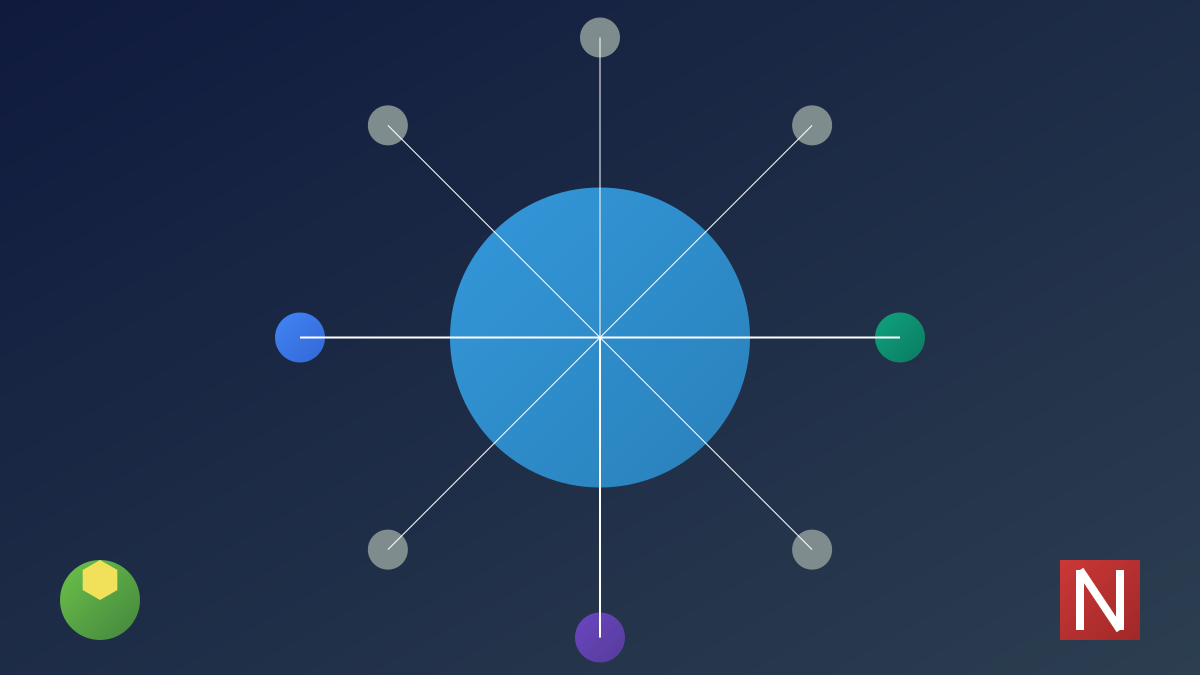
The core design philosophy of llm-interface is 'learn once, use anywhere'. Through the unified LLMInterface.sendMessage method, developers can interact with any supported provider without learning different SDKs. Its features include:

  • Streaming responses: Support for real-time output
  • Embedding vectors: Adapted for RAG architecture
  • Failover: Automatically switch to alternatives when the main service is unavailable
  • Response caching: Reduce costs and improve performance
  • Graceful retries: Exponential backoff strategy
  • JSON processing: Natively support structured output and format repair
  • Dynamic loading: Load provider modules on demand to reduce resource usage. It supports 36 providers, including mainstream services like OpenAI, Anthropic, Google Gemini, and Ollama.
4

Section 04

Evidence: Usage Examples and Technical Architecture

Usage Examples:

  1. Basic call: Call an OpenAI model via sendMessage after setting the API key;
  2. Quick call: Pass the provider and key in one line of code;
  3. Complex messages: Support conversation history and multi-turn interactions.

Technical Architecture: Built on Node.js, core dependencies include axios (HTTP requests), @google/generative-ai (Google Gemini SDK), jsonrepair (JSON repair), and loglevel (logging). Optional dependencies like flat-cache and cache-manager extend caching capabilities.

5

Section 05

Conclusion: Summary of the Project's Core Value

llm-interface provides an elegant multi-LLM integration solution for Node.js developers. Its value lies not only in technical implementation but also in its design philosophy: shielding underlying differences through an abstraction layer, allowing developers to focus on business logic rather than API adaptation, effectively reducing the code complexity of multi-model integration.

6

Section 06

Recommendations: Applicable Scenarios and Usage Suggestions

Applicable Scenarios:

  • Products that need to support multiple model providers simultaneously;
  • Projects that want to switch/upgrade models without modifying code;
  • Applications that need unified infrastructure like caching, retries, and error handling.

Suggestions: Teams building AI applications should evaluate this tool. The project uses the MIT license and has an active maintenance status, providing confidence for production environment use.

