Zing Forum

Reading

LLM Knowledge Distillation: Extracting Professional Semantic Filters from Large Models

A knowledge distillation framework that transfers the capabilities of large language models to lightweight dedicated semantic filters, significantly reducing inference costs and deployment barriers while maintaining performance.

知识蒸馏大语言模型模型压缩语义过滤教师-学生模型模型优化边缘部署
Published 2026-04-29 03:37Recent activity 2026-04-29 03:50Estimated read 7 min
LLM Knowledge Distillation: Extracting Professional Semantic Filters from Large Models
1

Section 01

LLM Knowledge Distillation: Core Value of Extracting Professional Semantic Filters

This article introduces a knowledge distillation framework designed to transfer the capabilities of large language models (LLMs) to lightweight dedicated semantic filters, significantly reducing inference costs and deployment barriers while maintaining performance. The framework focuses on semantic filtering tasks, achieves capability transfer through the teacher-student model paradigm, and is applicable to various scenarios such as content moderation and embedded devices, providing solutions for the practical implementation of large models.


2

Section 02

Efficiency Dilemma of Large Models and the Solution via Knowledge Distillation

Although large language models (LLMs) are powerful, their scale of tens or hundreds of billions of parameters poses deployment challenges: requiring expensive GPU clusters, high inference latency, and high energy consumption. The knowledge distillation technique, proposed by Hinton et al. in 2015, has a core idea of using a large model (teacher) to train a small model (student), allowing the student to mimic the teacher's behavior and gain similar capabilities with a smaller size, providing a solution direction for the efficiency dilemma.

3

Section 03

Project Architecture and Semantic Filtering Task Positioning

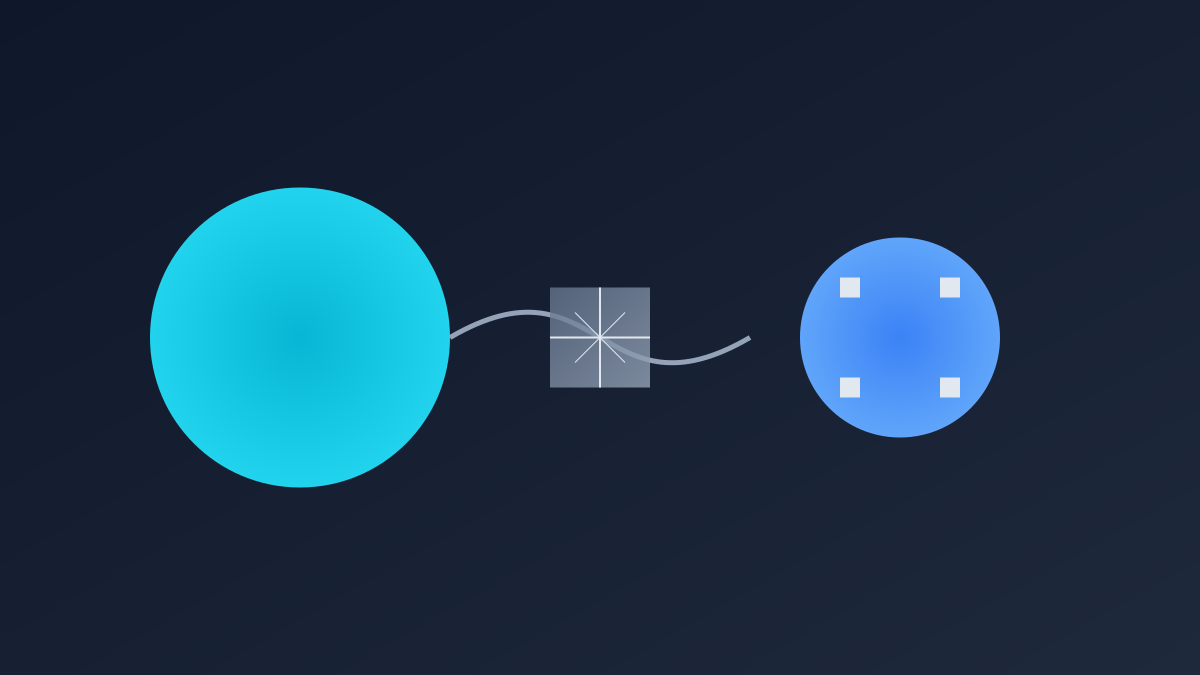
This project focuses on distilling general-purpose large models into dedicated semantic filters (the student model is a lightweight classifier/filter optimized for specific tasks). It adopts a teacher-student architecture: the teacher is a powerful but bulky LLM, and the student is a compact structure (such as a small Transformer or traditional ML model). During training, the student learns the soft labels output by the teacher (containing category similarity information). Semantic filtering tasks include content moderation, spam detection, topic classification, sentiment analysis, etc., which require understanding semantics rather than just keyword matching.

4

Section 04

Key Technical Implementation Details

  1. Data generation and augmentation: Use the teacher model to automatically generate training samples (input seed text to generate variants and label them), and expand the dataset with augmentation techniques such as synonym replacement, back-translation, and noise injection; 2. Temperature adjustment and soft targets: Increase the temperature to make the teacher's probability distribution smoother, allowing the student to learn the subtle relationships between categories, and restore normal temperature during inference; 3. Intermediate layer distillation: Transfer the semantic representation of the large model's hidden states, pass knowledge through mapping layers, which improves performance but increases complexity.
5

Section 05

Trade-off Results Between Performance and Efficiency

Experiments show that a well-distilled small model can achieve over 90% accuracy of the teacher model on specific tasks, with inference speed increased by 10-100 times and memory usage reduced to a fraction of the original. This trade-off is of great significance for edge devices, mobile applications, and high-concurrency services, and small models have better interpretability, which is convenient for debugging and compliance audits.

6

Section 06

Main Application Scenarios

  1. Real-time content moderation: Lightweight filters are deployed at edge nodes to perform initial content screening, and suspicious content is sent to large models for review, balancing efficiency and accuracy; 2. Embedded devices: Run on smart speakers and wearable devices without cloud connection, protecting privacy; 3. Cost-sensitive large-scale services: Small models optimized for high-frequency queries reduce cloud computing costs and ensure user experience.
7

Section 07

Project Limitations and Challenges

Knowledge distillation is not a panacea: 1. The upper limit of the student's ability is limited by its architecture, and it may not perform well on complex tasks; 2. Distillation requires a lot of computing resources to run the teacher model to generate data, and an overly large teacher model can become a bottleneck; 3. The student may inherit the teacher's biases and error patterns, so the selection and verification of the teacher model are crucial.

8

Section 08

Future Directions and Summary

Future research directions include online distillation, self-distillation, cross-modal distillation, etc. LLM knowledge distillation is a pragmatic practice in AI engineering, directly addressing the deployment limitations of large models and finding the optimal balance between capability and efficiency. Mastering distillation technology is important for AI implementation, and this project provides a good starting point for transforming theory into practical tools.

