Zing Forum

Reading

Browser-Side LLM Evaluation Dashboard: A One-Stop Tool for Model Performance Analysis Across Six Key Dimensions

A pure browser-side large language model (LLM) evaluation dashboard that runs without backend servers or installation configuration—ready to use out of the box. It supports monitoring, comparison, and in-depth analysis of LLM performance across six key dimensions, providing intuitive data support for model selection and optimization.

LLM评估大语言模型性能对比浏览器端工具模型选型AI工具开源项目零部署多维度分析效率优化
Published 2026-06-09 05:36Recent activity 2026-06-09 05:50Estimated read 6 min
Browser-Side LLM Evaluation Dashboard: A One-Stop Tool for Model Performance Analysis Across Six Key Dimensions
1

Section 01

Browser-Side LLM Evaluation Dashboard: Core Overview

This is a pure browser-side large language model (LLM) evaluation dashboard that runs without backend servers or installation configuration—ready to use out of the box. It supports monitoring, comparison, and in-depth analysis of LLM performance across six key dimensions, providing intuitive data support for model selection and optimization.

Project Source: Maintained by 05saitejaswi, open-sourced on GitHub (link: https://github.com/05saitejaswi/LLM-Evaluation-Dashboard-), released on June 8, 2026.


2

Section 02

Project Background and Pain Point Analysis

With the explosive growth of LLMs, developers and enterprises face challenges in model selection (e.g., GPT series, Llama, Mistral, Wenxin Yiyan, etc.). Traditional evaluations rely on subjective feelings or simple benchmarks, lacking systematic multi-dimensional comparisons; existing tools are either complex to deploy or only evaluate a single dimension. This project aims to address these pain points by providing a zero-deployment, ready-to-use browser-side evaluation tool.

3

Section 03

Detailed Explanation of Six Key Evaluation Dimensions

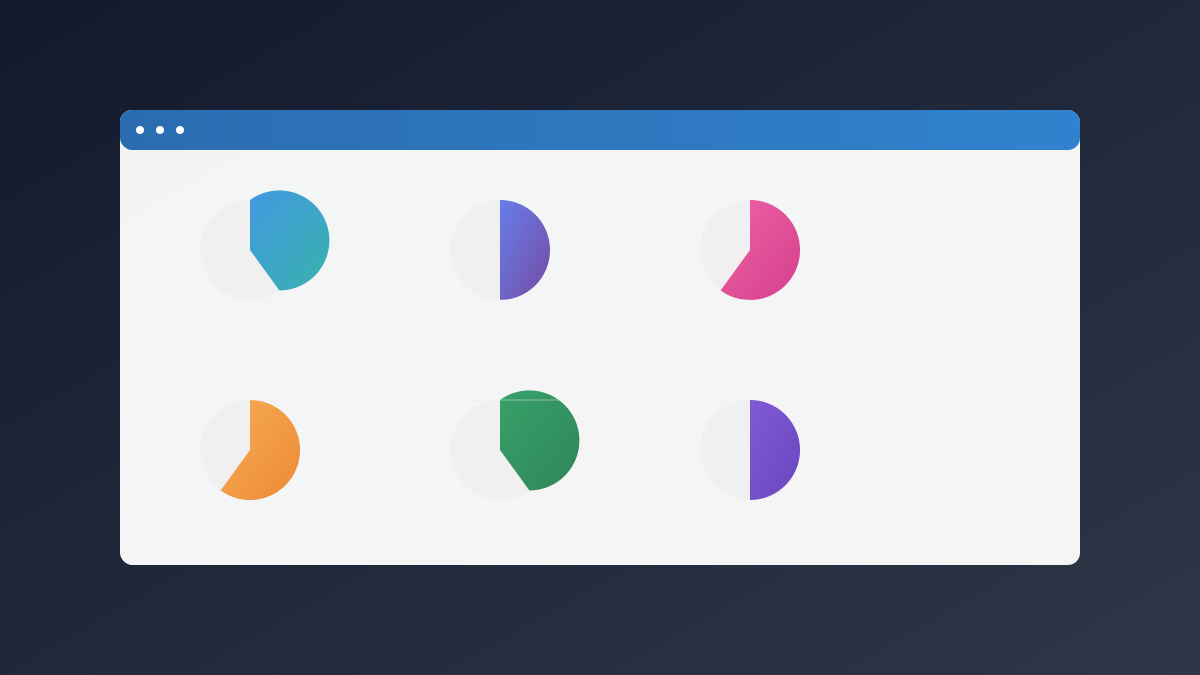
The dashboard builds an evaluation system around six core dimensions of LLM applications:

  1. Accuracy and Correctness: Evaluates factual accuracy, logical correctness, and task completion;
  2. Response Speed and Latency: Measures first-token response time and generation speed, which are critical for real-time application experiences;
  3. Cost-Benefit Analysis: Compares API call costs with output quality to help enterprises make economical choices;
  4. Context Understanding Ability: Tests capabilities in complex scenarios such as long text comprehension and multi-turn dialogue consistency;
  5. Safety and Bias: Identifies harmful content and biased tendencies to meet AI regulatory requirements;
  6. Multilingual Support: Evaluates performance in non-English languages, suitable for global applications.
4

Section 04

Technical Architecture and Design Advantages

Adopting a pure front-end architecture, it has the following advantages:

  • Zero deployment cost: Can be used directly by opening the HTML file, lowering the trial threshold;
  • Data privacy protection: All evaluation data is processed locally with no third-party uploads;
  • Instant response: Smooth local interaction with real-time result presentation;
  • Easy to expand: Modular design makes it simple to add new dimensions or modify test cases.
5

Section 05

Usage Scenarios and Practical Value

This tool is suitable for multiple scenarios:

  • Model selection decision-making: Provides enterprises with objective comparison data to avoid relying on marketing promotions;
  • Model iteration monitoring: Regularly verifies performance changes from version updates;
  • Prompt engineering optimization: Compares the effects of different prompt templates;
  • Education and training: Helps beginners understand LLM evaluation methods.
6

Section 06

Industry Trends and Project Significance

This project promotes the standardization of LLM evaluation and provides reference practical examples; enriches the open-source tool ecosystem and complements other AI tools; lowers the threshold for AI applications, allowing non-professional users to scientifically evaluate LLMs and promote AI popularization.

7

Section 07

Outlook on Future Development Directions

In the future, the tool may evolve in the following directions:

  • Automated evaluation: Integrate CI/CD to implement performance regression testing;
  • Domain customization: Provide professional templates for industries such as healthcare and law;
  • Real-time benchmarks: Establish a crowdsourced performance database;
  • Visualization enhancement: Support custom report generation.

This project marks the transition of LLM applications from the "trial phase" to the "rational evaluation phase", where users focus more on actual performance and cost-effectiveness, which is beneficial to the healthy development of the industry.

