Zing Forum

Reading

Speculative Decoding Technology: Using Large Models to Verify Small Model Predictions for LLM Inference Acceleration

An in-depth analysis of the principles of Speculative Decoding technology, which significantly accelerates large language model (LLM) inference without losing quality through a collaborative mechanism of draft generation by small models and verification by large models.

投机解码Speculative DecodingLLM推理加速草稿模型目标模型Qwen模型优化推理效率
Published 2026-05-02 19:43Recent activity 2026-05-02 19:49Estimated read 4 min
Speculative Decoding Technology: Using Large Models to Verify Small Model Predictions for LLM Inference Acceleration
1

Section 01

Core Guide to Speculative Decoding Technology: Small Model Draft + Large Model Verification for Lossless LLM Inference Acceleration

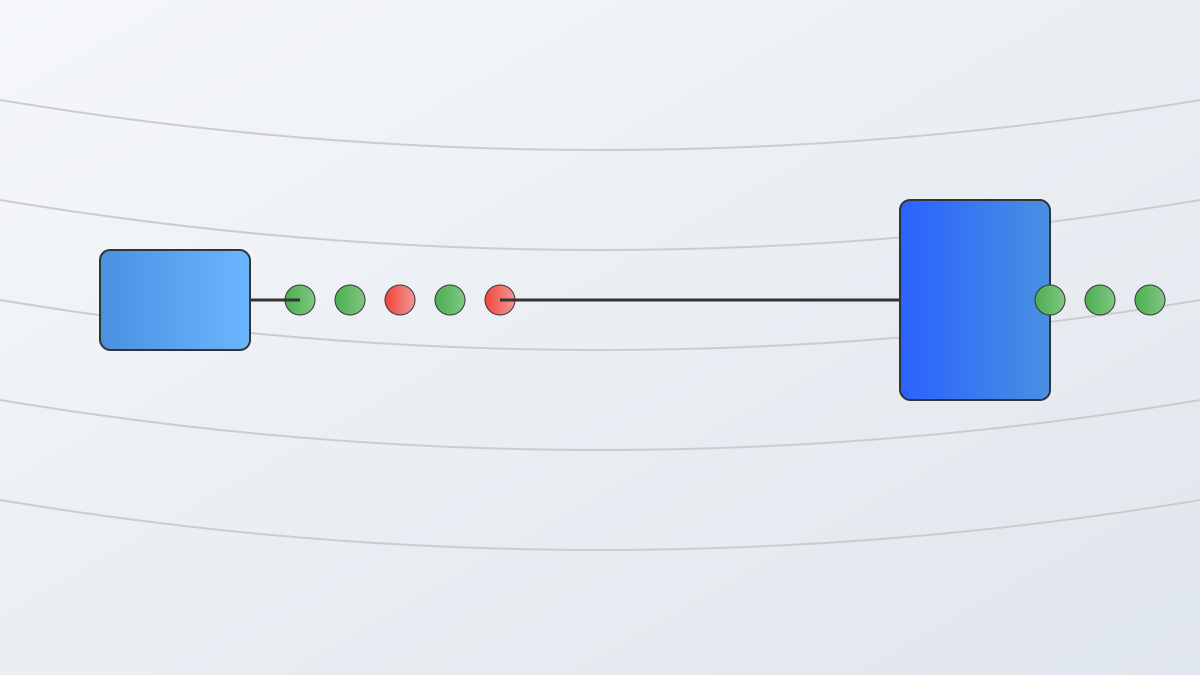
Speculative Decoding technology significantly accelerates large language model (LLM) inference without sacrificing output quality through a collaborative mechanism: small models (draft models) quickly generate candidate token sequences, then large models (target models) perform parallel verification. This article will analyze the technology from aspects such as background, principles, experiments, deployment, and applications.


2

Section 02

Speed Dilemma of Large Model Inference and Limitations of Traditional Optimization

Due to the autoregressive generation nature of large language models, each token requires a complete Transformer computation, leading to high inference latency and limiting applications in real-time scenarios. Traditional optimizations (quantization, distillation, hardware acceleration) need to balance quality and speed, while Speculative Decoding provides a new idea for lossless acceleration.

3

Section 03

Dual-Model Architecture and Verification Mechanism of Speculative Decoding

Dual-Model Architecture: Draft model (small size, fast candidate generation) + Target model (large size, parallel verification). Verification Mechanism: The target model can verify multiple candidate tokens in one forward pass, accept/reject candidates through a probability matching strategy, ensuring the output distribution is consistent with using the target model directly. The iterative process continues until the complete sequence is generated.

4

Section 04

Experimental Verification of Speculative Decoding Effect in Qwen 2.5 Family

The experiment uses Qwen2.5-7B-Instruct as the target model, testing 0.5B/1.5B draft models, covering tasks such as mathematical reasoning (GSM8K), multi-disciplinary question answering (MMLU), and text summarization (CNN/DailyMail). Results: The 0.5B draft model accelerates by 1.5-2x, the 1.5B by 2-3x, and the quality under deterministic decoding is completely consistent with the baseline.

5

Section 05

Key Considerations for Practical Deployment of Speculative Decoding

Deployment considerations: 1. Increased memory usage (but the draft model is small, so the overhead is controllable); 2. The draft model needs to match the target model (same family or distilled model); 3. Adaptively adjust the candidate sequence length k; 4. More suitable for parallel devices like GPUs.

6

Section 06

Application Scenarios and Future Outlook of Speculative Decoding

Applicable scenarios: High-concurrency online services, interactive applications (chatbots/code assistants), long text generation. In the future, it can be combined with technologies like quantization and pruning to become an important part of large model engineering.

