Zing Forum

Reading

llama-pr-reviewer: Locally Deployed AI Code Review Assistant, Runs on 8GB VRAM

A self-hosted GitHub PR review bot based on llama.cpp, supporting private deployment, running on 8GB VRAM, with features like auto-approval, incremental rechecking, and reasoning model support.

GitHubPR审查代码审查llama.cpp本地部署AI代码审查私有化开源工具
Published 2026-05-25 04:45Recent activity 2026-05-25 04:47Estimated read 6 min
llama-pr-reviewer: Locally Deployed AI Code Review Assistant, Runs on 8GB VRAM
1

Section 01

llama-pr-reviewer: Introduction to the Locally Deployed AI Code Review Assistant

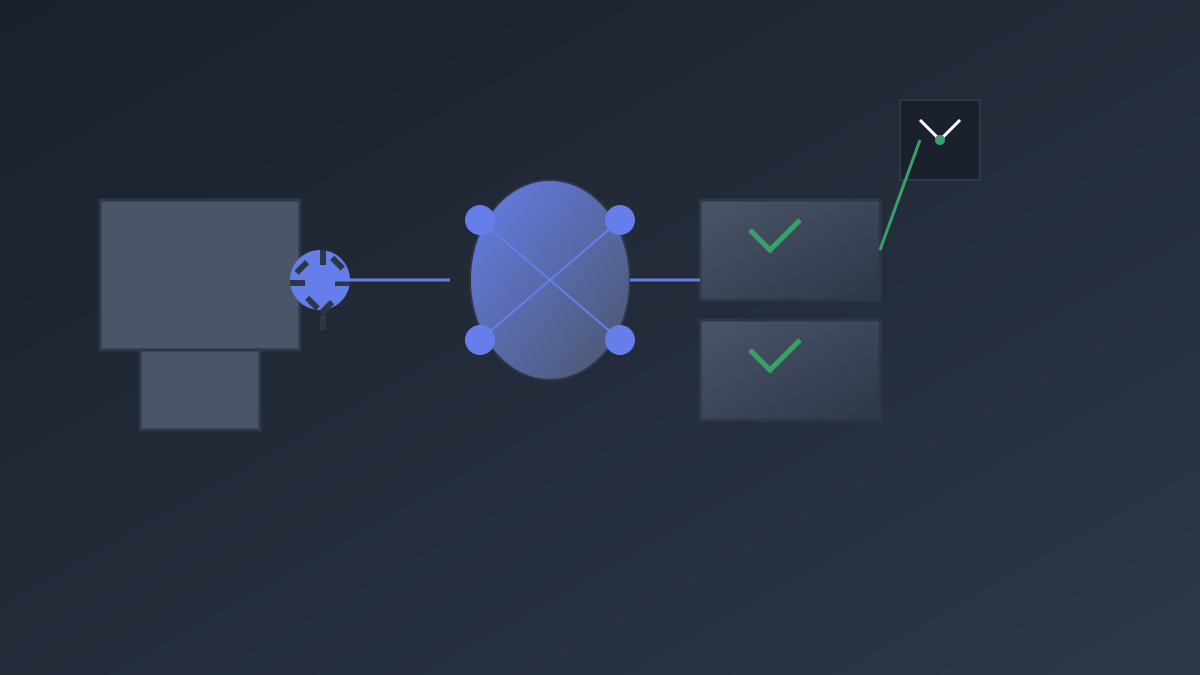
llama-pr-reviewer is a self-hosted GitHub PR review bot based on llama.cpp, supporting private deployment and running on only 8GB VRAM. Its core advantage is that all code analysis is done locally, ensuring data privacy and security with zero API costs. It has features like auto-approval, incremental rechecking, and reasoning model support, providing an efficient and privacy-preserving AI-assisted solution for code review.


2

Section 02

Project Background: Pain Points of Traditional Code Review and AI Solutions

Traditional code review relies on manual work, which is time-consuming and labor-intensive, and prone to missing issues due to fatigue. With the improvement of LLM capabilities, AI-assisted code review has become a trend. llama-pr-reviewer is designed for this demand; as a self-hosted tool, it runs via local LLM (llama.cpp or llama-server), fundamentally ensuring code privacy and security.

3

Section 03

Core Features: Localization, Low Threshold, and Intelligent Workflow

Fully Localized AI Review

  • Data Privacy Protection: Sensitive code never leaves the internal network
  • Zero API Cost: No token-based payment required
  • Offline Operation Supported

Low Hardware Threshold

Requires only 8GB VRAM, compatible with most consumer-grade GPUs (e.g., RTX3060/4060)

Intelligent Approval Workflow

  • Auto-approve simple low-risk modifications
  • Incremental Rechecking: Only review changed parts of PR
  • Issue Classification: Categorized by severity

Reasoning Model Support

Use reasoning models for in-depth analysis, identify hidden defects, and provide detailed suggestions

4

Section 04

Technical Architecture: Implementation Principles of llama.cpp and GitHub Integration

llama.cpp-based Inference Backend

  • Efficient CPU/GPU hybrid inference
  • Supports GGUF quantized models to reduce VRAM usage
  • Batch processing optimization to improve throughput

GitHub Integration Mechanism

Runs as a GitHub App or Actions, interacting via API:

  1. Webhook listens to PR events
  2. Extract code change Diff
  3. Build LLM analysis prompt
  4. Write review comments back to PR
5

Section 05

Deployment & Usage: Hardware Requirements, Configuration Steps, and Model Recommendations

Deployment Requirements

  • Hardware: 8GB+ VRAM or equivalent CPU
  • Software: Docker (recommended) or llama-server
  • GitHub: Configure App or Actions workflow

Configuration Process

  1. Clone the repository and install dependencies
  2. Configure GitHub App credentials and Webhook
  3. Specify GGUF model path
  4. Start llama-server backend
  5. Set review rules (auto-approval conditions, etc.)

Model Selection Recommendations

  • Code-specific models: CodeLlama, StarCoder
  • Inference-optimized models: DeepSeek-R1
  • Quantization level: Q4_K_M or Q5_K_M (choose based on VRAM)
6

Section 06

Applicable Scenarios & Value: Privacy-Sensitive Projects and Efficiency Improvement

Applicable Scenarios

  1. Privacy-sensitive projects (finance, medical, government)
  2. Internal code review (reduce manual burden)
  3. Open-source project maintenance (timely feedback to community contributions)
  4. Individual developers (automated quality checks)

Value Delivered

  • Improve review efficiency: Automatically handle simple PRs
  • Unify code standards: Consistent check rules
  • 24/7 Availability: No time restrictions
  • Reduce omission risk: AI maintains quality consistently
7

Section 07

Limitations & Considerations: Issues to Note When Using

  1. Model Hallucination: Local models may produce inaccurate results; important decisions require manual confirmation
  2. Complex Logic Understanding: Limited understanding of complex business logic changes
  3. Configuration Tuning: Need to adjust prompts and rules according to the project
  4. Hardware Cost: Although the threshold is low, certain hardware investment is still required
8

Section 08

Summary & Outlook: Direction of Edge-Side AI-Assisted Development

llama-pr-reviewer represents the privacy-first direction of AI-assisted development, using local large models to improve efficiency. Future outlook:

  • Smaller model size and lower hardware requirements
  • More accurate code understanding and analysis
  • Deep integration with IDE and CI/CD

For teams concerned about data security, it is a worth-trying AI code review tool.

