Zing Forum

Reading

LifeOS AI Finance: Architecture and Practice of an Intelligent Personal Financial Analysis Platform

An in-depth analysis of the LifeOS AI Finance project, a comprehensive AI-driven personal financial management platform built with FastAPI, Streamlit, and machine learning.

个人财务AI应用FastAPIStreamlit机器学习NLP数据可视化
Published 2026-05-14 01:26Recent activity 2026-05-14 01:31Estimated read 7 min
LifeOS AI Finance: Architecture and Practice of an Intelligent Personal Financial Analysis Platform
1

Section 01

Introduction: Core Overview of the LifeOS AI Finance Intelligent Financial Platform

LifeOS AI Finance is a comprehensive AI-driven personal financial management platform built with FastAPI, Streamlit, and machine learning. Its core value lies in mining consumption patterns, predicting trends, identifying anomalies, and providing personalized advice through intelligent analysis—distinguishing itself from traditional bookkeeping software that only focuses on recording. This article will deeply analyze its technical architecture, core functions, and practical significance.


2

Section 02

Background: Intelligent Transformation of Personal Financial Management and Project Positioning

In the digital era, personal financial management is evolving from traditional bookkeeping software to intelligent analysis platforms. LifeOS AI Finance is positioned as an "AI-driven personal financial analysis platform" that integrates into the vision of a daily life operating system. It uses a Python tech stack (FastAPI backend + Streamlit frontend), with a core focus on "analysis" rather than "recording", and realizes data value mining through AI technology.

3

Section 03

Technical Architecture: Full-stack Implementation with FastAPI + Streamlit + Machine Learning

Backend Service Layer: Supported by FastAPI

  • Asynchronous processing capability to efficiently handle I/O-intensive operations
  • Automatic API documentation and type safety
  • Layered design that separates data access, business logic, and API interfaces

Frontend Presentation Layer: Streamlit for Agile Development

  • Interactive dashboards and data visualization (Plotly, Altair)
  • Rapid prototype iteration without requiring frontend skills

Machine Learning Modules

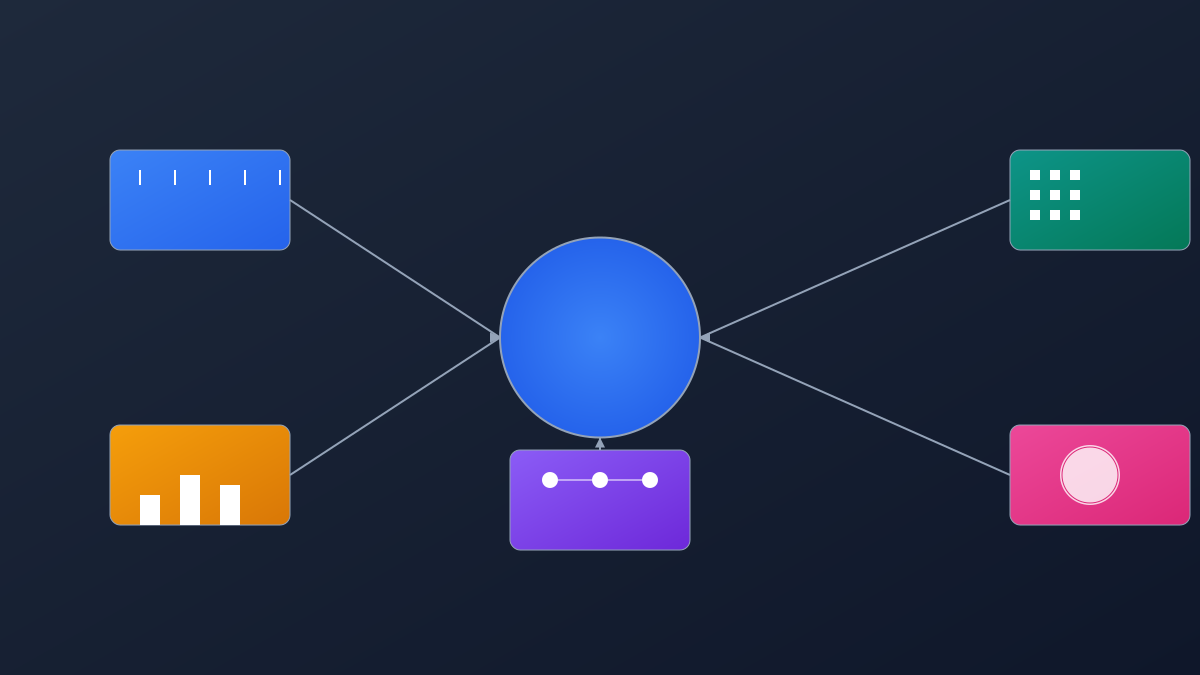
  • NLP Transaction Classification: Text preprocessing → Feature extraction → Classification model → Continuous learning
  • Fraud Detection: Feature engineering → Anomaly detection algorithm → Rule engine → Real-time alert
  • Budget Prediction: Time series analysis → Consumption pattern recognition → Budget deviation analysis
4

Section 04

Core Functions: Intelligent Classification, Visualization, and AI Advisor

Intelligent Transaction Classification

Automatically recognizes the semantics of transaction descriptions and categorizes them into dining, transportation, etc.—still accurate even for new merchant names.

Interactive Data Dashboard

  • Spending trend charts, category proportion pie charts, consumption heatmaps
  • Comparative analysis of historical同期 data and budget targets

AI Financial Advisor

  • Savings advice, consumption optimization, investment planning (based on risk preference)
  • Financial goal tracking (house purchase, travel fund, etc.)
5

Section 05

Technical Highlights: Modular Design and Data Security Considerations

Modular Design

Loosely coupled components including data access, preprocessing, analysis, visualization, and advice modules.

Extensible Data Pipeline

Supports bank CSV/Excel, open banking API, manual entry, and third-party software import.

Privacy and Security

  • Local-first processing to reduce cloud transmission
  • Encrypted storage of sensitive fields, role-based access control, and audit log tracing
6

Section 06

Application Scenarios and Comparison with Similar Products

Application Scenarios

  • Personal finance beginners: Build budget awareness
  • Family users: Integrate multi-account management
  • Freelancers: Plan cash flow
  • Advanced users: Assist in asset allocation decisions

Comparison with Similar Products

| Feature | Traditional Bookkeeping App | LifeOS AI Finance | | ------ | ------------ | ------------------ | | Data Entry | Manual为主 | Intelligent import + NLP automatic classification | | Analysis Depth | Basic statistics | ML prediction + Pattern recognition | | Personalization | General advice | AI-driven personalized advice | | Visualization | Fixed charts | Interactive custom dashboard | | Fraud Detection | Usually none | Built-in anomaly detection |

7

Section 07

Future Development Directions: Multi-Asset Integration and Function Expansion

  1. Multi-asset integration: Add investments, real estate, cryptocurrency, etc., besides bank accounts
  2. Social features: Share expenses with relatives/friends and set joint savings goals
  3. Open API: Third-party plugin expansion
  4. Mobile application: Native app to enhance user experience
  5. Voice interaction: Voice queries and commands
8

Section 08

Conclusion: Value and Reference Significance of Intelligent Financial Management

LifeOS AI Finance represents the trend of personal financial management tools evolving towards intelligence and personalization. Through the combination of FastAPI, Streamlit, and machine learning, it demonstrates how to build practical AI applications using modern tech stacks. It has important reference value for improving users' financial management efficiency and for developers to learn full-stack AI application development.

