Zing Forum

Reading

LifeLine AI: Reconstructing a Predictive Rescue Network for Blood Supply Chains Using Machine Learning and Graph Theory

An open-source blood donation prediction and scheduling system that uses Random Forest/XGBoost to predict regional shortages, the Hopcroft-Karp algorithm to match optimal donors, and OSRM real-time traffic ETA instead of straight-line distance to achieve precise rescue scheduling.

血液捐赠机器学习随机森林XGBoost图论Hopcroft-KarpOSRM预测分析供应链优化开源医疗
Published 2026-05-11 22:24Recent activity 2026-05-11 22:28Estimated read 6 min
LifeLine AI: Reconstructing a Predictive Rescue Network for Blood Supply Chains Using Machine Learning and Graph Theory
1

Section 01

LifeLine AI: Reconstructing Blood Supply Chains with ML & Graph Theory (Introduction)

LifeLine AI is an open-source predictive blood donation and scheduling network. It addresses traditional blood supply system's issues (lag, waste, extensive scheduling) by combining ML (RandomForest/XGBoost) for shortage prediction and graph theory (Hopcroft-Karp) + OSRM real-time traffic ETA for optimal donor scheduling, aiming to achieve precise rescue dispatch.


2

Section 02

Background: Pain Points of Traditional Blood Supply Systems

Current blood bank systems rely on passive response mechanisms—only sending mass texts to donors within a fixed radius after shortages occur. Defects include response lag, resource waste, and extensive scheduling. When hospitals make emergency requests, the system can't distinguish between donors who are close but stuck in traffic vs. those far but with smooth routes, leading to low rescue efficiency.

3

Section 03

Project Overview: Birth of LifeLine AI

LifeLine AI is a 100% open-source predictive blood donation network. It doesn't wait for crises but predicts shortages in advance based on real risk factors. When emergency requests come, it uses mathematical algorithms to compute optimal donor combinations and schedules based on actual traffic ETA instead of geographic distance.

4

Section 04

Core Mechanism I: Dual-Engine Prediction Model

The system uses RFMTC variables plus modern environmental factors (accident risk, weather severity, weekend effect) to build a custom dataset.

  • Classification Engine (RandomForest): Predicts if a region will face shortages due to surging accident risk or bad weather.
  • Regression Engine (XGBoost): Precisely calculates how many blood units need to be mobilized to replenish local cold chain inventory before crises, avoiding donor fatigue from over-recruitment.
5

Section 05

Core Mechanism II: Graph Theory Optimized Scheduling

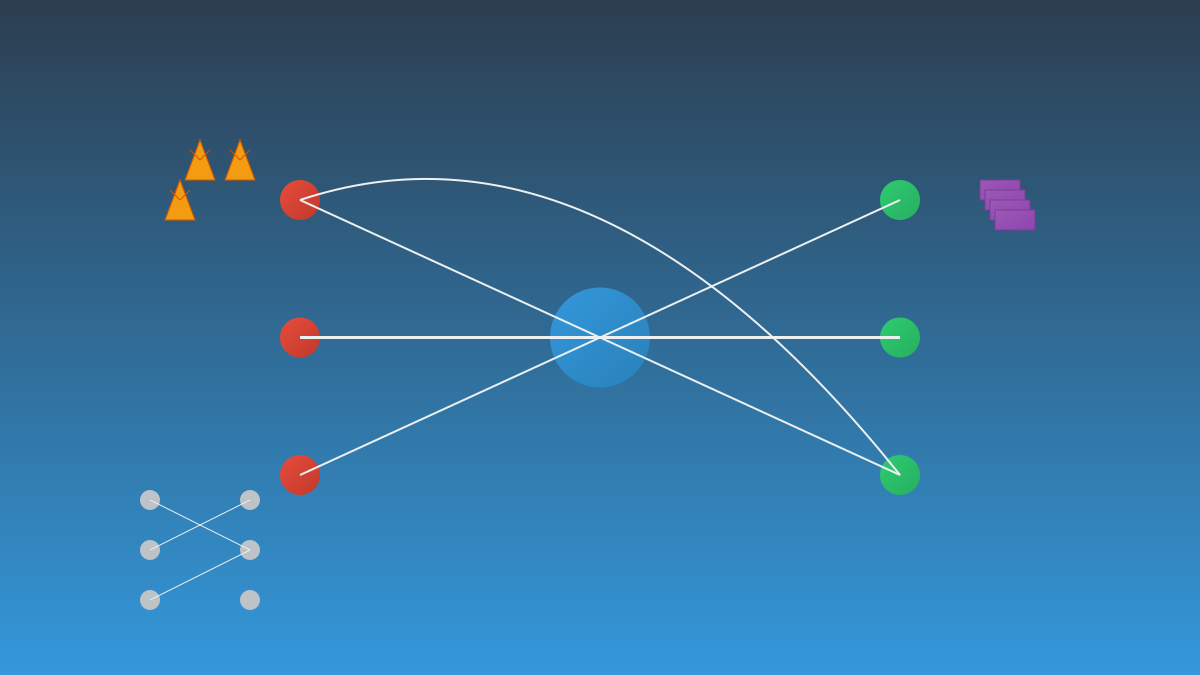
  • Hopcroft-Karp Bipartite Matching: Treats hospital requests and available donors as a bipartite graph to find the "maximum matching"—using the fewest donors to meet exact unit needs, replacing the extensive "text everyone" approach.
  • OSRM Open-Source Routing Engine: Abandons simple Haversine straight-line distance. The system queries OSRM in real time to compute actual road network driving time, prioritizing donors with shorter ETA even if they are physically farther.
6

Section 06

System Architecture & Three Portals

  • Admin Command Portal: Built with Next.js and Leaflet maps, showing real-time prediction maps (AI "radar" for local shortages) and active Hopcroft-Karp hospital dispatch nodes.
  • Hospital Dispatch Portal: Features cold chain unit tracking and emergency request broadcasting, directly triggering the Hopcroft-Karp algorithm.
  • Donor Portal: Donors can view real-time matching requests based on their coordinate ETA and a gamification leaderboard tracking the number of lives saved.
7

Section 07

Tech Stack & Deployment

Frontend uses Next.js (App Router), React, Tailwind CSS, shadcn/ui, Leaflet. Backend uses Python FastAPI, Scikit-Learn, XGBoost, Uvicorn. Algorithm layer integrates Hopcroft-Karp bipartite matching and OSRM routing engine. Deployment steps: Initialize virtual environment → install dependencies → run ML training pipeline to generate .pkl models → start backend server → install frontend dependencies and run dev server. A default admin login is provided for experience.

8

Section 08

Practical Significance & Implications

LifeLine AI demonstrates how classic algorithms (Hopcroft-Karp, 1973) can combine with modern ML and real-time traffic data to solve life-or-death problems. Its open-source architecture allows any blood center to fork and deploy, retraining models with local data. For developers, it's an excellent full-stack AI project example covering data science, algorithm optimization, map visualization, and real-time scheduling. Most importantly, it proves technology can save lives through precise prediction and intelligent scheduling, not just fancy interfaces.

