Zing Forum

Reading

LeafLens: An AI-Powered Indoor Plant Identification and Care Assistant System

This is an AI application project for plant enthusiasts, which uses computer vision technology to identify plant species and provide personalized care advice. It was developed as a final project for a university artificial intelligence course.

Plant IdentificationHouseplant CareImage ClassificationComputer VisionDeep LearningAI Application
Published 2026-05-21 07:08Recent activity 2026-05-21 07:23Estimated read 5 min
LeafLens: An AI-Powered Indoor Plant Identification and Care Assistant System
1

Section 01

LeafLens Project Overview: AI Empowers Indoor Plant Care

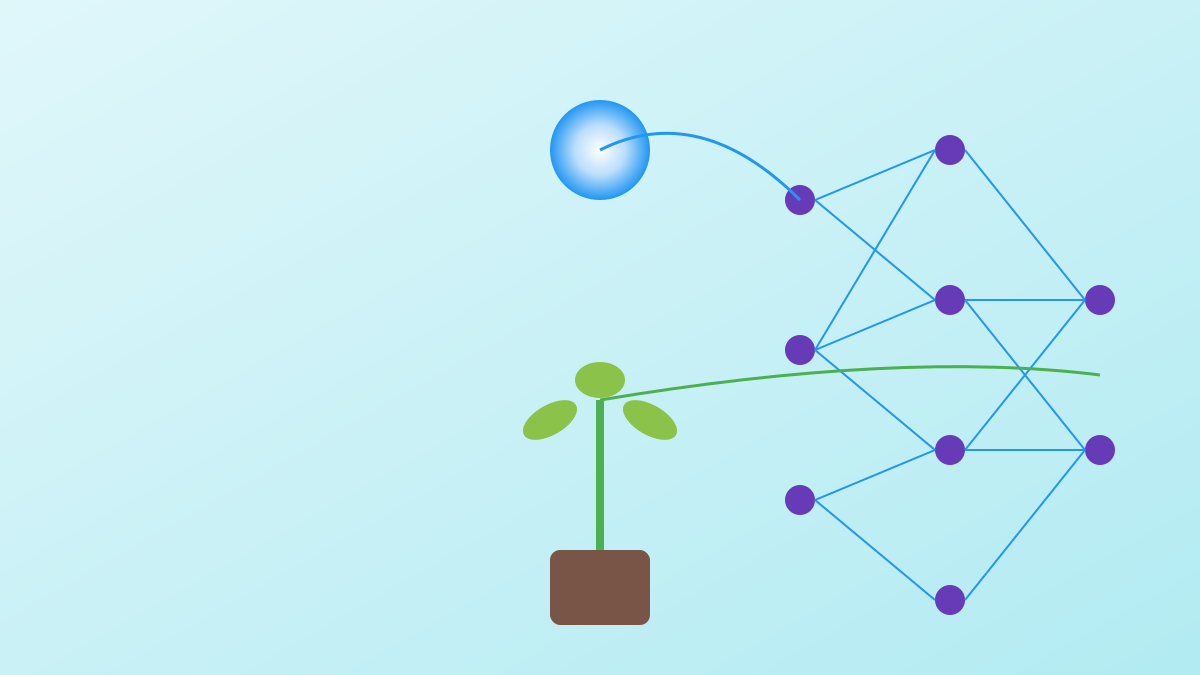
LeafLens is the final project for the Artificial Intelligence course at Colombia Surcolombia University. Designed for plant enthusiasts, it uses computer vision technology to identify indoor plant species and provide personalized care advice, aiming to solve common problems such as difficulty in plant identification and improper care.


2

Section 02

Project Background: Pain Points in Indoor Plant Care and AI Solutions

Indoor plants are an important part of modern urban life, but more than 60% of indoor plants die due to improper watering or unsuitable light conditions. Caregivers often lack knowledge about the specific needs of plants. The LeafLens project was born to try to solve this practical problem using AI technology, demonstrating a feasible path for AI to move from the laboratory to daily life.

3

Section 03

Core Functions and Technical Implementation Path

Core Functions

  1. Intelligent Identification Module: Taking a photo of a plant allows identification of hundreds of common indoor plant species, returning scientific names, common names, and confidence scores.
  2. Personalized Advice Module: Generates targeted care guides based on species characteristics, covering key dimensions such as watering, light, and temperature.

Technical Implementation

  • Uses an optimized Convolutional Neural Network (CNN) algorithm, enhancing model robustness through data preprocessing such as random cropping and color jitter;
  • Builds a structured care knowledge base to ensure the scientific validity of advice;
  • Designs a simple three-step interaction process (take photo → identify → view advice) to lower the threshold for use.
4

Section 04

Application Scenarios and User Value

Target user groups are broad:

  • Plant beginners: Quickly understand information about newly purchased plants;
  • Gardening enthusiasts: Verify judgments or discover new species;
  • Plant shops: Use as a customer service tool to help customers care for plants.

This application reflects the trend of AI democratization, where small teams or individual developers can create AI tools that serve specific communities.

5

Section 05

Educational Significance and Technical Insights

Educational Value

As a course project, LeafLens allows students to fully experience the entire lifecycle of a machine learning project and cultivate engineering practice capabilities.

Technical Insights

Vertical domain AI applications need to focus on:

  • Depth of domain knowledge;
  • Data quality;
  • User experience design.
6

Section 06

Future Development Directions and Suggestions

Potential expansion directions:

  1. Add pest and disease identification functions;
  2. Establish a user community to share care experiences;
  3. Connect to smart home systems to implement automatic care reminders.

Technical optimization: Explore transfer learning to support more plant species, and introduce multi-modal input to improve identification accuracy. The core value remains lowering the threshold for plant care knowledge.

