Zing Forum

Reading

LAGMiD: An LLM-Augmented Graph Neural Network Framework for Academic Citation Error Detection

This article introduces the LAGMiD framework, which innovatively combines the reasoning capabilities of large language models (LLMs) with the topological analysis of graph neural networks (GNNs) to achieve efficient detection of citation errors in academic networks, providing new insights for addressing the problem of incorrect citations in academic literature.

错误引用检测大语言模型图神经网络学术诚信知识蒸馏链式思维推理LAGMiD框架学术网络分析
Published 2026-04-09 08:00Recent activity 2026-04-11 00:37Estimated read 7 min
LAGMiD: An LLM-Augmented Graph Neural Network Framework for Academic Citation Error Detection
1

Section 01

Introduction: LAGMiD Framework—A New Solution for Academic Citation Error Detection Combining LLMs and GNNs

This article introduces the LAGMiD (LLM-Augmented Graph Miscitation Detector) framework, which innovatively combines the reasoning capabilities of large language models (LLMs) with the topological analysis capabilities of graph neural networks (GNNs) to efficiently detect citation errors in academic networks. The article covers the problem background of citation errors, limitations of existing methods, core design of LAGMiD, experimental performance, application scenarios, and future directions, providing new ideas for solving the problem of incorrect citations in academic literature.


2

Section 02

Background: Types of Academic Citation Errors and Their Harm to the Academic Ecosystem

Types of citation errors in academic literature include: content errors (cited literature does not support the argument), attribution errors (distorting the original author's views), technical errors (citing wrong papers/pages/retracted literature), and circular citations (closed citation loops). Their harms include damage to individual academic reputation, distortion of disciplinary knowledge accumulation, formation of unvalidated "academic memes", etc., posing a serious threat to the academic ecosystem.

3

Section 03

Analysis of Limitations of Existing Detection Methods

Existing methods have shortcomings: 1. Text similarity-based methods struggle to capture deep semantic relationships and cannot distinguish between reasonable summaries and incorrect citations; 2. GNN methods based on network structure ignore text content, making it difficult to distinguish between cross-disciplinary citations and incorrect ones, and have high computational complexity; 3. Direct use of LLMs faces challenges such as high computational cost, hallucination issues, and context limitations.

4

Section 04

Core Design of LAGMiD Framework: Organic Integration of LLMs and GNNs

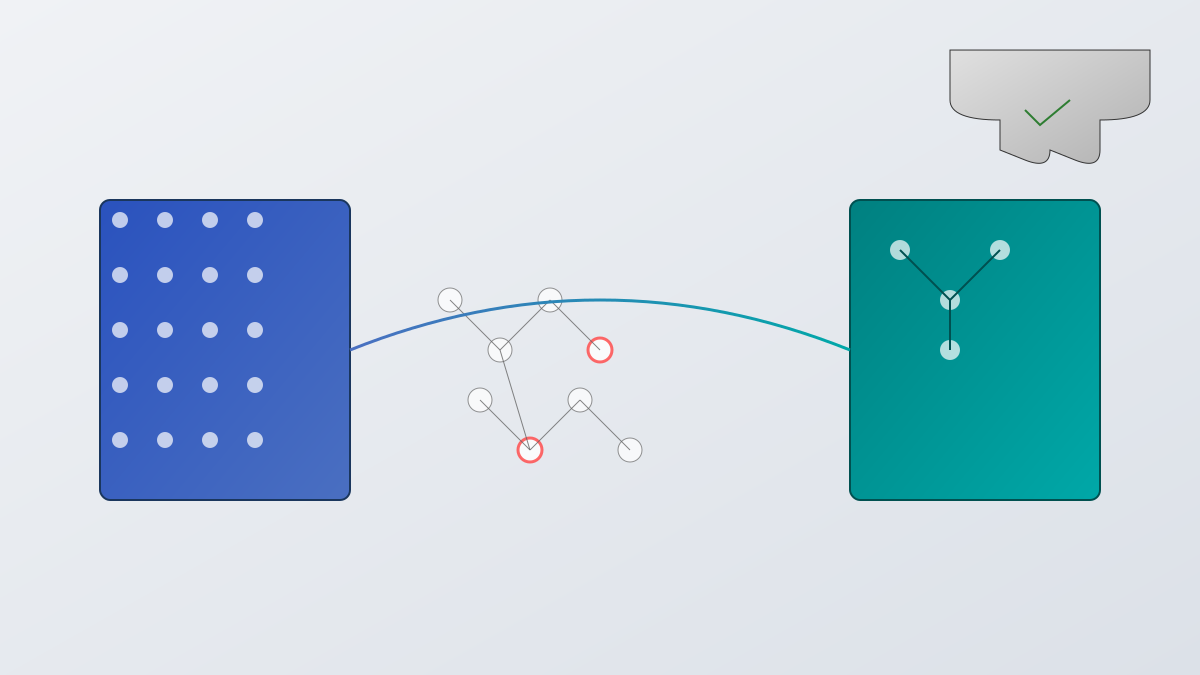
The LAGMiD framework consists of three core components: 1. Text encoder (academically fine-tuned pre-trained model to generate semantic vectors); 2. GNN module (message passing in heterogeneous citation networks to capture topological relationships); 3. LLM-augmented reasoning module (selectively uses chain-of-thought reasoning to judge suspicious citations identified by GNN). It also uses knowledge distillation optimization, training a lightweight student model with LLMs to reduce costs.

5

Section 05

Experimental Evaluation: Performance Advantages and Component Effectiveness of LAGMiD

The experiment built a benchmark dataset containing 50,000 citations (15% incorrect citations). LAGMiD improved the F1 score by 23% compared to the baseline, with strong multi-hop reasoning capabilities and good cross-domain generalization. Ablation experiments showed: without LLM augmentation, recall rate decreased by 18%; without GNN, network context errors could not be detected; without knowledge distillation, reasoning cost was 50 times higher.

6

Section 06

Practical Application Scenarios of LAGMiD: Boosting Academic Quality

Application scenarios include: 1. Pre-review screening for journals (reducing the burden of peer review and correcting citation errors); 2. Quality maintenance of academic databases (regularly screening existing literature and generating quality reports); 3. Assistance in research integrity investigations (quickly identifying suspicious citation patterns as investigation clues).

7

Section 07

Limitations and Future Directions: Improvement Space for LAGMiD

Current limitations: Language coverage is mainly English, with limited multilingual support; inability to access full texts due to copyright restrictions affects accuracy; knowledge base needs dynamic updates to cope with academic knowledge development. Future directions: Multimodal fusion (supporting citation verification of datasets/code, etc.); causal reasoning (judging citation causal chains); crowdsourced verification (human-machine collaboration to improve data quality).

8

Section 08

Conclusion: Reflections on Technology Empowering Academic Integrity

The LAGMiD framework achieves a balance between accuracy and efficiency, representing an important progress of AI in the field of academic integrity. However, maintaining academic integrity requires joint efforts from technical tools and the academic community: cultivating normative awareness, establishing fair evaluation mechanisms, and fostering an honest research culture are the fundamental ways. We look forward to a more transparent and reliable academic environment in the future.

