Zing Forum

Reading

JiuwenSwarm: An AI Agent Extending Large Model Capabilities to Daily Communication Apps

Introducing JiuwenSwarm—an intelligent AI Agent built on openJiuwen that brings the powerful capabilities of large language models directly to users' fingertips via daily communication apps.

AI Agent大语言模型通讯应用openJiuwen微信飞书钉钉多平台集成
Published 2026-05-18 14:34Recent activity 2026-05-18 14:53Estimated read 7 min
JiuwenSwarm: An AI Agent Extending Large Model Capabilities to Daily Communication Apps
1

Section 01

Introduction: JiuwenSwarm—An AI Agent Integrating Large Model Capabilities into Daily Communication

JiuwenSwarm is an intelligent AI Agent project built on openJiuwen. Its core goal is to extend the powerful capabilities of large language models to daily communication apps used by users (such as WeChat, Feishu, DingTalk, etc.), solve the 'island' problem of AI applications, achieve an AI experience that is 'anytime, anywhere, and within reach', and lower the threshold for users to use AI.


2

Section 02

Background: The 'Island' Dilemma of AI Applications and the Trend of Communication Integration

The explosive development of large language models has reshaped the boundaries of human-computer interaction, but most AI applications still require users to actively open specific apps/websites, forming 'application islands' that limit convenience and accessibility. Seamlessly integrating AI capabilities into high-frequency communication apps (like WeChat, Feishu, DingTalk, etc.) is a natural evolutionary direction, which can greatly lower the usage threshold and achieve a convenient AI experience.

3

Section 03

Project Architecture and Core Capabilities

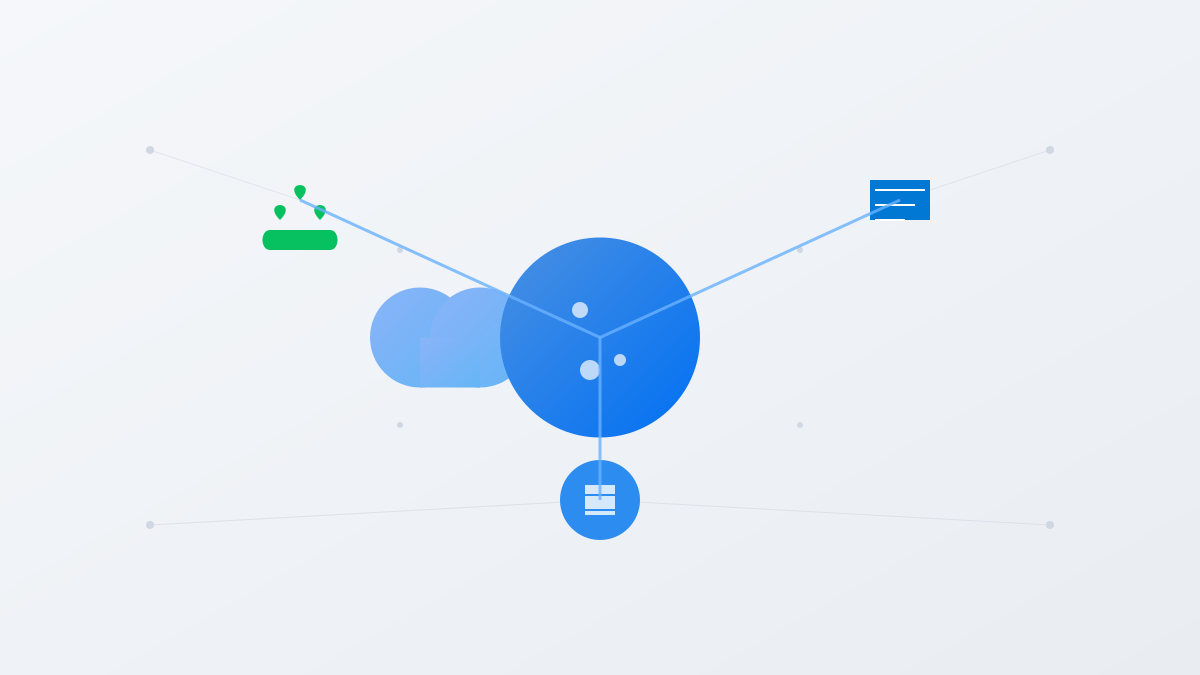
JiuwenSwarm is built on the open-source AI Agent framework openJiuwen and adopts an adapter pattern: the core engine is responsible for natural language understanding, reasoning planning, and response generation, while platform adapters connect to specific communication app APIs to achieve 'develop once, run on multiple ends'. Its core capabilities include: intelligent Q&A and knowledge retrieval (supporting multi-turn conversations), content creation assistance (email/document/code generation), information summarization and organization (meeting minutes/document summaries), task planning and reminders, multilingual translation, etc., which can be invoked via natural language commands.

4

Section 04

Multi-Platform Adaptation: Covering Mainstream Communication Ecosystems

JiuwenSwarm supports multi-platform adaptation:

  • Personal communication: WeChat (as a friend/group member), Telegram (using Bot API to support complex interactions);
  • Enterprise collaboration: Feishu (integrating approval/schedule/document functions), DingTalk (linking with enterprise OA systems);
  • Developer communities: Discord (channel management/role permissions), Slack (integration with international team workflows). The multi-platform strategy adapts to the needs of different scenarios such as individuals, enterprises, and communities.
5

Section 05

Technical Implementation: Message Processing and Context Management

Technical implementation faces challenges in message processing and context management:

  • Message processing: Using message queues and asynchronous architecture to handle high concurrency, out-of-order messages, and API differences across different platforms;
  • Context management: Session isolation mechanism (storing each conversation context independently), summary compression technology (retaining key information in long conversations);
  • User identity recognition: Cross-platform user preference synchronization and permission management to prevent abuse.
6

Section 06

Usage Scenarios and Value Proposition

Practical usage scenarios and value of JiuwenSwarm:

  • Personal knowledge management: Recording inspiration, organizing materials, and retrieving past content in note groups;
  • Team collaboration: Assisting with meeting minutes, task tracking, and deadline reminders in project groups;
  • Customer service: Automatically answering common questions, collecting feedback, and guiding to human agents in customer service groups;
  • Learning communities: Answering questions, recommending resources, and organizing discussions in education groups. These scenarios improve efficiency and reduce labor costs.
7

Section 07

Open-Source Ecosystem and Future Outlook

As part of the openJiuwen ecosystem, JiuwenSwarm supports an open-source plugin system (event-driven architecture, allowing developers to extend platform adapters and customize functions). Community-contributed plugins cover scenarios such as weather queries and GitHub notifications. Future outlooks include: deeper enterprise application integration (from information assistant to business assistant), multi-Agent collaboration (cooperation between professional Agents), and multi-modal capabilities (processing images/voice/videos).

8

Section 08

Conclusion: A Democratic Practice of Integrating AI into Daily Workflows

JiuwenSwarm represents an important direction in the development of AI applications: integrating AI into users' existing workflows instead of making users adapt to AI. By embedding into daily communication apps, it lowers the threshold for using AI, promotes AI democratization, and makes intelligent services truly accessible.

