Zing Forum

Reading

Java-based Handwritten Digit Recognition Project: MNIST_IA Technical Analysis and Practical Guide

MNIST_IA is a handwritten digit recognition project implemented in Java, which builds machine learning models based on the classic MNIST dataset. This article provides an in-depth analysis of the project's technical architecture, implementation details, and the application value of Java in the field of machine learning.

JavaMNIST手写数字识别机器学习神经网络OCR
Published 2026-04-27 23:01Recent activity 2026-04-27 23:19Estimated read 7 min
Java-based Handwritten Digit Recognition Project: MNIST_IA Technical Analysis and Practical Guide
1

Section 01

Introduction: Analysis of the Java-based MNIST Handwritten Digit Recognition Project

MNIST_IA is a handwritten digit recognition project implemented in pure Java, which builds machine learning models based on the classic MNIST dataset. This article provides an in-depth analysis of the project's technical architecture and implementation details, demonstrates the application value of Java in the field of machine learning, breaks the stereotype that Java is not suitable for machine learning, and provides a feasible path for integrating machine learning functions in enterprise environments.


2

Section 02

Project Background and Motivation

In the field of machine learning, Python has long dominated due to its rich ecosystem and concise syntax, while Java, as the preferred language for enterprise application development, its application value in ML scenarios is often underestimated. The MNIST_IA project implements a complete handwritten digit recognition system in pure Java, proving that Java is competent for ML tasks. The MNIST dataset contains 60,000 training images and 10,000 test images, each being a 28×28 pixel grayscale image with moderate difficulty. Choosing Java to implement this classic task not only demonstrates the language's flexibility but also provides a path for enterprises to integrate ML.

3

Section 03

Technical Architecture and Core Components

MNIST_IA adopts a layered architecture, separating the responsibilities of data loading, preprocessing, model training, and inference prediction. Data processing layer: It needs to parse the special binary format of MNIST, and Java's IO stream API and NIO package provide efficient reading capabilities; image normalization (0-255 → 0.0-1.0) is the key to improving model convergence. Model implementation: It may use MLP or CNN architecture. Java's object-oriented features encapsulate network layers, activation functions, etc., into reusable classes, improving code readability and extensibility.

4

Section 04

Unique Advantages of Java in Machine Learning

Advantages of using Java for ML development: 1. Performance: The JIT compiler compiles hot code into native machine code, improving the performance of long-term training tasks; 2. Type safety: The static type system catches potential errors at compile time, which is beneficial for ML iterative experiments; 3. Enterprise integration: Seamlessly integrates into the Java technology stack, avoiding the complexity and performance loss of cross-language calls; 4. Concurrent processing: The Executor framework and CompletableFuture support multi-threaded data loading and parallel training; 5. Deployment and operation: Mature ecosystem (Maven/Gradle, JVM monitoring, containerization) simplifies deployment.

5

Section 05

Implementation Details and Key Algorithms

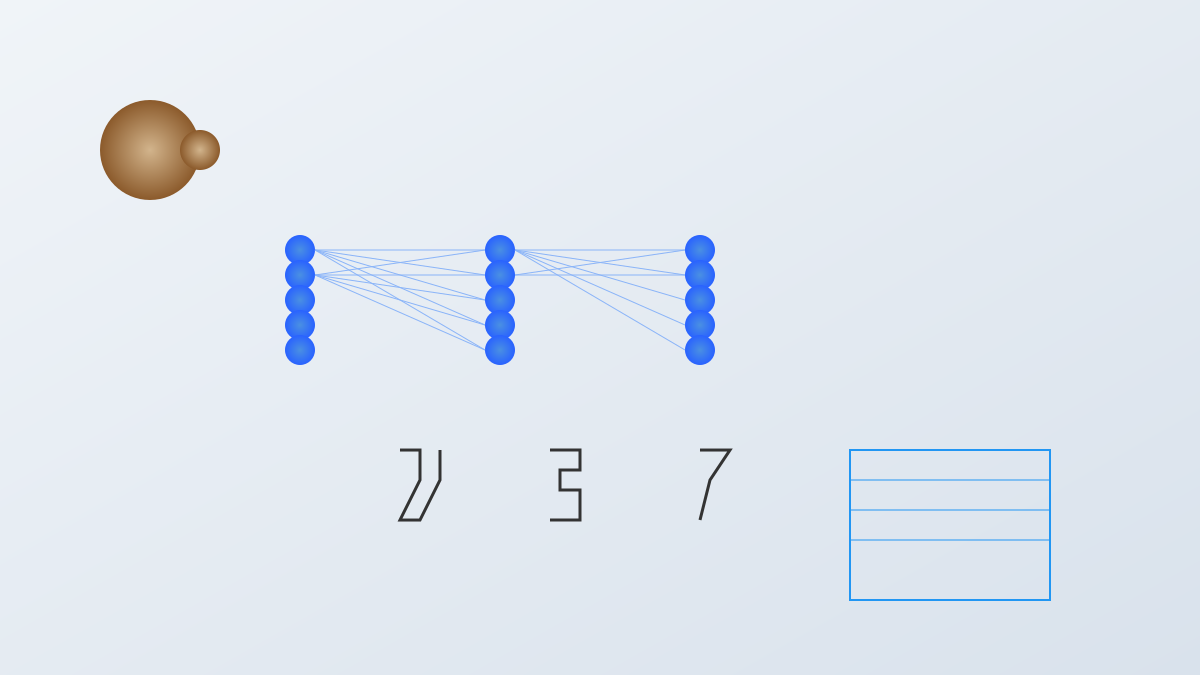
Core algorithm design: The basic method is a fully connected neural network, with an input layer of 784 neurons (flattened from 28×28), hundreds of neurons in the hidden layer, and 10 neurons in the output layer (categories 0-9). Forward propagation: Matrix multiplication + activation function (ReLU to alleviate gradient vanishing), and the output layer uses Softmax to convert to a probability distribution. Backward propagation: Calculate gradients using cross-entropy loss and update weights; hyperparameters (learning rate, batch size, number of training epochs) affect performance. For higher accuracy, CNN can be chosen: Convolutional layers use local connections + weight sharing to reduce the number of parameters, pooling layers reduce dimensionality and enhance translation invariance, and Java's class inheritance and polymorphism help manage complexity.

6

Section 06

Practical Significance and Summary Outlook

Practical significance: Handwritten digit recognition is the foundation of OCR, applied in scenarios such as bank check processing and postal code recognition; it provides a low-threshold ML entry path for Java developers; educationally, it demonstrates the underlying principles of ML (forward/backward propagation, gradient descent). Summary: MNIST_IA proves the feasibility and value of Java in the ML field. Outlook suggestions: Reproduction starts with understanding the MNIST format, then gradually implements data loading, network definition, etc.; optimizations such as regularization and learning rate decay can be added; or export to ONNX for interoperability with other frameworks. With the maturity of Java ML frameworks like DJL, the AI competitiveness of Java developers will improve.

