Zing Forum

Reading

InterviewPro: An Intelligent Recruitment Management System Integrating Machine Learning and Generative AI

InterviewPro is a full-stack recruitment management system that integrates the Random Forest algorithm to predict candidate admission probabilities and uses a rule engine to generate AI evaluation reports, providing data-driven recruitment decision support for modern enterprises.

招聘系统机器学习随机森林生成式AI人才管理数据驱动决策全栈开发
Published 2026-06-07 17:07Recent activity 2026-06-07 17:24Estimated read 5 min
InterviewPro: An Intelligent Recruitment Management System Integrating Machine Learning and Generative AI
1

Section 01

InterviewPro: Guide to the Intelligent Recruitment Management System Integrating Machine Learning and Generative AI

InterviewPro is a full-stack recruitment management system developed by BVarunReddy on GitHub (released on June 7, 2026). Its core functions include integrating the Random Forest algorithm to predict candidate admission probabilities and using a rule engine to generate AI evaluation reports, providing data-driven recruitment decision support for enterprises. Key words include recruitment system, machine learning, Random Forest, generative AI, etc.


2

Section 02

Background of AI Transformation in the Recruitment Field

Current enterprise recruitment faces challenges such as time-consuming resume screening, strong subjectivity in interview evaluations, and uneven candidate experiences. Traditional ATS can only manage processes but lack intelligent decision support. InterviewPro was born in this context, integrating machine learning prediction and generative AI evaluation modules to reshape recruitment decisions in a data-driven way.

3

Section 03

System Architecture and Core Intelligent Modules

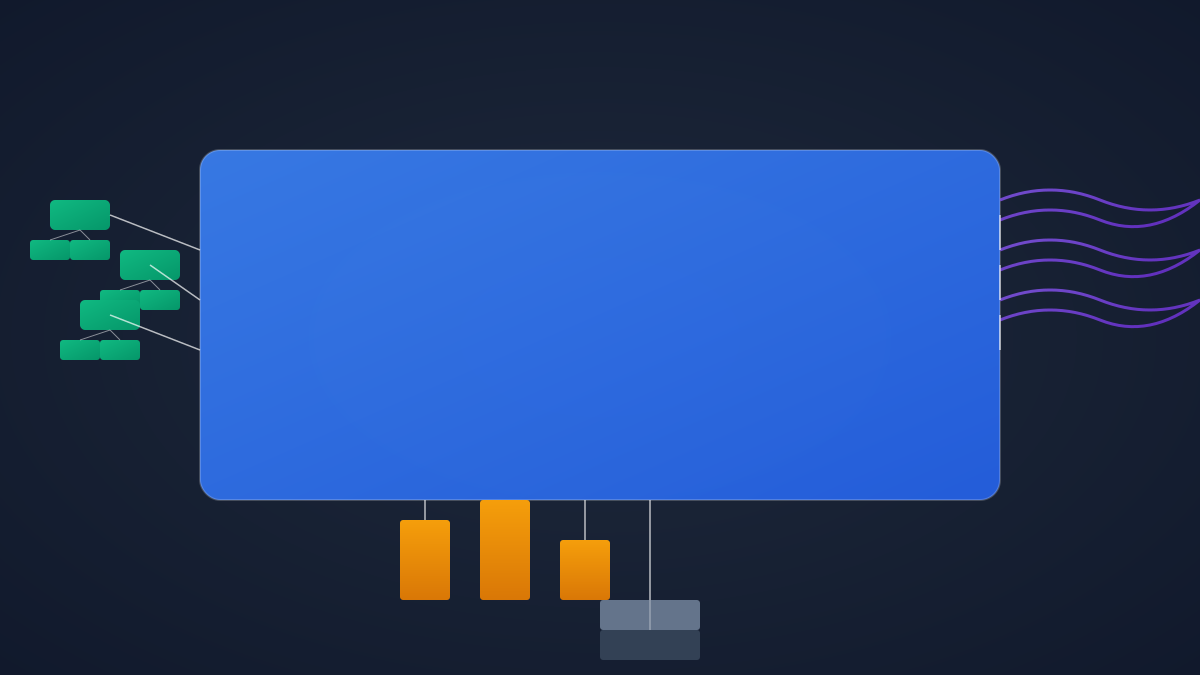
InterviewPro adopts a three-layer architecture: the front-end is a lightweight interface built with HTML5/CSS3/native JS; the back-end is based on Node.js+Express.js+MySQL, with security guaranteed by JWT; the AI layer is the core feature, including two modules: Random Forest classifier (predicting admission probability) and rule engine (generating evaluation reports).

4

Section 04

Implementation Details of the Machine Learning Prediction Module

The algorithm uses Random Forest (100 decision trees, trained with 100 data entries). Features cover dimensions such as experience (work years, etc.), ability (technical score, etc.), process (interview rounds), and background (educational level, etc.). The output is a three-level probability classification: ≥70% (Highly Likely), 40-69% (Moderately Likely), <40% (Low), providing detailed decision-making references.

5

Section 05

Rule Engine Design for Generative AI Evaluation

A rule-based generative engine is used, with advantages of controllability (no hallucinations), low cost, and fast response. The generated evaluation report includes three core parts: strengths, gaps, and suggestions, making it easy for HR to quickly grasp candidate situations and provide comparative feedback.

6

Section 06

Application Scenarios and Value of InterviewPro

For recruitment teams of small and medium-sized enterprises, the value is reflected in: efficiency improvement (automated resume scoring and report generation), decision assistance (ML prediction provides objective references), standardization (comparable feedback reduces bias), and data accumulation (lays the foundation for model optimization).

7

Section 07

Project Limitations and Improvement Directions

As a graduation project, it has limitations such as small data scale (only 100 training records) and insufficient feature richness. Improvement directions include expanding data scale, adding features like programming tests/personality assessments, upgrading models (e.g., XGBoost), and exploring the introduction of large language models under a controllable framework.

8

Section 08

Conclusion: AI-Assisted Rather Than AI-Replaced Recruitment Decision-Making Model

InterviewPro practices the idea of AI assisting human decision-making. AI undertakes auxiliary work such as information organization and pattern recognition, allowing HR to focus on real interactions with candidates and in-depth judgments. This hybrid model of "AI assistance + human decision-making" is a reasonable intelligent path at the current stage.

