Zing Forum

Reading

Internal Knowledge Search: Enterprise-Grade RAG Intelligent Knowledge Retrieval Platform

An open-source enterprise knowledge search platform based on the RAG architecture, integrating semantic search, vector databases, and generative AI technologies. It can accurately retrieve answers from internal documents, PDFs, and enterprise data, and offers an online demo version.

RAG知识检索语义搜索向量数据库企业AI生成式AI文档搜索PDF检索智能问答Vercel
Published 2026-05-11 17:49Recent activity 2026-05-11 18:01Estimated read 6 min
Internal Knowledge Search: Enterprise-Grade RAG Intelligent Knowledge Retrieval Platform
1

Section 01

Introduction: Core Overview of the Enterprise-Grade RAG Intelligent Knowledge Retrieval Platform

The open-source project Internal Knowledge Search is an enterprise-grade intelligent knowledge retrieval platform based on the RAG (Retrieval-Augmented Generation) architecture. It integrates semantic search, vector databases, and generative AI technologies to solve the "information silo" problem of internal enterprise documents. It offers an online demo version and balances the accuracy of information retrieval with the flexibility of AI generation.


2

Section 02

Background: Pain Points in Enterprise Internal Knowledge Management

In the era of information explosion, massive internal enterprise documents have become "information silos", making it difficult for employees to quickly access the knowledge they need. Traditional keyword search has limited effectiveness for complex queries, and pure large language models are prone to "hallucinations". The RAG architecture balances relevance and accuracy by first retrieving real content before generating answers.

3

Section 03

Technical Architecture: Analysis of the RAG Tech Stack

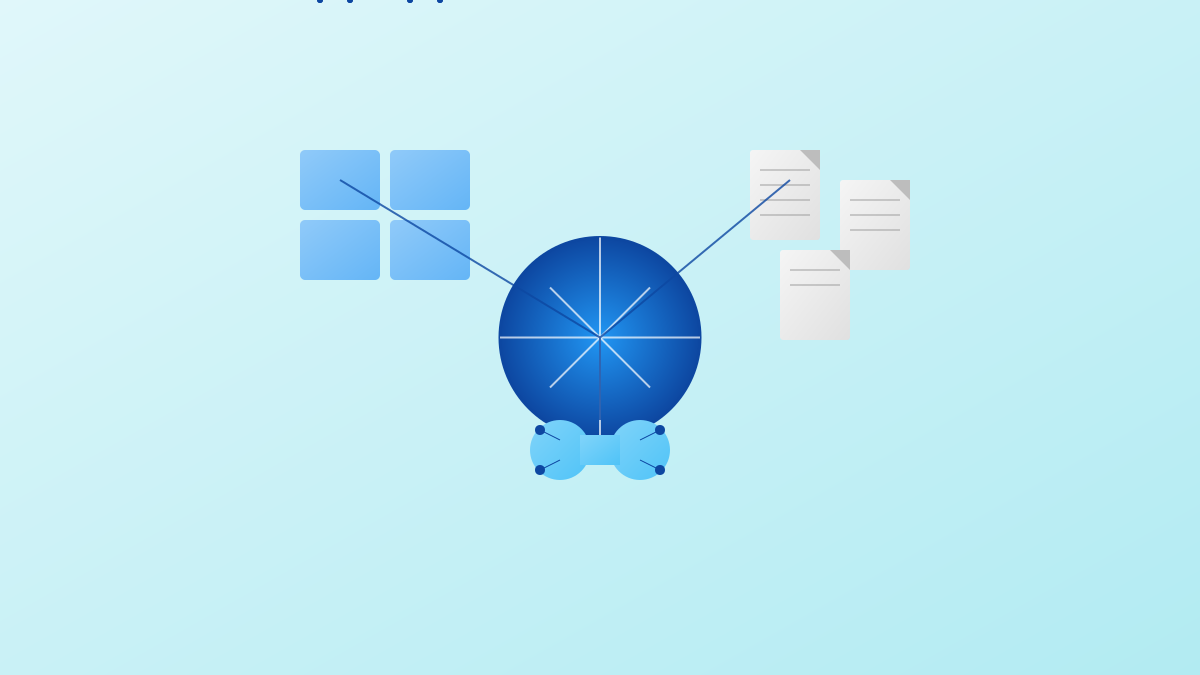
Data Ingestion Phase: Process multi-format documents such as PDFs and Word files, split them into text chunks, convert to vectors via embedding models, and store in vector databases (common choices include Pinecone, Weaviate, Chroma, etc.). Query Phase: Convert user questions to vectors, recall relevant fragments through semantic search, and generate answers based on real content by combining with large language models.

4

Section 04

Application Scenarios: Practical Value Across Multiple Domains

Internally, it can serve as an intelligent customer service to answer policy/process inquiries; in the customer service field, it can respond to product manual/FAQ queries; R&D teams can retrieve technical documents. Semantic search understands deep meanings (e.g., "remote work application" matches content about "flexible work arrangements"). Generative AI directly generates coherent answers to enhance the interactive experience.

5

Section 05

Deployment & Scaling: Flexible Implementation Options

The demo version is deployed on the Vercel platform to lower the trial threshold. It supports private deployment to ensure sensitive data security. It can horizontally scale vector database nodes and replace embedding/generative models to adapt to the needs of data volume and concurrent growth.

6

Section 06

RAG Technology: Advantages & Challenges

Advantages: Reduces AI hallucinations, answers can be traced back to document fragments, natural interaction methods. Challenges: Document splitting strategies affect retrieval quality, embedding models have large performance differences across domains, and need to handle information conflicts and timeliness issues.

7

Section 07

Solution Comparison: Open Source & Enterprise Scenario Optimization

Comparison with traditional knowledge bases (inefficient manual maintenance), enterprise search engines (no semantic understanding), and commercial platforms (closed and expensive). This project is open-source and transparent with strong controllability, optimized for enterprise scenarios (e.g., permission management, multi-tenant isolation, etc.). Compared to other open-source RAG projects, it focuses more on internal knowledge scenarios.

8

Section 08

Summary & Outlook: The Future of Intelligent Knowledge Management

This project represents the direction of intelligent enterprise knowledge management and provides a starting point for technical teams to implement RAG engineering. In the future, it can develop multi-modal RAG and Agentic RAG, optimize conversation history management, integrate collaboration tools, and improve retrieval and generation performance.

