Zing Forum

Reading

IntelliCompile: When Traditional Compilers Meet Artificial Intelligence, Compilation Technology Usheres in a New Revolution

IntelliCompile is an intelligent compilation system that combines traditional compiler processes with machine learning. It optimizes code quality and compilation efficiency through AI, representing a new direction in the development of compiler technology.

编译器人工智能机器学习代码优化静态分析GCCClang编译技术代码质量
Published 2026-06-08 14:45Recent activity 2026-06-08 14:48Estimated read 6 min
IntelliCompile: When Traditional Compilers Meet Artificial Intelligence, Compilation Technology Usheres in a New Revolution
1

Section 01

[Introduction] IntelliCompile: The New Revolution of Integration Between Traditional Compilers and AI

IntelliCompile is an intelligent compilation system that combines traditional compiler processes with machine learning, aiming to optimize code quality and compilation efficiency, representing a new direction in the development of compiler technology.

Basic project information:

2

Section 02

Background: The Need for Intelligent Transformation of Compilers

Traditional compilers (such as GCC and Clang) have continuously improved in optimization algorithms, but they essentially rely on preset rules and heuristic strategies. With the rapid development of artificial intelligence technology, a core question emerges: Can compilers be equipped with learning capabilities to make more intelligent optimization decisions? IntelliCompile is a positive exploration of this question.

3

Section 03

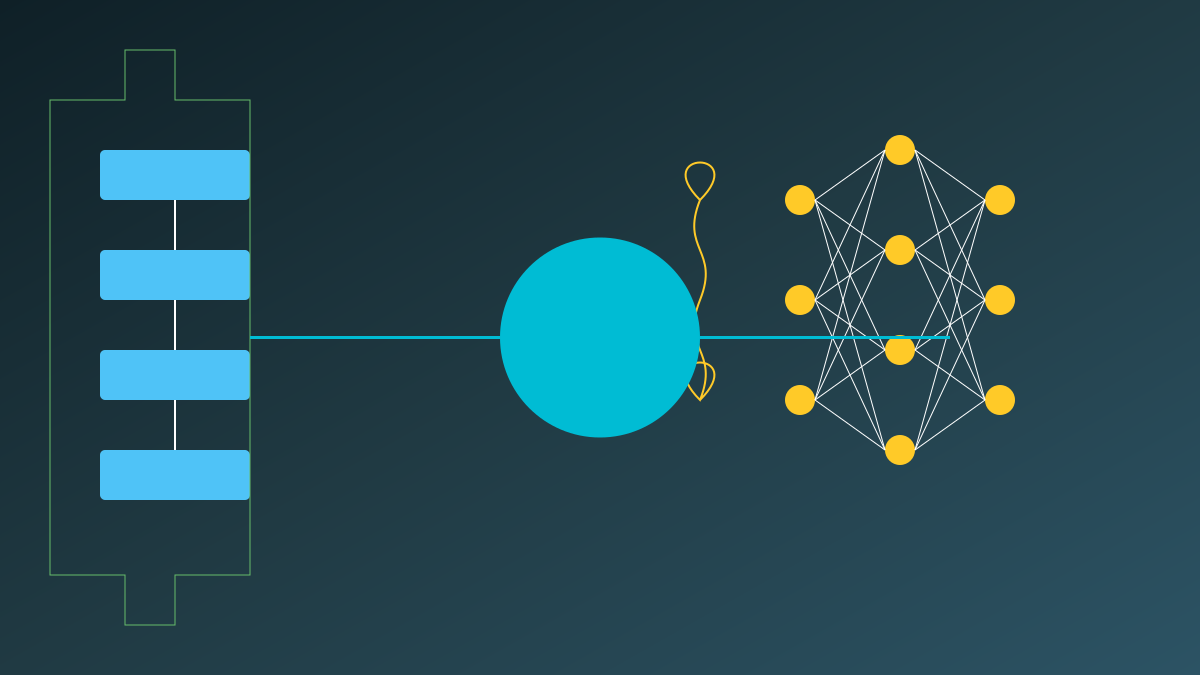
Architecture: Integration of Traditional Compilation Processes and AI Enhancement Layer

IntelliCompile retains the core stages of traditional compilers to ensure compilation correctness and stability:

  • Lexical analysis: Decompose source code into lexical units
  • Syntax analysis: Construct abstract syntax trees
  • Semantic analysis: Check type consistency and scope
  • Code generation: Convert intermediate representation to machine code

On this basis, an AI/ML enhancement layer is introduced for:

  • Code quality prediction
  • Optimization strategy selection
  • Performance bottleneck identification
4

Section 04

Technical Highlights: Key Mechanisms of Intelligent Compilation

  1. Code Quality Analysis Engine: Combines static checking and historical code pattern learning to identify potential issues (such as memory management problems) in advance and provide improvement suggestions.
  2. Adaptive Optimization Strategy: Dynamically selects optimization schemes for different modules based on features like code complexity and call frequency (aggressive optimization for hot paths, saving compilation time for cold paths).
  3. Cross-project Learning Capability: Accumulates general optimization patterns from the compilation history of multiple projects, and improves understanding of specific domains over time.
5

Section 05

Practical Significance: Core Value for Developers

  • Lower Optimization Threshold: Automatically takes on optimization decisions, allowing developers to focus on business logic.
  • Improve Code Quality: Captures potential issues during compilation, reducing later maintenance costs.
  • Balance Performance and Efficiency: Fast compilation during development, deep optimization during release, coordinated automatically by AI.
6

Section 06

Challenges and Future Outlook

Challenges faced by intelligent compilers:

  1. Interpretability: The contradiction between the black-box nature of AI models and the deterministic requirements of compilers.
  2. Training Data and Generalization: Avoid overfitting the model to specific projects or styles, ensuring stable performance in diverse scenarios.
  3. Toolchain Integration: Compatibility issues with existing components like debuggers and linkers.

Future efforts need to continue exploring these directions to promote the maturity of intelligent compilation technology.

7

Section 07

Conclusion: An Important Direction in Compiler Technology Evolution

IntelliCompile represents the evolution direction of compilers from rule-driven to data-driven, and from static optimization to dynamic learning. Although in the early stage, its exploration value has been demonstrated, providing a reference for subsequent intelligent compiler research. The intelligent transformation of compilers is not achieved overnight, but such projects are sowing the seeds of change for the field.



