Zing Forum

Reading

Healix: An Intelligent Garbage Classification and Recycling Assistance System Based on Convolutional Neural Networks

This article introduces the Healix project, a university initiative that leverages Convolutional Neural Networks (CNN) and deep learning technology to assist in garbage classification and recycling, exploring the application value of AI in environmental protection and its technical implementation path.

垃圾分类卷积神经网络深度学习环保CNN智能回收
Published 2026-05-05 02:43Recent activity 2026-05-05 02:53Estimated read 7 min
Healix: An Intelligent Garbage Classification and Recycling Assistance System Based on Convolutional Neural Networks
1

Section 01

[Introduction] Healix: Core Overview of the CNN-Based Intelligent Garbage Classification and Recycling Assistance System

Healix is a university research project that uses Convolutional Neural Networks (CNN) and deep learning technology to build an intelligent garbage classification and recycling assistance system. It aims to address issues like low efficiency, high cost, and poor accuracy in global garbage classification, while exploring the application value of AI in environmental protection and its technical implementation path. The project covers data collection, model training, inference deployment, and user interaction, and can be applied in household, commercial, and industrial scenarios to promote the development of the circular economy.


2

Section 02

[Project Background] Global Garbage Classification Challenges and the Urgent Need for AI Technology

With the acceleration of global urbanization and rising consumption levels, garbage generation has grown exponentially. According to the World Bank, the world produces over 2 billion tons of solid waste annually, and this is expected to increase by 70% by 2050. Garbage disposal dilemmas threaten the ecological environment and cause resource waste. Traditional manual classification is inefficient, costly, and inaccurate; classification standards vary across regions, leading to frequent misjudgments by residents and professionals. The development of artificial intelligence—especially computer vision and deep learning—provides a new solution for garbage classification, giving birth to the Healix project.

3

Section 03

[Technical Core] Working Principle of CNN in Garbage Classification

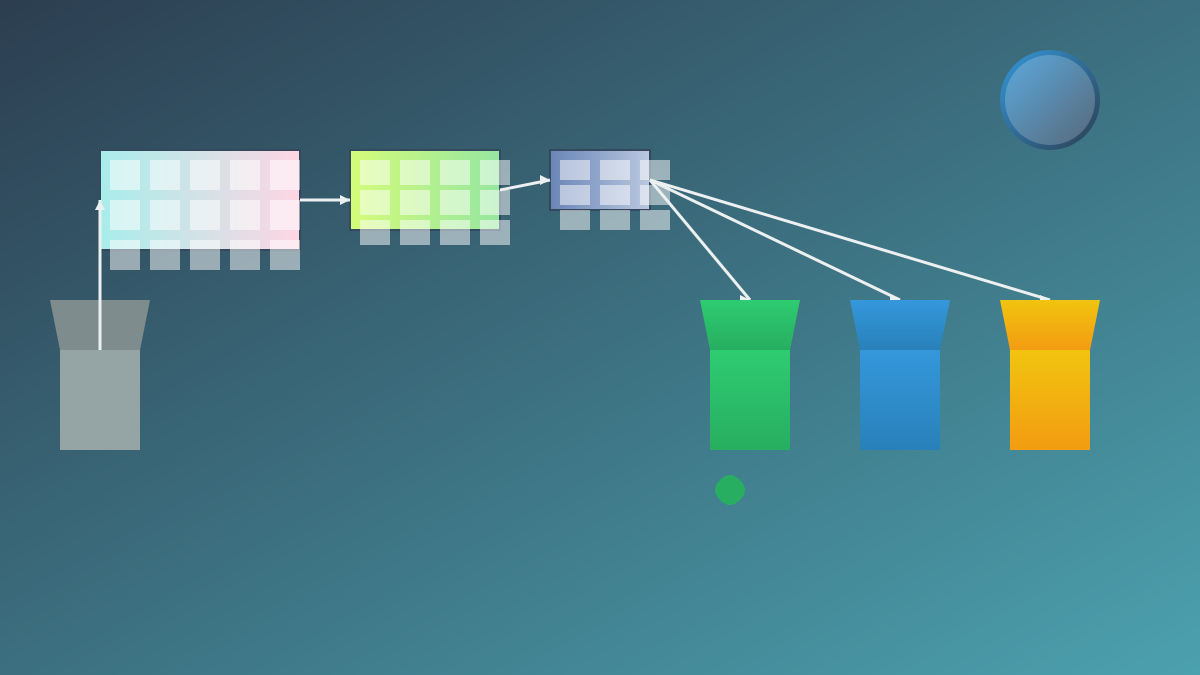
Convolutional Neural Networks (CNN) are a representative deep learning architecture that excels in image recognition, inspired by the biological visual cortex. Its basic units include: convolutional layers (extracting local features via filters—shallow layers capture simple features, deep layers combine complex structures), pooling layers (reducing dimensionality and enhancing translation invariance), and fully connected layers (mapping high-level features to classification outputs). In garbage classification, CNN learns to distinguish visual features of different garbage types, such as the transparent material and cylindrical shape of plastic bottles, or the fibrous texture of paper.

4

Section 04

[System Architecture] Full-Process Design of the Healix System

The Healix architecture covers four links: data collection, model training, inference deployment, and user interaction. Data collection builds a high-quality dataset covering multiple garbage categories, considering factors like lighting and angle. Model training selects architectures like ResNet/VGG, balancing accuracy and efficiency, and uses data augmentation to improve robustness. Inference deployment supports cloud, edge, or mobile deployment. User interaction includes mobile apps, fixed camera guidance, and backend data dashboards.

5

Section 05

[Model Optimization] Key Strategies to Improve Healix's Classification Performance

Healix improves performance through multiple strategies: for class imbalance, over/under sampling, weight adjustment, or GAN-generated synthetic samples are used; for fine-grained classification, multi-task learning or hierarchical classification is applied; Grad-CAM is used to visualize model attention areas to enhance interpretability; a continuous learning mechanism adapts to new garbage types, avoiding retraining from scratch.

6

Section 06

[Application Value] Multi-Scenario Applications and Social Significance of Healix

Healix is applied in household (mobile app-assisted classification), commercial (smart recycling bins for automatic sorting), and industrial (automated sorting lines) scenarios. Its social significance lies in promoting the circular economy: ensuring recyclables are regenerated, hazardous waste is properly handled, and wet waste is converted into resources, contributing to carbon neutrality and sustainable development.

7

Section 07

[Future Outlook] Challenges of Healix and Industry Development Directions

Healix faces limitations like occlusion, light sensitivity, and shape diversity—these can be addressed via multi-modal fusion (combining weight sensors and spectral analysis). Cross-domain generalization requires domain adaptation technology and data feedback. Cost issues can be mitigated by model compression to reduce computational demands. In the future, the popularization of edge AI chips and 5G coverage will drive its adoption; combining with blockchain can build digital infrastructure for the circular economy.

