Zing Forum

Reading

HAL: A Secure HTTP API Middle Layer Built for Large Language Models

An in-depth analysis of the HAL project, a HTTP API middle layer designed specifically for LLMs, supporting seamless Web API interactions and automated tool generation based on OpenAPI specifications to enhance the integration efficiency between AI applications and external services.

HALLLMAPI中间层OpenAPI工具生成AI安全Function CallingAPI集成
Published 2026-04-29 06:41Recent activity 2026-04-29 09:47Estimated read 8 min
HAL: A Secure HTTP API Middle Layer Built for Large Language Models
1

Section 01

Introduction: HAL—Core Value of a Secure API Middle Layer for LLMs

HAL (HTTP API Layer) is a secure HTTP API middle layer designed specifically for Large Language Models (LLMs), aiming to solve the security, complexity, and standardization issues when LLMs interact with external Web APIs. It supports automatic tool generation from OpenAPI specifications, handles underlying details like authentication and request construction via the middle layer proxy, allowing LLMs to focus on intent understanding and improving the integration efficiency between AI applications and external services.


2

Section 02

Project Background and Core Issues

Modern AI applications increasingly rely on tool usage capabilities; LLMs need to interact with external services (such as weather, payment interfaces) to evolve into intelligent assistants. Direct API calls have three major pain points:

  1. Security Issues: Sensitive information (API keys, credentials) is easily exposed;
  2. Complexity: Large differences in authentication, request formats, and error handling logic across different APIs;
  3. Standardization Issues: Lack of a unified calling paradigm.

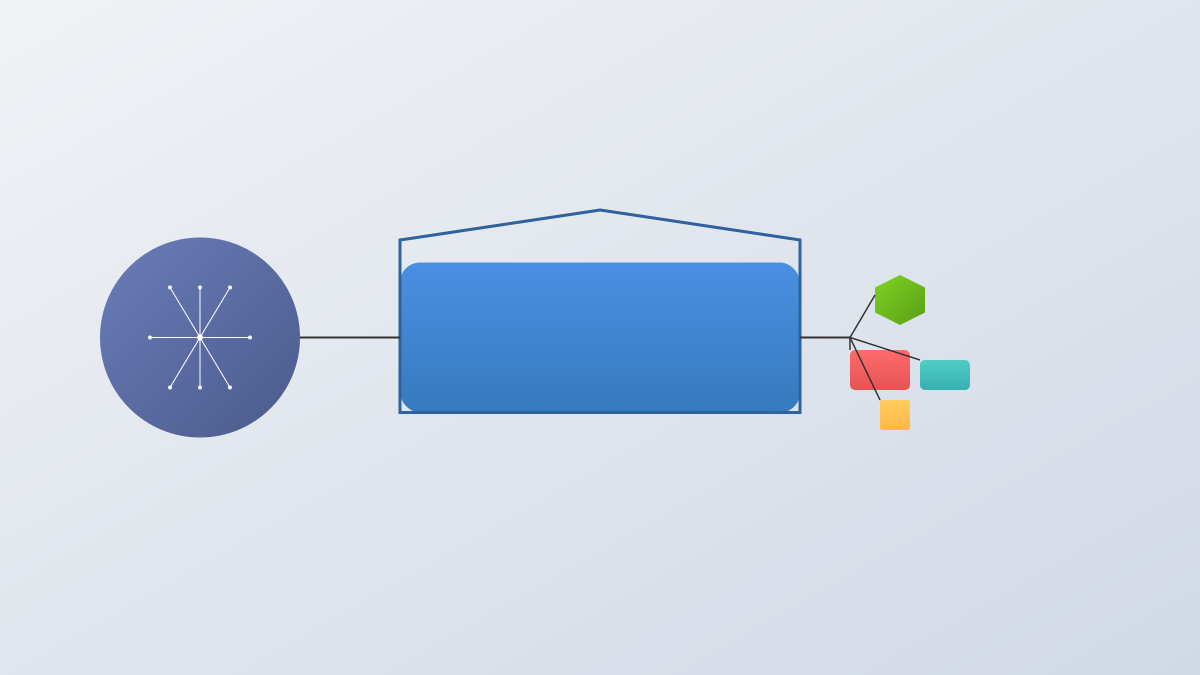
HAL solves these problems through a middle layer architecture, establishing a controlled proxy layer between LLMs and APIs to handle authentication, request construction, response parsing, and security auditing.

3

Section 03

Architecture Design and Core Components

API Gateway Layer

The system entry point, providing a unified RESTful interface, supporting API key, JWT, OAuth2.0 authentication, and implementing request validation, rate limiting, logging, and routing.

OpenAPI Parsing and Tool Generation

Automatically converts OpenAPI 3.0 documents into LLM tool definitions, including endpoint mapping, parameter extraction, type conversion, and document generation, reducing the workload of integrating new APIs.

Security Proxy Layer

  • Credential Isolation: Sensitive credentials are stored in a key management system; LLMs only get abstract identifiers;
  • Request Review: A policy engine checks requests, restricts domains, and prohibits sensitive operations;
  • Response Filtering: Desensitizes sensitive fields;
  • Audit Logs: Records complete request-response information.

Execution Engine

Responsible for initiating HTTP requests, supporting synchronous/asynchronous calls and streaming responses, with built-in connection pooling, timeout control, retry mechanisms, and unified error handling.

4

Section 04

Integration Modes with LLMs

Function Calling Mode

Adapts to mainstream models like OpenAI and Anthropic; tool definitions comply with Function Calling specifications, allowing models to directly decide which tools to call and their parameters—native support without additional prompt engineering.

ReAct Mode

Designed for models that do not support native Function Calling; guides the "Think-Act-Observe" loop via prompt templates and parses the model's text output to execute instructions.

Pre-execution Mode

Pre-executes API calls and injects results into prompts, suitable for data preparation tasks and reducing the model's decision-making burden.

5

Section 05

Application Scenarios and Practical Cases

  • Enterprise Knowledge Assistant: Integrates HR systems and project management tools, supporting natural language queries for attendance and leave submissions;
  • E-commerce Intelligent Customer Service: Connects inventory, order, and logistics APIs to enable order tracking and inventory queries;
  • DevOps Assistant: Encapsulates CI/CD and monitoring APIs, supporting natural language-triggered deployments and service status queries;
  • Multi-Agent Collaboration System: Serves as a unified tool layer, allowing agents to securely access shared services.
6

Section 06

Technical Implementation Highlights

  • High-Performance Caching: Multi-level caching strategy reduces repeated calls and supports active invalidation notifications;
  • Streaming Processing: Transparently passes SSE/WebSocket streaming responses, suitable for real-time scenarios;
  • Observability: Built-in metric collection and distributed tracing to monitor latency, error rates, etc.;
  • Plugin Extension: Supports custom middleware to insert authentication logic and data conversion rules.
7

Section 07

Future Outlook

  • GraphQL Support: Add automatic tool generation for GraphQL endpoints;
  • Multimodal Integration: Extend API calls for images, voice, and video;
  • Intelligent Caching Strategy: LLM-assisted decision-making for caching rules;
  • Federated Security Policy: Cross-instance federated security policies to adapt to distributed deployments.
8

Section 08

Summary

HAL provides a secure and elegant solution for connecting LLMs to the outside world. Through automated tool generation, comprehensive security proxies, and flexible integration modes, it lowers the threshold for AI application development. As AI-native applications evolve, such middle layer tools will play an important role.

