GSLM-DSM: An Analysis of the Deep Learning-Driven Genomic Sequence Language Model Framework
Introduction: When Artificial Intelligence Meets Genomics
In the digital wave of life sciences, the explosive growth of genomic data has posed unprecedented challenges to analytical tools. Traditional bioinformatics methods, while performing well in specific tasks, often fall short when dealing with massive, high-dimensional genomic sequence data. In recent years, breakthroughs in deep learning technology have provided new possibilities for solving this problem. GSLM-DSM (Genomic Sequence Language Model - Deep Sequence Model) is an innovative framework born in this context. It introduces the concept of language models from natural language processing into the field of genomics, creating a new paradigm for sequence analysis.
Project Background and Technical Positioning
GSLM-DSM was developed by the Lilab Genomics Laboratory. It is an open-source deep learning framework specifically designed for processing and analyzing genomic sequence data. The core idea of the project is to treat DNA sequences as a special "language", where nucleotides (A, T, C, G) are equivalent to letters, gene fragments to words, and the genome to a complete "book of life". Based on this understanding, GSLM-DSM draws on the architecture of language models in natural language processing and adapts it to the characteristics of genomic data, enabling efficient learning and prediction of sequence patterns.
Core Technical Architecture: Bimodal Convolutional Neural Network
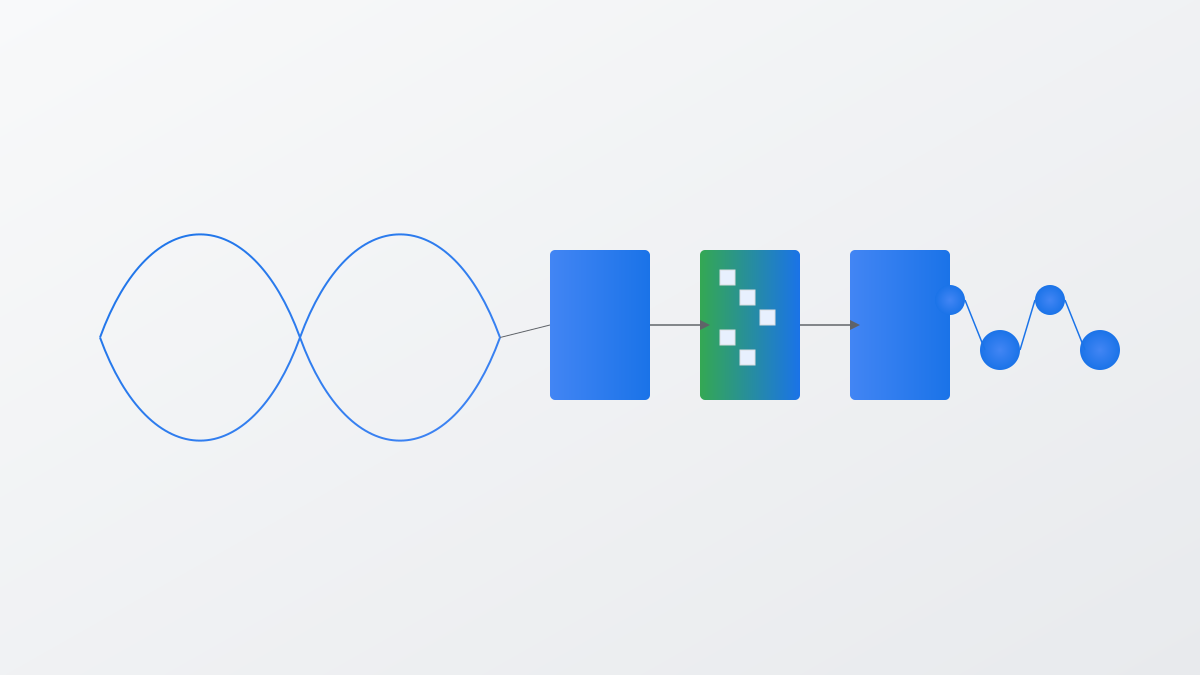
The technical core of GSLM-DSM lies in its unique bimodal sequence feature processing mechanism. Unlike traditional unimodal models, this framework considers two key representations of genomic sequences simultaneously:
Sequence Modality: Directly processes raw nucleotide sequences to capture local sequence patterns and long-range dependencies. Convolutional Neural Networks (CNNs) use a sliding window mechanism to automatically learn sequence motifs of different lengths, which often correspond to biologically functional regulatory elements.
Feature Modality: Extracts auxiliary information such as physicochemical properties, structural features of sequences—like GC content, coding potential, conservation scores, etc. These features provide additional biological prior knowledge to the model, helping to improve the accuracy and interpretability of predictions.
Through a parallel dual-branch architecture, GSLM-DSM can fuse information from both modalities to form a more comprehensive sequence representation, thus achieving better performance in downstream tasks.
Application Scenarios and Potential Value
GSLM-DSM framework shows great potential in multiple genomics application scenarios:
Gene Function Annotation: By learning patterns of known functional sequences, the model can predict the functional categories of unknown genes, accelerating the genome annotation process.
Regulatory Element Identification: Cis-regulatory elements such as promoters and enhancers often have specific sequence features. GSLM-DSM can automatically identify these patterns, assisting in the study of regulatory networks.
Variant Effect Prediction: For genetic variations like Single Nucleotide Polymorphisms (SNPs), the model can assess their potential impact on gene function, providing clues for disease association studies.
Cross-Species Transfer Learning: Some patterns in genomic sequences are conserved across different species. Pre-trained language models can quickly adapt to new species data through transfer learning.
Technical Implementation and Open-Source Ecosystem
As an open-source project, GSLM-DSM is hosted on the GitHub platform. It is developed in Python and built based on mainstream deep learning frameworks (such as PyTorch or TensorFlow). The open-source nature of the project means researchers can freely use, modify, and extend the framework, promoting rapid technological iteration and community collaboration.
The code repository includes model architecture definitions, training scripts, sample data, and user documentation, lowering the barrier for new users to get started. At the same time, the open-source model facilitates independent verification and improvement of the method by the academic community, driving technological progress in the entire field.
Challenges and Outlook
Although GSLM-DSM represents an important advancement in genomic sequence analysis, it still faces several challenges. First, the high cost of annotating genomic data limits the effectiveness of supervised learning; second, the interpretability of the model still needs to be improved so that biologists can understand the biological mechanisms behind predictions; in addition, how to effectively integrate multi-omics data (such as epigenetics, 3D genome structure, etc.) is also a future research direction.
Looking ahead, with the popularization of computing resources and the continuous accumulation of genomic data, deep learning frameworks like GSLM-DSM are expected to play a greater role in precision medicine, synthetic biology, agricultural breeding, and other fields. The deep integration of artificial intelligence and life sciencesciences is opening a new chapter in understanding the mysteries of life.
Conclusion
The GSLM-DSM project demonstrates the power of interdisciplinary innovation—applying cutting-edge natural language processing technology to genomics, a traditional life science field. This "language model" perspective not only provides a powerful analytical tool but also deepens our understanding of the genome as an information carrier. For bioinformatics researchers, computational biologists, and developers interested in the AI+life science cross-discipline, GSLM-DSM is undoubtedly an open-source project worth paying attention to.