Zing Forum

Reading

GradientForge: Make Neural Network Training Visual and Code-Free

A neural network visualization training tool for macOS that allows users to train models without writing code, intuitively understand the network learning process, and export Core ML models with one click, lowering the entry barrier to deep learning.

深度学习神经网络可视化无代码Core MLmacOS机器学习教育
Published 2026-05-23 05:44Recent activity 2026-05-23 05:51Estimated read 6 min
GradientForge: Make Neural Network Training Visual and Code-Free
1

Section 01

[Introduction] GradientForge: A Visual, Code-Free Neural Network Training Tool

GradientForge is a neural network visualization training tool for macOS, designed to address the black-box dilemma of deep learning. It allows users to train models without writing code, intuitively understand the network learning process, and supports one-click export of Core ML models, lowering the entry barrier to deep learning and promoting technology popularization and education.


2

Section 02

Background: The Black-Box Dilemma of Deep Learning

Deep learning has transformed the face of AI over the past decade, but the lack of interpretability is a core issue. Neural networks are like mysterious black boxes to beginners and even practitioners—key information such as gradient flow and feature evolution is hidden behind code and mathematical formulas, requiring complex tools for analysis. This high barrier hinders popularization and education.

3

Section 03

Solution: Core Philosophy of GradientForge

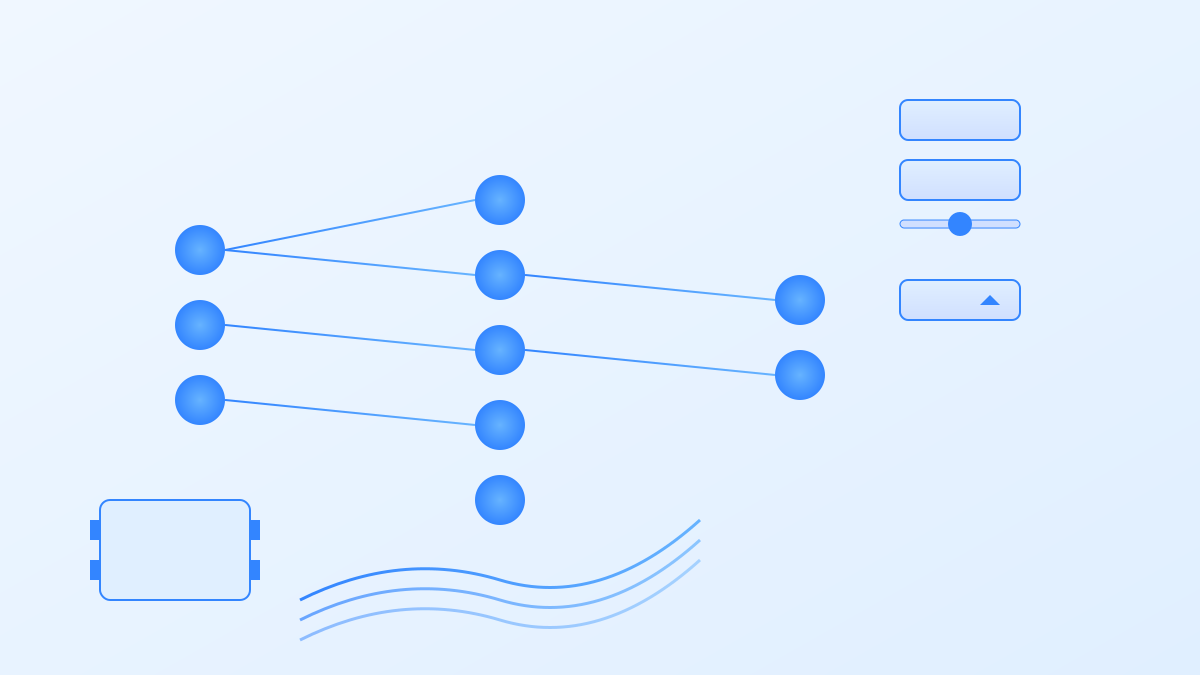
GradientForge is specifically designed for macOS, with the core idea of "letting you see the learning process of neural networks". It adopts a code-free design philosophy—users do not need to write scripts or configure environments, and can complete the entire process from data import to model export through a graphical interface.

4

Section 04

Core Features: Visual Training and Code-Free Workflow

Visual Training

Real-time observation of feature map evolution, gradient flow, weight distribution, and activation patterns helps quickly identify training issues (data preprocessing, network structure, learning rate, etc.).

Code-Free Workflow

Drag and drop to build network architectures, select predefined layer components to adjust hyperparameters, and abstract links such as data processing and training loops—suitable for users without technical backgrounds and educational scenarios.

One-Click Core ML Export

Seamlessly export models to Apple ecosystem applications, supporting efficient operation on iOS/macOS and other devices—ideal for rapid prototyping and small-scale deployment.

5

Section 05

Technical Implementation: Apple Ecosystem and Hardware Optimization

As a native macOS application, GradientForge uses the neural network engine of Apple Silicon to accelerate training and inference. It is built with Swift/SwiftUI to ensure a smooth experience, and the underlying layer encapsulates existing deep learning frameworks but remains transparent to users, aligning with Apple's design philosophy of hiding complexity.

6

Section 06

Applicable Scenarios and Target Users

GradientForge is suitable for:

  • Educational field: Intuitive teaching in introductory deep learning courses
  • Rapid prototyping: Data scientists quickly validate ideas
  • Interdisciplinary research: Non-computer background researchers explore ML applications
  • Design exploration: Creative workers experiment with AI generation and style transfer
7

Section 07

Limitations and Future Outlook

Limitations: Not suitable for large-scale distributed training, complex custom architectures, or cutting-edge research scenarios; its positioning is to complement rather than replace traditional frameworks. Outlook: Support for more models (Transformers, diffusion models), collaboration features, iPad version, cloud integration, etc.

8

Section 08

Conclusion: Making AI Technology More Accessible and Understandable

GradientForge represents the trend of AI technology accessibility. We not only need powerful models but also tools for understanding and sharing. When the training process is visible and interactive, more people can participate in the technological revolution. For those who want to "see" how neural networks learn, it is worth a try.

