Zing Forum

Reading

Machine Learning for Predicting Electrochemical Oxidation Degradation Kinetics of Pharmaceutical Pollutants: A Synergistic Framework of GNN and Traditional Models

A predictive framework open-sourced by the Southeast University team, combining traditional machine learning and graph neural networks (GNNs) to predict the degradation kinetics of pharmaceutical pollutants during electrochemical oxidation, including 355 sets of experimental data and SHAP interpretability analysis.

graph neural networkenvironmental chemistrypharmaceutical pollutantselectrochemical oxidationmachine learningwater treatmentSHAPXGBoost
Published 2026-06-12 13:09Recent activity 2026-06-12 13:17Estimated read 5 min
Machine Learning for Predicting Electrochemical Oxidation Degradation Kinetics of Pharmaceutical Pollutants: A Synergistic Framework of GNN and Traditional Models
1

Section 01

[Introduction] Machine Learning for Predicting Electrochemical Oxidation Degradation Kinetics of Pharmaceutical Pollutants: A Synergistic Framework of GNN and Traditional Models

The Southeast University team open-sourced a predictive framework that combines traditional machine learning and graph neural networks (GNNs) to predict the degradation kinetics of pharmaceutical pollutants during electrochemical oxidation. It includes 355 sets of experimental data and SHAP interpretability analysis, facilitating environmental risk assessment, process optimization, and methodological reference.


2

Section 02

Background: Pharmaceutical Residues in Water Treatment and Challenges of Electrochemical Oxidation Technology

The modern pharmaceutical industry leads to the continuous entry of pharmaceutically active compounds into water bodies. Traditional sewage treatment processes struggle to effectively degrade pollutants with complex molecular structures. Electrochemical oxidation technology is efficient and environmentally friendly, but predicting degradation kinetics is challenging due to large differences in pharmaceutical molecular structures and complex influences of reaction conditions (voltage, pH, electrolyte concentration).

3

Section 03

Methods: Synergistic Machine Learning Framework and Technical Architecture

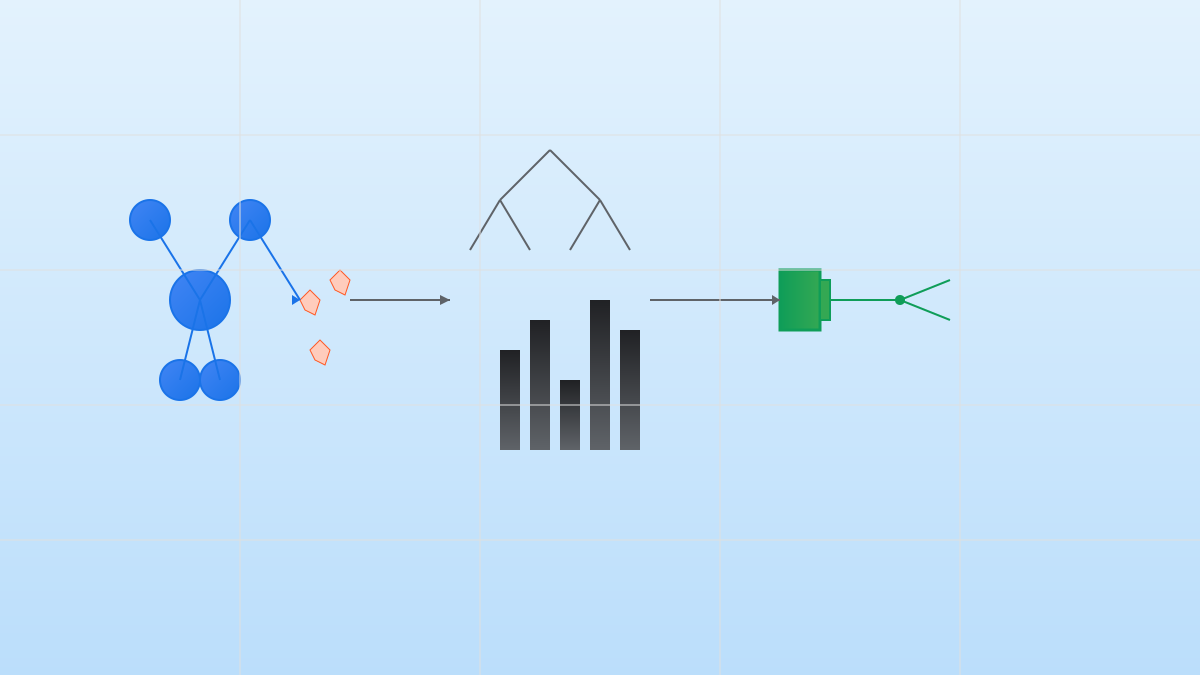
The project adopts a multi-model synergistic framework integrating traditional ML and GNN:

  1. Traditional ML baselines: Build models such as SVM and Random Forest, providing benchmarks based on molecular numerical features;
  2. XGBoost optimized model: After hyperparameter optimization, process tabular features to capture nonlinear interactions;
  3. GNN model: Model molecules as graphs (atoms as nodes, chemical bonds as edges) to learn the impact of topological structures on degradation; It also provides a complete data processing pipeline (cleaning, feature engineering, standardization).
4

Section 04

Evidence: Dataset and SHAP Interpretability Analysis

The dataset contains 355 sets of experimental observation data covering 31 types of drugs. Through SHAP analysis, the contribution of molecular features is quantified, key influencing factors (such as specific functional groups, aromatic ring structures, and heteroatom positions) are identified, verifying the model's rationality and guiding environmental risk assessment.

5

Section 05

Conclusion: Application Value and Significance of the Framework

The framework's value is reflected in:

  • Environmental risk assessment: Quickly predict the degradation characteristics of new pharmaceutical molecules;
  • Process optimization: Guide the selection of electrochemical oxidation reaction conditions;
  • Methodological reference: The synergistic strategy of traditional ML and GNN can be transferred to other environmental chemistry problems.
6

Section 06

Open-Source Contribution and Usage Recommendations

The project is open-sourced (GitHub link: https://github.com/Chenwx-seu/EO-Pharmaceutical-Pollutants-ML), and the associated paper should be cited. The code structure is clear (including model definition, training, evaluation, and visualization tools), making it suitable as a teaching case and research starting point. It is recommended that researchers use this framework in combination with domain knowledge to solve practical environmental problems.

