Zing Forum

Reading

GitHub Copilot CLI Observability Solution: Monitoring Practice for AI Programming Assistants Based on OpenTelemetry

This article introduces how the ghcp-mon project implements end-to-end monitoring of GitHub Copilot CLI sessions, builds an observability system based on OpenTelemetry standards, and discusses performance analysis and optimization methods for AI-assisted programming tools.

GitHub CopilotOpenTelemetry可观测性AI编程助手监控仪表板OTEL生成式AI监控CLI工具性能分析
Published 2026-05-01 09:44Recent activity 2026-05-01 10:18Estimated read 5 min
GitHub Copilot CLI Observability Solution: Monitoring Practice for AI Programming Assistants Based on OpenTelemetry
1

Section 01

Introduction to GitHub Copilot CLI Observability Solution

This article introduces how the ghcp-mon project builds an end-to-end monitoring system for GitHub Copilot CLI sessions based on OpenTelemetry standards, discusses performance analysis and optimization methods for AI-assisted programming tools, and covers core scenarios such as usage, performance metrics, and cost management.


2

Section 02

Popularization of AI-Assisted Programming and Monitoring Needs

GitHub Copilot has deeply integrated into the workflows of millions of developers, changing the way software is developed. As usage scales up, monitoring and optimizing its performance have become important topics: team managers evaluate return on investment, developers optimize workflows, and operations teams ensure service stability.

3

Section 03

ghcp-mon Project Design Goals and OpenTelemetry Application

ghcp-mon is an observability tool for GitHub Copilot CLI, providing an independent OTEL collector and a visual dashboard. Its core concept follows open standards and adopts OpenTelemetry semantic conventions. It not only monitors Copilot CLI but also provides references for monitoring other generative AI clients, helping to build a unified observability system for AI systems.

4

Section 04

Analysis of ghcp-mon Technical Architecture

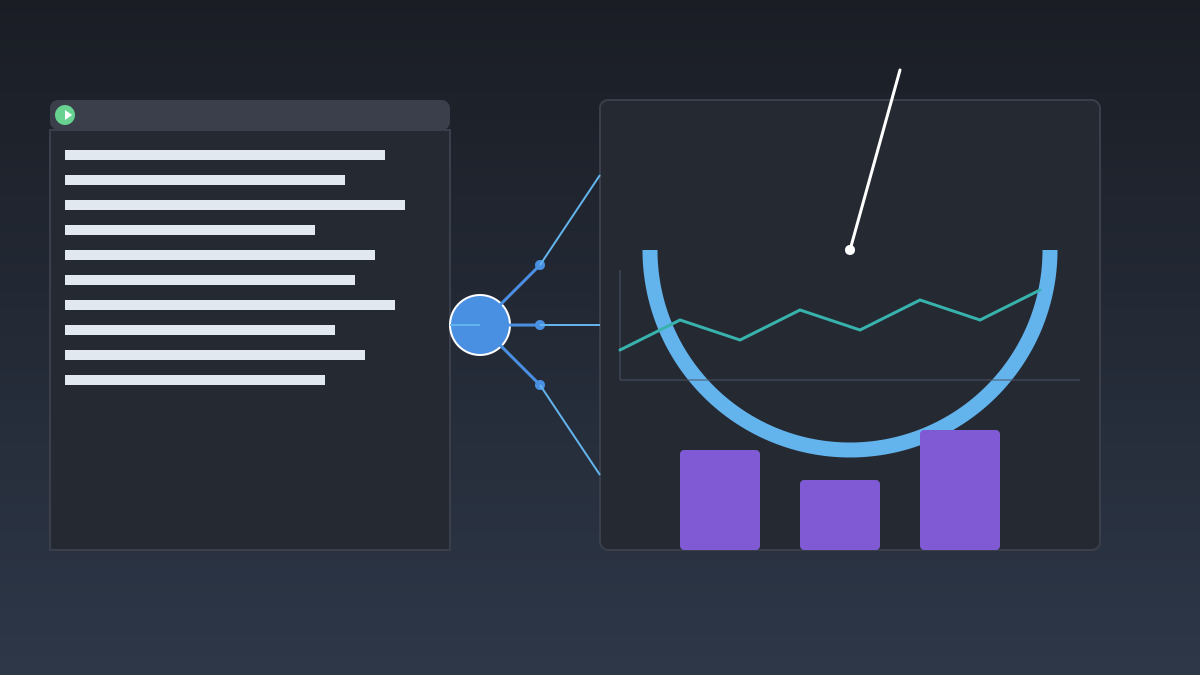
Data Collection Layer: An independent OTEL collector that obtains telemetry data through interception/listening, supports OTLP, HTTP, and gRPC protocols, and requires no intrusive modifications to Copilot CLI. Data Processing and Storage: Raw data is processed and aggregated into metrics such as latency distribution and throughput trends, and stored in time-series/analytical databases. Visual Dashboard: Includes core views such as real-time overview, performance analysis, usage statistics, and error analysis.

5

Section 05

Special Considerations for Generative AI Monitoring

Compared to traditional web service monitoring, AI client monitoring has unique challenges: 1. Streaming response processing: Need to accurately measure first-token latency and complete response time; 2. Long session tracking: Maintain session state and associate continuous interactions to the same link; 3. Multimodal content processing: Identify and measure consumption of different types of content.

6

Section 06

Practical Application Scenarios of ghcp-mon

Team-level Usage Analysis: Managers understand team adoption rates, active periods, and commonly used features, providing a basis for training and promotion. Performance Optimization Guidance: Developers identify slow scenarios through latency metrics and optimize prompt strategies or usage habits. Cost Management: Establish a cost model based on token consumption, set budget alerts, and identify abnormal consumption patterns.

7

Section 07

Ecosystem Integration and Future Outlook

Ecosystem Integration: As an OTEL-compatible collector, ghcp-mon seamlessly integrates with mainstream platforms such as Prometheus, Grafana, Jaeger, and Datadog, and is incorporated into the enterprise's unified monitoring system. Future Outlook: AI observability will develop towards intelligent proactive optimization, end-to-end tracking across toolchains, and business value quantification. ghcp-mon is an early exploration and is worth trying for Copilot CLI teams.

