Zing Forum

Reading

Building an End-to-End Machine Learning Pipeline in GitHub Actions: A Zero-Cost Bitcoin Price Prediction System

Explore how to use GitHub Actions' free computing resources, combined with Rust, Python, and TypeScript, to build a complete machine learning pipeline that enables data acquisition, model training, and visual deployment without cloud services.

GitHub ActionsMLOps机器学习流水线RustPython比特币预测零成本部署CI/CDParquetReact
Published 2026-05-10 08:56Recent activity 2026-05-10 10:27Estimated read 7 min
Building an End-to-End Machine Learning Pipeline in GitHub Actions: A Zero-Cost Bitcoin Price Prediction System
1

Section 01

Introduction: Zero-Cost ML Pipeline Powered by GitHub Actions

This article introduces the innovative project gha_ml_pipeline, which uses GitHub Actions' free computing resources and combines Rust, Python, and TypeScript to build an end-to-end machine learning pipeline for Bitcoin price prediction. The project automates the entire process of data acquisition, model training, and visual deployment without paid cloud services. All data and models are stored in the GitHub repository, enabling truly zero-cost deployment.


2

Section 02

Project Background and Tech Stack Selection

Background

GitHub Actions provides free computing resources for public repositories, which is suitable for lightweight ML tasks. The project aims to demonstrate an end-to-end ML workflow and avoid cloud service costs, making it highly valuable for individual developers, students, or small teams.

Tech Stack Logic

  • Rust: Efficiently handles data acquisition and format conversion
  • Python: Uses the rich ML ecosystem for model training
  • TypeScript/React: Builds the frontend visualization interface Choosing a multi-language architecture is to match the best tools for specific tasks, reflecting modern software engineering best practices.
3

Section 03

Deep Dive into System Architecture

Data Layer

Data tools written in Rust fetch Bitcoin price data from external sources, convert it to Parquet columnar storage format (which has better compression and query performance than CSV), and store it in the data/ directory.

Model Layer

Python code (including Jupyter Notebooks) uses Conda to manage the environment. Trained model weights and metadata are saved in the models/ directory to simplify the deployment process.

Presentation Layer

The React application written in TypeScript visualizes prediction results. It is hosted for free via GitHub Pages with automatic update deployment. The final result can be accessed at elarsaks.github.io/gha_ml_pipeline.

4

Section 04

CI/CD Pipeline Automation Process

Three-Stage Workflow

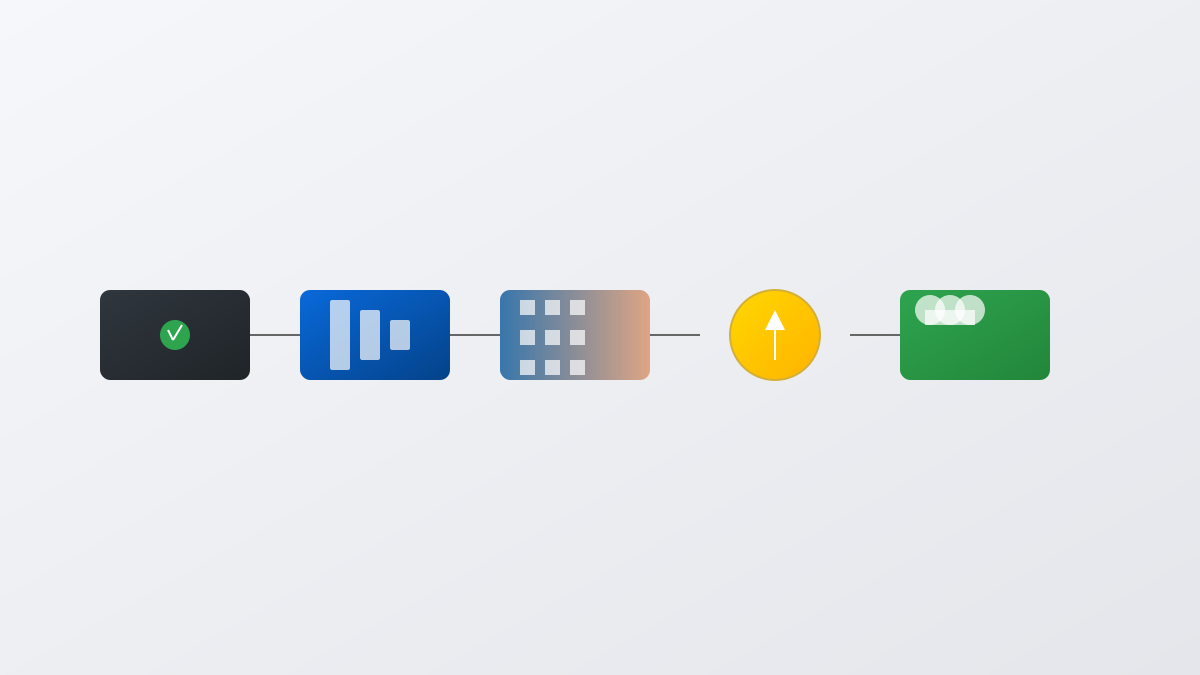
  1. Data Acquisition: Trigger Rust tools to pull the latest data and update Parquet files
  2. Model Training: Run Python scripts in the Conda environment to retrain or fine-tune the model
  3. Deployment: Push prediction results to GitHub Pages and commit new models and data to the repository

Trigger Methods

Supports scheduled triggers (cron) for regular updates and code pushes to trigger the full pipeline, suitable for time-series tasks and development debugging.

5

Section 05

Practical Value and Expansion Directions

Educational Significance

Provides complete learning resources for ML beginners from experiment to production, proving that production-grade ML systems do not require complex cloud architectures.

Production Considerations

Free quota limitations (2000 minutes per month, 2-core CPU/7GB memory) make it suitable for lightweight applications. Expansion directions include:

  • Use self-hosted runners to improve computing power
  • Integrate DVC for model version control
  • Add performance monitoring and alerts
  • Introduce an A/B testing framework
6

Section 06

Community Ecosystem and Open Source Spirit

The project uses the MIT license to encourage community contributions, with technical tags covering data-pipeline, github-actions, mlops, and other fields. In today's complex MLOps toolchain landscape, this project provides a back-to-basics option, emphasizing that technology selection should serve problem-solving rather than stacking complexity.

7

Section 07

Conclusion: Innovation and Inspiration

gha_ml_pipeline demonstrates the innovative vitality of the open source community by combining GitHub Actions with a multi-language tech stack to build a zero-cost ML system. It is not just a technical demo but also inspires developers to achieve their goals through creative thinking under resource constraints. With clear code structure and complete documentation, it is high-quality material for learning end-to-end ML engineering, recommended for MLOps beginners and teams looking for lightweight deployment solutions.

