Zing Forum

Reading

Immutable Governance Architecture: Eliminating Systemic Drift in Generative Intelligence via Isomorphic Biological Framework

This article explores the problem of systemic drift in large language models after deployment and introduces an innovative solution called the "Isomorphic Biological Framework", which ensures the long-term stability and predictability of AI systems through immutable governance mechanisms, cryptographic verification, and deterministic constraints.

生成式智能AI治理系统性漂移同构生物框架大型语言模型确定性约束密码学验证M-ROPE注意力机制AI安全
Published 2026-04-18 08:00Recent activity 2026-04-18 17:19Estimated read 6 min
Immutable Governance Architecture: Eliminating Systemic Drift in Generative Intelligence via Isomorphic Biological Framework
1

Section 01

Introduction: Immutable Governance Architecture - An Innovative Solution to Systemic Drift in Generative Intelligence

This article focuses on the problem of systemic drift in large language models (LLMs) after deployment and introduces the "Isomorphic Biological Framework" as a solution. Through immutable governance mechanisms, cryptographic verification, deterministic constraints, and other means, this framework aims to ensure the long-term stability and predictability of AI systems, providing security guarantees for AI applications in high-risk fields.


2

Section 02

Background: The Problem of Systemic Drift in Generative Intelligence

Systemic drift refers to the phenomenon where an AI system's internal state and behavioral patterns gradually deviate uncontrollably due to continuous exposure to new information and interactions during operation. Its hidden and cumulative nature may lead to catastrophic consequences in key fields such as healthcare and finance. For example, a customer service AI may give advice contrary to its design after several months of operation.

3

Section 03

Limitations of Traditional AI Governance Paradigms

Current AI governance relies on "extractive governance" with post-hoc detection and manual intervention, which has flaws such as being reactive, human-dependent, and fragmented. Moreover, proprietary APIs and closed infrastructure in cloud environments make external audits difficult, increasing governance complexity.

4

Section 04

Core Components of the Isomorphic Biological Framework

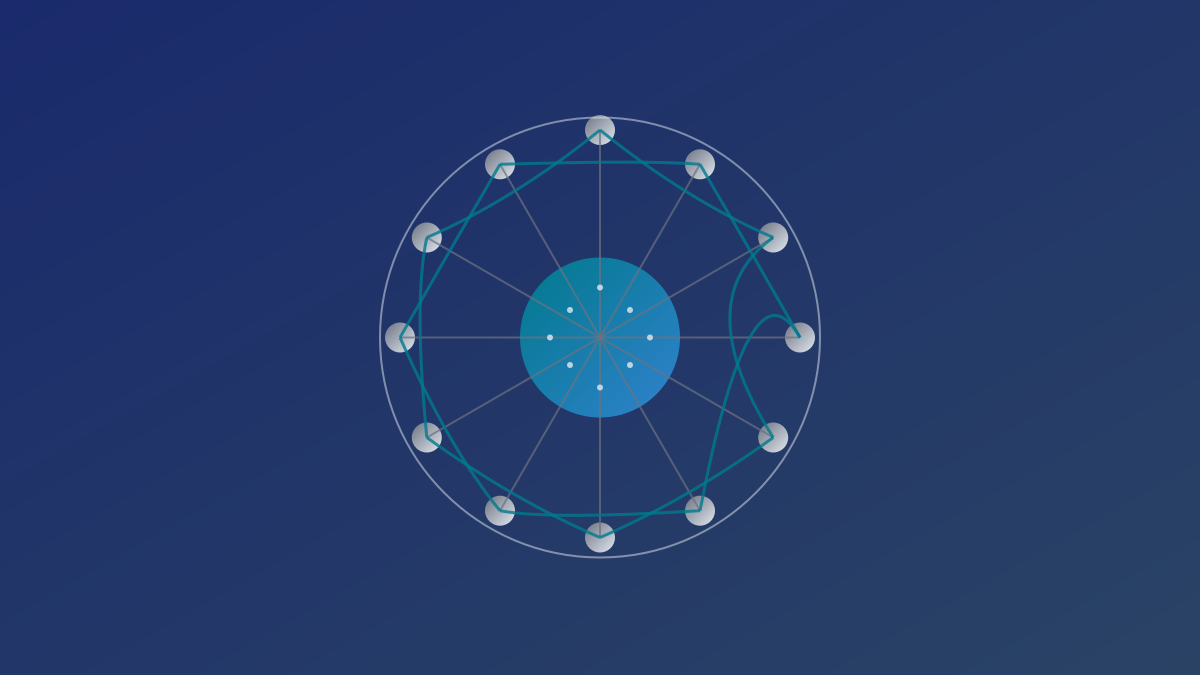
The Isomorphic Biological Framework treats AI as an "organism" with clear boundaries and a lifecycle. Its core components include: 1. Immutable Governance Layer (cryptographically encoded rules that cannot be tampered with); 2. Deterministic Execution Environment (ensures consistent output for the same input, including M-ROPE positional encoding); 3. Metabolic Attention Mechanism (attention decay to prevent information overload); 4. Verification and Proof System (formal verification to ensure behavior complies with specifications).

5

Section 05

Key Innovations in Technical Implementation

The framework's technical innovations include: 1. M-ROPE Positional Encoding (introduces a metabolic dimension to reflect information freshness and decay); 2. Probabilistic State Assertion (PSA constrains the behavior space, balancing creativity and security); 3. Balance Between Global Constraints and Local Autonomy (a layered architecture ensures core goals are not deviated from while retaining flexibility).

6

Section 06

Practical Application Scenarios of the Isomorphic Biological Framework

This framework can be applied in multiple fields: in healthcare, ensuring diagnostic AI does not deviate from medical standards; in finance, preventing trading algorithms from generating risks due to data drift; in law, ensuring contract review AI complies with regulations; in content moderation, maintaining standard consistency.

7

Section 07

Challenges and Future Research Directions

The deployment of the framework faces challenges such as high computational overhead and potential flexibility limitations due to over-constraints. Future efforts need to optimize the efficiency of verification algorithms, develop fine-grained constraint control mechanisms, explore methods to enhance adaptive capabilities, and integrate with existing AI infrastructure.

8

Section 08

Conclusion: Moving Towards a Trustworthy AI Future

Systemic drift is a core challenge for generative intelligence. The Isomorphic Biological Framework constrains uncertainty within an acceptable range through architectural design, achieving "glass-box" governance (transparent and verifiable without excessively limiting functionality), and providing guarantees for technology to serve human well-being.

