Zing Forum

Reading

Solar-Powered Irrigation: A Breakthrough for Sustainable Agriculture in Rural Africa

This article analyzes the technical feasibility and economic benefits of solar water pump irrigation systems in rural Nigeria, demonstrating their significant advantages over traditional diesel pumps in terms of cost, environmental friendliness, and sustainability.

太阳能灌溉可持续农业农村发展尼日利亚清洁能源光伏水泵粮食安全非洲农业
Published 2026-04-16 08:00Recent activity 2026-04-18 03:50Estimated read 6 min
Solar-Powered Irrigation: A Breakthrough for Sustainable Agriculture in Rural Africa
1

Section 01

Introduction: Solar Irrigation—A Breakthrough for Sustainable Agriculture in Rural Africa

Taking rural Nigeria as a case study, this article systematically evaluates the technical feasibility and economic benefits of solar water pump irrigation systems. Compared with traditional diesel pumps, they show significant advantages in cost, environmental protection, and sustainability, providing a practical path for agricultural transformation and sustainable development in Sub-Saharan Africa.


2

Section 02

Research Background: Dilemmas of Rural Irrigation in Africa and Opportunities for Solar Energy

Only 4% of farmland in Sub-Saharan Africa is equipped with irrigation systems (far below the global average of 20%), relying on seasonal rainfall which poses production risks. Traditional diesel pumps in countries like Nigeria have drawbacks such as high cost, difficult maintenance, and high emissions, while remote areas lack grid coverage. Solar photovoltaic technology does not require an external power grid and uses abundant solar resources, providing a zero-fuel, low-maintenance, and environmentally friendly solution for rural irrigation.

3

Section 03

Technical Design: Architecture of Solar Irrigation System in the Nigerian Case

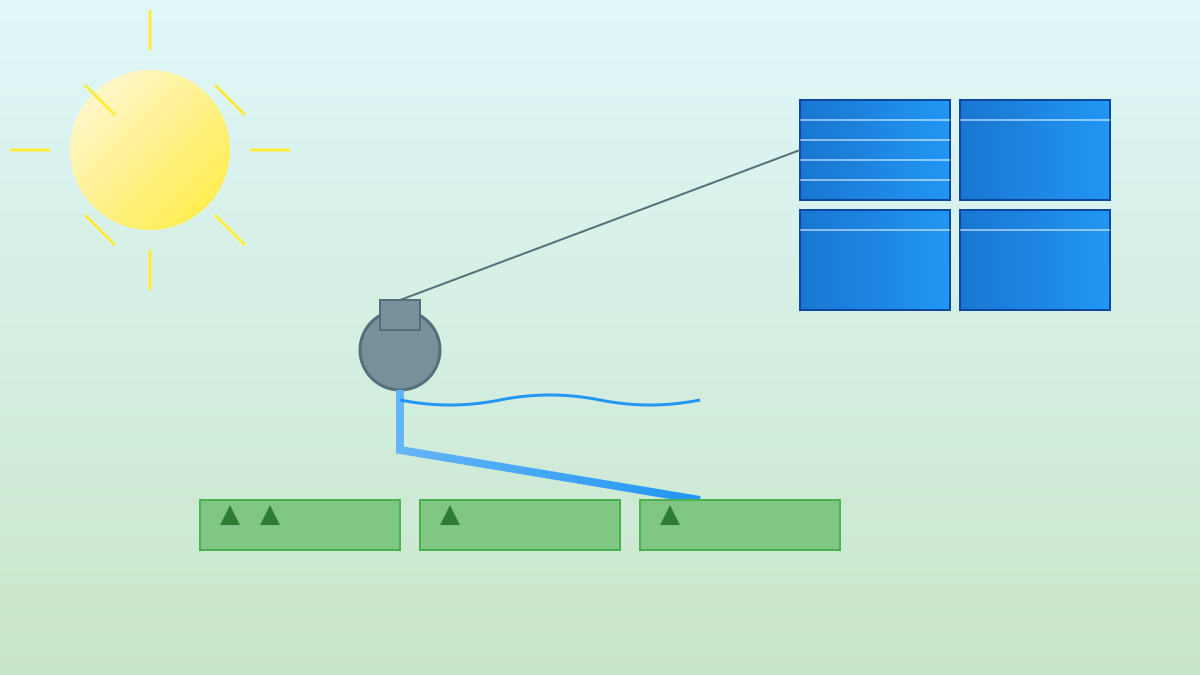
A system was deployed in a rural community in Kano State. Core components include a 9.7kW photovoltaic array (fixed tilt angle facing the equator), a centrifugal submersible pump (258m lift, 15.7 cubic meters per hour flow rate), and a water storage tank with 1.5 times the daily water consumption. It is equipped with an MPPT controller and intelligent monitoring devices, supporting remote monitoring via mobile phones.

4

Section 04

Performance Evaluation: Multi-dimensional Advantages of Solar Irrigation vs. Diesel Pumps

  • Pumping efficiency: The solar system has a reliability rate of 95%, supplying 120 cubic meters of water daily to meet the needs of 20 hectares; the diesel pump has an availability rate of only 70%.
  • Economics: Initial investment is $24,000 (vs. $15,000 for diesel pumps), lower life-cycle cost over 20 years, payback period of 5-7 years, and annual savings of $3,000-$4,000 afterward.
  • Environmental benefits: Carbon emission intensity is only 5% of that of diesel pumps, reducing 15 tons of CO₂ annually and eliminating the risk of diesel pollution.
5

Section 05

Socio-economic Impact: Positive Changes in Agricultural Yield and Community Development

  • Productivity improvement: Crop yield increases by 40%-60%, enabling multi-cropping throughout the year.
  • Labor optimization: Automation lowers barriers, promoting women's participation in irrigation management.
  • Energy awareness: Encourages farmers to install household photovoltaic systems, forming a technology diffusion effect.
6

Section 06

Promotion Barriers and Countermeasures: Breaking Through Funding, Technical, and Policy Bottlenecks

  • Funding: It is recommended that international institutions provide preferential loans, governments set up subsidy funds, and explore leasing/pay-per-water-use models.
  • Technology: Train local technicians and set up service outlets for equipment suppliers.
  • Policy: Simplify approval processes, improve technical standards, and integrate into national agricultural strategies.
7

Section 07

Future Directions: Innovative Evolution of Solar Irrigation Technology

  • Energy storage integration: Equip lithium batteries to provide power at night or on cloudy days.
  • Intelligent precision: Integrate sensors and models to automatically adjust irrigation plans.
  • Multi-energy complementation: Wind-solar hybrid systems improve power supply stability.
8

Section 08

Conclusion: The Value of Solar Irrigation in Promoting Sustainable Agricultural Development in Africa

This study proves the feasibility and superiority of solar irrigation, providing a green path for agricultural transformation in Africa. Policy, funding, and capacity building need to be coordinated to promote widespread application, helping to achieve food security and carbon neutrality goals.