Zing Forum

Reading

How Digital Twin Technology Reshapes the Resilience of Building Energy Systems: A New Paradigm from Optimization to Self-Healing

This article explores a self-healing digital twin framework for building energy systems under climate stress, which takes stability maintenance as its core goal. Through the synergy of physics-informed models, data assimilation, and model predictive control, it achieves energy consumption reduction and thermal comfort guarantee under extreme conditions such as heatwaves.

数字孪生建筑能源系统模型预测控制稳定性保持自愈系统数据同化物理信息神经网络气候韧性热浪应对智能建筑
Published 2026-04-08 08:00Recent activity 2026-04-09 21:32Estimated read 5 min
How Digital Twin Technology Reshapes the Resilience of Building Energy Systems: A New Paradigm from Optimization to Self-Healing
1

Section 01

Introduction: A New Paradigm for Reshaping Building Energy System Resilience via Digital Twin Technology

This article discusses a self-healing digital twin framework for building energy systems under climate stress, with stability maintenance as the core goal. Through the synergy of physics-informed models, data assimilation, and model predictive control, it achieves energy consumption reduction and thermal comfort guarantee under extreme conditions, promoting a paradigm shift from 'optimization priority' to 'resilience priority'.


2

Section 02

Background: Dilemmas of Traditional Building Energy Systems Under Extreme Climate

The frequency of global extreme weather events is increasing. Traditional building energy management systems, which focus on optimization, expose vulnerabilities under extreme conditions: model mismatch amplifies errors, sensor drift and disturbances lead to hidden degradation, and the lack of explicit consideration of stability makes them prone to unstable states. Existing digital twin research mostly focuses on optimization, ignoring the problem of stability maintenance under extreme conditions.

3

Section 03

Methodology: Design of a Self-Healing Digital Twin Framework for Stability Maintenance

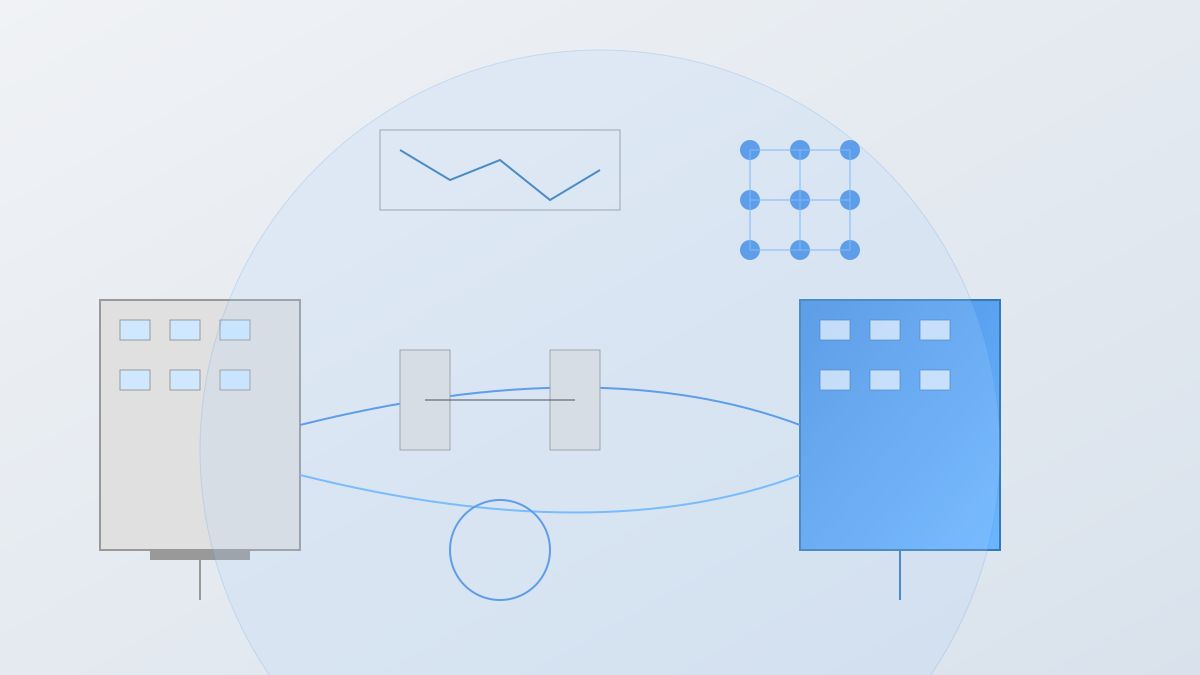
The new framework takes stability maintenance as its primary goal and includes three key layers: 1. Physics-informed neural networks integrate prior knowledge such as heat conduction equations with data-driven approaches, balancing flexibility and physical consistency; 2. Data assimilation technology continuously fuses sensor data to correct model parameters, enabling online adaptation; 3. Closed-loop intervention with stability constraints ensures that control actions keep the system state within a stable region.

4

Section 04

Evidence: Experimental Verification Results Under Heatwave Scenarios

Experiments in heatwave scenarios show: total energy consumption reduced by 11.2%, thermal comfort violation time reduced by 56.2%; stable operation was maintained under multi-compound disturbance scenarios; ablation experiments indicate that data assimilation contributed the most, followed by physics-informed modeling, and stability constraints improved reliability (with a slight loss of optimality).

5

Section 05

Technical Details: Three-Layer Implementation Mechanism of Self-Healing Capability

The self-healing capability is divided into three layers: 1. Detection layer: monitors residuals between the physical system and the virtual model, identifies anomalies when thresholds are exceeded; 2. Diagnosis layer: estimates the type, location, and severity of anomalies through data assimilation; 3. Repair layer: achieves adaptive repair via online parameter updates, control strategy adjustments, or logic reconstruction.

6

Section 06

Conclusion and Outlook: Practical Significance and Future Research Directions

Practical significance: provides proactive adaptation solutions for building energy systems under climate uncertainty, and offers references for resilience design in fields such as power grids and transportation; future directions: explore issues like coordinated control of building clusters, trade-offs among multiple stakeholders, and integration of human experience into automated decision-making.

