Zing Forum

Reading

Exoplanet Detection: Analyzing Kepler Telescope Time-Series Data with Convolutional Neural Networks

An open-source project for automatic exoplanet detection using convolutional neural networks based on Kepler mission light curve data

exoplanetKeplerCNNtime-seriesastronomymachine-learninglight-curve
Published 2026-06-03 01:14Recent activity 2026-06-03 01:22Estimated read 5 min
Exoplanet Detection: Analyzing Kepler Telescope Time-Series Data with Convolutional Neural Networks
1

Section 01

[Introduction] Open-Source Project for Exoplanet Detection: Analyzing Kepler Time-Series Data with CNN

ExoPlanet-Detection is an open-source project that implements automatic exoplanet detection using Convolutional Neural Networks (CNN) based on light curve data from the Kepler Telescope. This project applies deep learning technology to astrophysics, providing efficient automated tools for analyzing massive astronomical data and supporting exoplanet research.


2

Section 02

Background: Needs and Challenges of Exoplanet Detection

Since the discovery of the first exoplanet in 1995, the transit method has become the main detection method for telescopes like Kepler. However, manual analysis of the massive light curve data generated by Kepler (tens of thousands of stars, years of observations) is difficult to complete, so machine learning technology is urgently needed to solve this problem.

3

Section 03

Core Method: Application of CNN in Light Curve Analysis

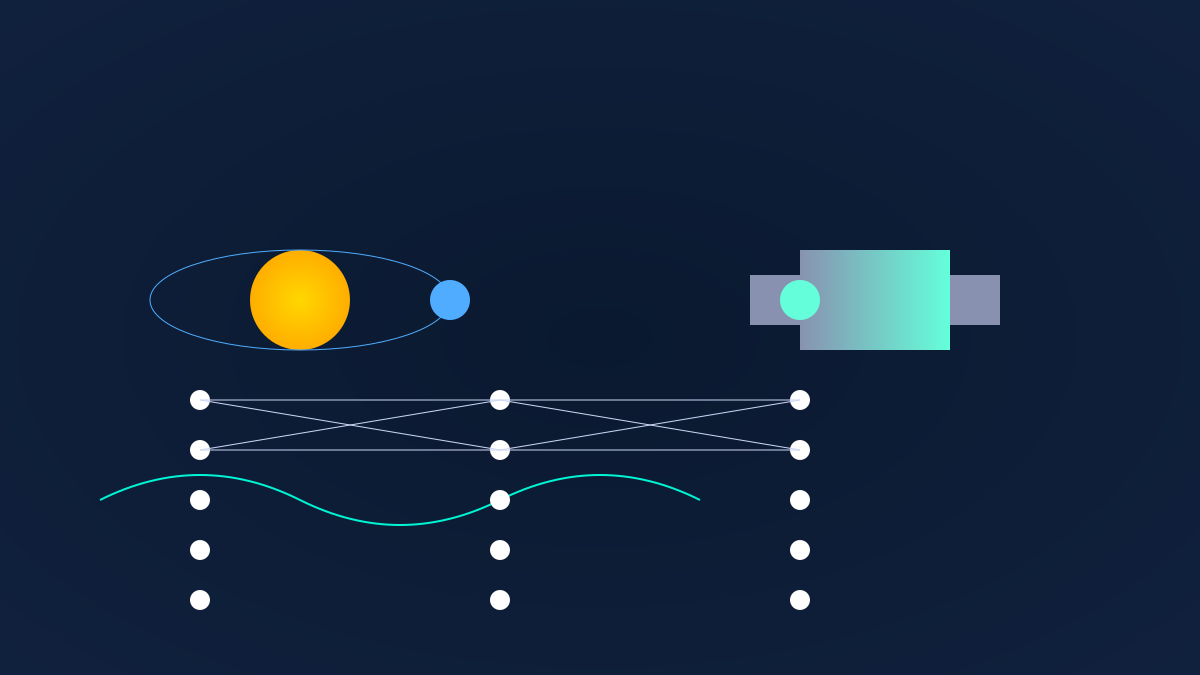
Kepler light curves record changes in stellar brightness. Transit events cause periodic brightness dips (usually less than 1%), but the data has issues like noise and outliers. CNN can automatically learn transit signal features (such as U-shaped/V-shaped dips), which is more robust than manual feature engineering and suitable for large-scale data processing.

4

Section 04

Project Structure and Implementation Workflow

The project includes modules such as data acquisition (01_descarga.py), preprocessing (02_preprocesar.py), model training (03_entrenamiento.py, ExoNet.py), experimental analysis (multiple Notebooks like Shallue_model.ipynb), and hyperparameter optimization (Optuna framework), covering the complete MLOps workflow.

5

Section 05

Technical Highlights and Innovations

  1. Draws on the groundbreaking work of Google researchers in 2018; 2. Explores models combining wavelet transform and time-frequency analysis; 3. Follows good machine learning engineering practices, such as data separation, version control, and hyperparameter tracking.
6

Section 06

Practical Application Value

  1. Assists astronomers in quickly screening high-confidence candidate planets; 2. May discover weak-signal planets missed by traditional methods (e.g., Kepler-90i); 3. Experience can be applied to data analysis of next-generation telescopes like TESS.
7

Section 07

Challenges and Limitations of the Project

  1. Data class imbalance (positive samples are far fewer than negative samples); 2. False positive problem (non-planetary phenomena easily produce similar transit signals); 3. Machine learning results require manual verification by professional astronomers.
8

Section 08

Summary and Future Outlook

This project demonstrates the potential of machine learning in astronomical research and provides an efficient tool for exoplanet detection. With the commissioning of facilities like JWST, machine learning will play a greater role in planetary atmosphere characterization and habitable world search, and this open-source project provides an entry reference for developers and researchers.

