Zing Forum

Reading

Predicting Mental Health with Neural Networks: An Open-Source Project for Questionnaire-Based Depression, Anxiety, and Stress Assessment

This article introduces an open-source machine learning project that uses neural network models to predict depression, anxiety, and stress levels based on users' questionnaire responses. It analyzes the project's technical architecture, data processing methods, and practical application value.

机器学习神经网络心理健康抑郁预测焦虑评估MLP问卷分析开源项目
Published 2026-05-02 00:13Recent activity 2026-05-02 00:23Estimated read 6 min
Predicting Mental Health with Neural Networks: An Open-Source Project for Questionnaire-Based Depression, Anxiety, and Stress Assessment
1

Section 01

[Introduction] Core Overview of the Open-Source Project for Predicting Mental Health with Neural Networks

This article introduces the open-source project named mental-health-project on GitHub, released by developer tasneem33355. It uses neural network models to predict users' depression, anxiety, and stress levels based on responses to the standardized DASS-21 questionnaire. The project provides a complete pipeline from data processing to model training and an interactive prediction interface, aiming to address issues such as traditional mental health assessments relying on professionals, long cycles, and poor accessibility, thus offering practical references for the intelligentization of mental health screening.


2

Section 02

Project Background: Current Status and Problem Definition of Mental Health Assessment

Over 280 million people worldwide are affected by depression, and the prevalence of anxiety disorders is equally severe. Traditional assessments rely on face-to-face interviews, facing bottlenecks such as a shortage of professionals. The project builds a model based on the DASS-21 scale (21 questions, divided into three dimensions: depression, anxiety, and stress, with a four-level rating). The core hypothesis is that the pattern of questionnaire responses contains regularities that can be captured by the model, and prediction is achieved by learning the mapping relationship of labeled samples.

3

Section 03

Technical Architecture: Data Processing, Model Design, and Interactive Interface

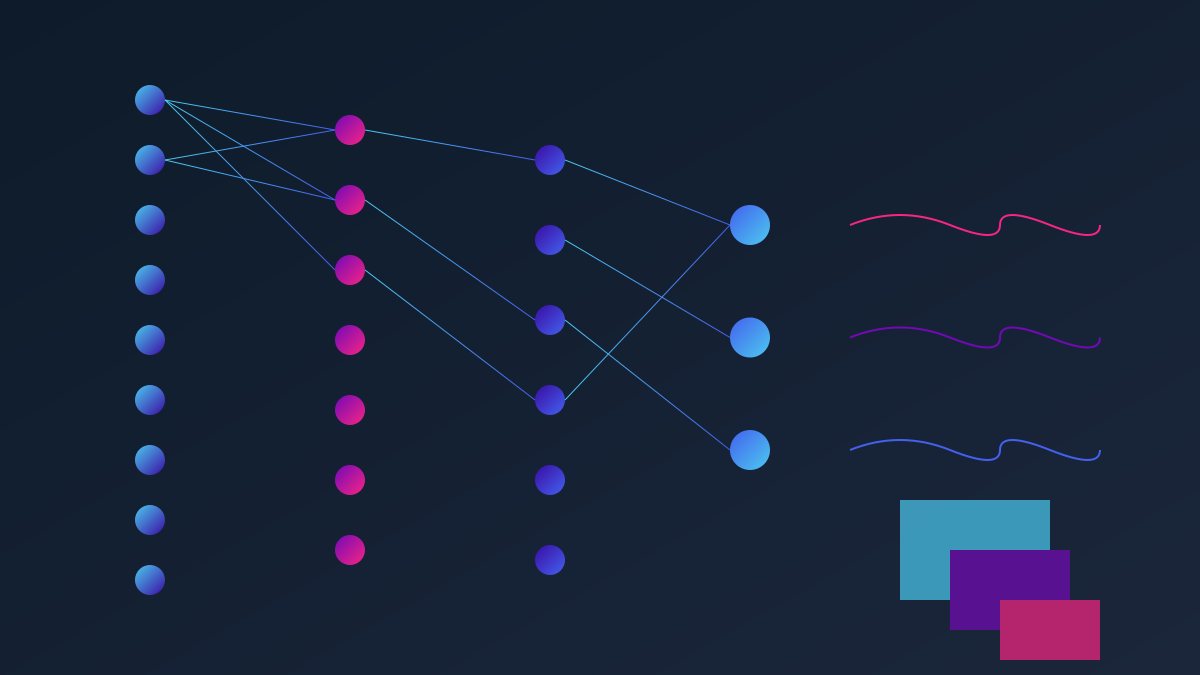
Data Processing: Clean missing/abnormal values, feature encoding (retain rank order or one-hot encoding), split into 80/20 training and test sets, and cross-validation can be introduced. Model Design: Use a Multi-Layer Perceptron (MLP), where the input layer receives preprocessed features, the hidden layer uses ReLU activation, and the output layer performs multi-task learning to predict three dimensions simultaneously; Adam optimizer is used for training, and Dropout and early stopping are applied to prevent overfitting. Interactive Interface: Provide a user-friendly interface, allowing non-technical users to answer the questionnaire and get intuitive prediction results, lowering the threshold for use.

4

Section 04

Model Evaluation: Key Metrics and Performance Analysis

Evaluation metrics include accuracy, precision, recall, and F1 score, among which recall is crucial for screening scenarios (the consequences of missed detection are more serious). Since mental health levels are continuously distributed, it is necessary to examine the performance at different levels; the confusion matrix can show the classification performance at each level, helping to optimize the weak links of the model.

5

Section 05

Ethical Considerations: Usage Boundaries and Privacy Protection

This tool is only for preliminary screening and cannot replace professional diagnosis; it is necessary to strictly comply with data privacy regulations to ensure that user data collection and storage comply with the principle of informed consent; attention should be paid to fairness issues caused by training data bias to avoid low prediction accuracy for some groups.

6

Section 06

Application Prospects and Expansion Directions

Application Scenarios: Can be deployed on corporate health platforms, school psychological systems, and community health institutions as a preliminary screening tool. Improvement Directions: Introduce Transformer to capture the dependency between questions; combine NLP to analyze free text; integrate multi-modal data such as voice/facial expressions/physiological signals; develop longitudinal tracking functions to monitor state changes.

7

Section 07

Summary: Project Value and Future Challenges

The project demonstrates the complete process of building a mental health prediction tool using neural networks and provides clear and reproducible practical references. Although it faces challenges such as accuracy verification, ethical compliance, and fairness assurance, it opens up an exploration path for the intelligentization and universalization of mental health services, and is a valuable starting point for AI applications in the public health field.

