Zing Forum

Reading

Persian Traffic Sign Recognition: A Computer Vision Application Based on Convolutional Neural Networks

This article introduces a Persian traffic sign recognition system based on convolutional neural networks and discusses the application of computer vision technology in the fields of autonomous driving assistance and intelligent transportation.

交通标志识别卷积神经网络计算机视觉自动驾驶深度学习智能交通
Published 2026-05-20 23:13Recent activity 2026-05-20 23:29Estimated read 16 min
Persian Traffic Sign Recognition: A Computer Vision Application Based on Convolutional Neural Networks
1

Section 01

[Introduction] Persian Traffic Sign Recognition: Application of CNN in Intelligent Transportation and Autonomous Driving

This article introduces a Persian traffic sign recognition system based on convolutional neural networks (CNN) and discusses the application value of computer vision technology in the fields of autonomous driving assistance and intelligent transportation. The project designs and trains models targeting the characteristics of traffic signs in Persian-speaking regions, analyzes the technical architecture, implementation details, application scenarios, and future development directions, providing a practical case for traffic sign recognition in specific regions.

2

Section 02

Background: The Critical Significance of Traffic Sign Recognition for Intelligent Transportation and Autonomous Driving

Background: The Importance of Traffic Sign Recognition

Traffic sign recognition is one of the key applications of computer vision in intelligent transportation systems and autonomous driving. Accurate recognition of road traffic signs is crucial for driving safety, as it helps drivers and autonomous driving systems understand road rules, comply with speed limits, pay attention to dangerous sections, and follow navigation instructions.

With the development of autonomous driving technology, traffic sign recognition systems not only need high accuracy but also real-time performance, being able to quickly process images captured by cameras when vehicles are moving at high speeds. The rise of deep learning, especially convolutional neural networks (CNN), has brought revolutionary progress to traffic sign recognition, enabling systems to handle complex road scenes and diverse types of signs.

3

Section 03

Technical Architecture: Application of CNN in Traffic Sign Recognition and Challenge Mitigation

Technical Architecture Analysis

Basics of Convolutional Neural Networks

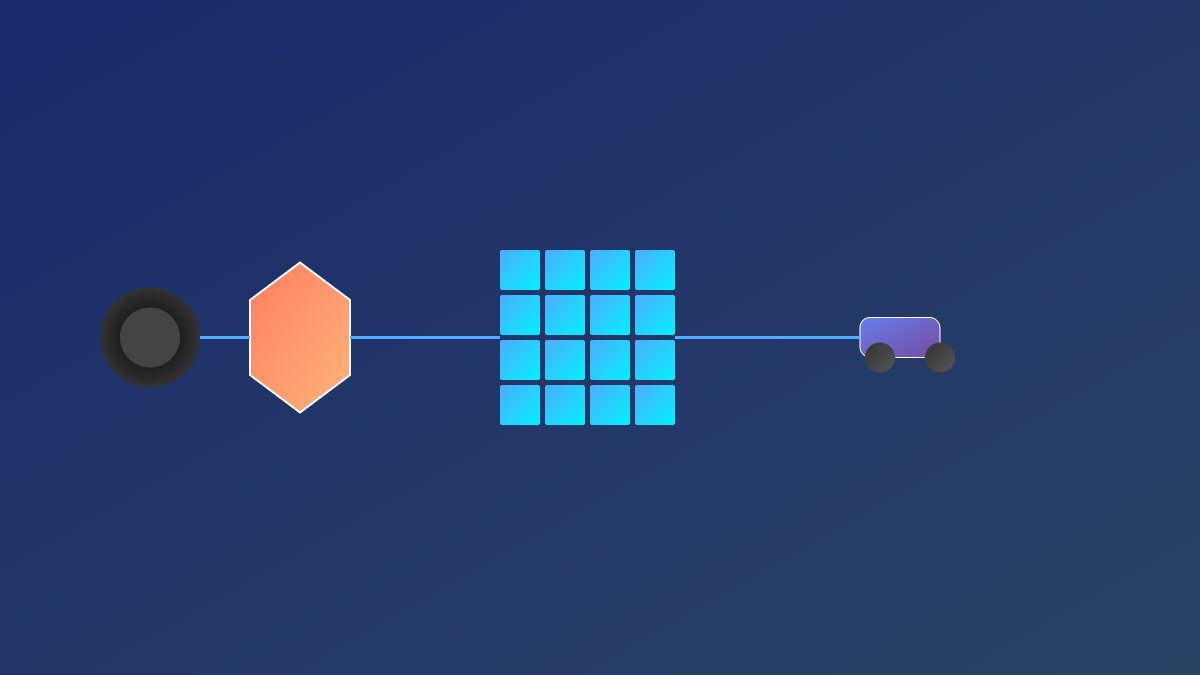
Convolutional neural networks are one of the most successful architectures in deep learning, especially suitable for processing image data. The core components of CNN include:

  • Convolutional layers: Extract local features such as edges, textures, and shapes by sliding convolution kernels over images
  • Activation functions: Introduce non-linearity to enable the network to learn complex patterns
  • Pooling layers: Reduce the size of feature maps, decrease computational load, and enhance translation invariance
  • Fully connected layers: Map extracted features to final classification results

For traffic sign recognition tasks, CNN can automatically learn visual features of signs, such as shape features (circles, triangles, rectangles) and color features (red, blue, yellow).

Special Challenges in Traffic Sign Recognition

Traffic sign recognition tasks face unique challenges:

  • Scale variation: The size of signs in images changes with distance, from small targets far away to large targets nearby
  • Perspective change: Different shooting angles cause shape distortion of signs
  • Lighting variation: Lighting differences under different times and weather conditions affect image quality
  • Occlusion and damage: Some signs may be blocked by trees or have surface damage
  • Complex background: Road scenes are complex, requiring distinction between signs and background
  • Class imbalance: Some sign types appear much less frequently than others

Data Augmentation Strategies

To address the above challenges, the project may adopt various data augmentation techniques:

  • Geometric transformations: Rotation, translation, scaling, shearing to simulate different perspectives and distances
  • Color transformations: Adjust brightness, contrast, saturation to simulate different lighting conditions
  • Noise addition: Add Gaussian noise, salt-and-pepper noise to enhance robustness
  • Random occlusion: Simulate partial occlusion situations

Model Architecture Selection

Traffic sign recognition can use various CNN architectures:

  • Classic architectures: LeNet, AlexNet, VGG, etc., suitable as baseline models
  • Efficient architectures: ResNet, MobileNet, EfficientNet, etc., balancing accuracy and computational efficiency
  • Lightweight architectures: SqueezeNet, ShuffleNet, etc., suitable for embedded device deployment

For practical deployment, a trade-off between accuracy and inference speed may be needed to select a model suitable for the target platform.

4

Section 04

The Uniqueness of Persian Traffic Signs and Dataset Challenges

Characteristics of Persian Traffic Signs

Persian (Farsi) is the official language of Iran, Afghanistan, Tajikistan, and other countries, using the Persian-Arabic script. Persian traffic signs have the following characteristics:

Text content: Many traffic signs contain Persian text descriptions, such as street names, distance indicators, and warning messages. This requires the recognition system to not only identify graphic symbols but also handle text recognition tasks.

Cultural differences: The meaning of some signs may vary by regional culture, so the model needs to be trained according to the sign specifications of specific regions.

Dataset scarcity: Compared to traffic sign datasets from English-speaking countries (e.g., Germany's GTSRB, Belgium's BTSC), annotated datasets for Persian traffic signs are relatively scarce, and self-collection and annotation may be required.

5

Section 05

Technical Implementation: Dataset Construction and Model Training Evaluation

Technical Implementation Details

Dataset Construction

Building a high-quality traffic sign dataset is key to the project's success. The dataset construction process includes:

  • Data collection: Collect traffic sign images using on-board cameras or web crawlers
  • Data cleaning: Remove blurry or severely occluded images to ensure data quality
  • Data annotation: Annotate the category and bounding box position for each image
  • Category division: Classify traffic signs into categories such as speed limits, prohibitions, warnings, and directions

Model Training

The model training process includes:

  • Pre-training: Use large datasets like ImageNet to pre-train the model and learn general visual features
  • Transfer learning: Fine-tune the pre-trained model on the traffic sign dataset to adapt to specific tasks
  • Hyperparameter tuning: Adjust hyperparameters such as learning rate, batch size, and optimizer
  • Regularization: Use techniques like Dropout and weight decay to prevent overfitting

Evaluation Metrics

Evaluation metrics for traffic sign recognition systems include:

  • Classification accuracy: The proportion of correctly recognized sign categories
  • Precision and recall: Evaluate the recognition performance of each category
  • F1 score: Comprehensively consider precision and recall
  • Inference speed: Time taken by the model to process a single image, crucial for real-time applications
  • Model size: Affects the feasibility of deployment on embedded devices
6

Section 06

Application Scenarios: Multiple Values of Persian Traffic Sign Recognition

Application Scenarios and Values

The Persian traffic sign recognition system has multiple application values:

Autonomous driving assistance: As a perception module of autonomous driving systems, it recognizes road signs in real time to assist decision-making

Advanced Driver Assistance Systems (ADAS): Deployed on traditional vehicles to remind drivers of speed limits, parking signs, etc.

Intelligent traffic management: Used in traffic monitoring cameras to automatically identify violations and count traffic flow

Map update: Collect road sign information through crowdsourcing to assist in updating and maintaining map data

Driving training: Used in driving simulators to evaluate trainees' ability to recognize traffic signs

7

Section 07

Limitations, Improvement Directions, and Future Outlook

Limitations and Improvement Directions

Current limitations:

  • Dataset size: Compared to large public datasets, self-built datasets may have limited scale
  • Scene coverage: Training data may not cover all road scenes and weather conditions
  • Real-time performance: May struggle to meet real-time performance requirements on resource-constrained embedded devices

Improvement directions:

  • Data expansion: Collect more data, especially samples under extreme conditions
  • Multi-task learning: Perform detection and recognition simultaneously to improve end-to-end performance
  • Model optimization: Use techniques like model quantization and pruning to compress the model and improve inference speed
  • Continuous learning: Design incremental learning mechanisms to enable the model to adapt to new sign types

Future Development Directions

Traffic sign recognition technology can develop in the following directions:

Multi-language support: Expand to traffic sign recognition in other language regions and build a universal multi-language recognition system

End-to-end detection: Directly detect and recognize signs from images without predefined regions of interest

Multi-modal fusion: Combine multi-source information such as GPS, map data, and LiDAR to improve recognition reliability

Edge deployment: Optimize the model to adapt to the computational resource constraints of on-board embedded devices

Adversarial robustness: Improve the model's resistance to adversarial examples to prevent malicious attacks

8

Section 08

Conclusion: Practical Significance of CNN Technology in Persian Traffic Sign Recognition

Conclusion

The Persian traffic sign recognition project demonstrates the application of convolutional neural networks in domain-specific computer vision tasks. By designing and training models for the characteristics of Persian traffic signs, the project contributes a valuable practical case to intelligent transportation systems and autonomous driving technology. With the continuous progress of deep learning technology and the upgrade of computing hardware, traffic sign recognition systems will become more accurate, efficient, and popular, providing solid technical support for road safety and smart mobility.


