Zing Forum

Reading

Neural Network Efficiency Optimization: A Comprehensive Solution Combining Pruning, Compression, and Causality Analysis

An open-source project that improves neural network efficiency through neuron pruning, model compression, and Granger causality analysis

神经网络模型剪枝模型压缩格兰杰因果深度学习效率优化边缘计算
Published 2026-05-19 17:44Recent activity 2026-05-19 17:52Estimated read 6 min
Neural Network Efficiency Optimization: A Comprehensive Solution Combining Pruning, Compression, and Causality Analysis
1

Section 01

Comprehensive Solution for Neural Network Efficiency Optimization: Pruning, Compression, and Causality Analysis

This open-source project focuses on neural network efficiency optimization. It reduces computational overhead while maintaining performance through three complementary technical approaches: neuron pruning, model compression, and Granger causality analysis. It is suitable for resource-constrained scenarios such as edge devices and mobile applications, providing a systematic solution for deep learning engineering.


2

Section 02

Background: Efficiency Dilemma of Deep Learning Models

The number of parameters in deep learning models has increased dramatically (e.g., the GPT series from hundreds of millions to hundreds of billions), leading to high training and inference costs. They face severe challenges in edge devices, mobile applications, and real-time systems. How to reduce computational overhead while maintaining performance has become a core issue, with pruning, quantization, and knowledge distillation being the mainstream optimization directions.

3

Section 03

Core Method 1: Neuron Pruning Strategy

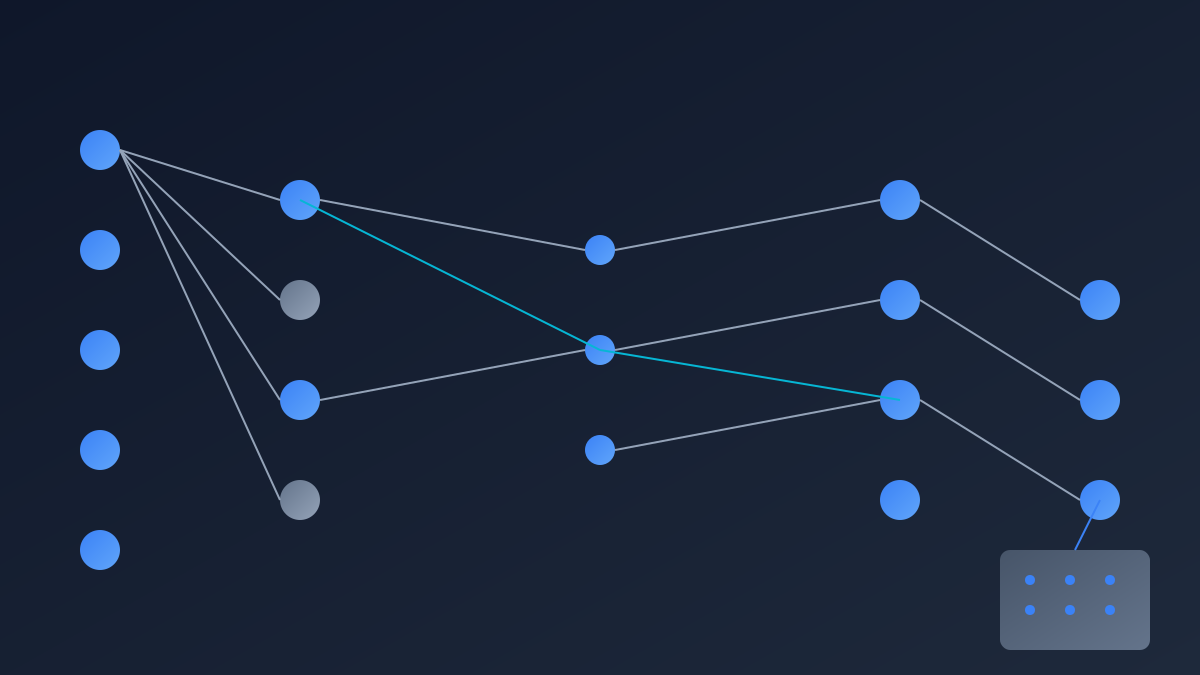
Pruning improves efficiency by removing redundant connections and neurons. The project implements both structured pruning (removing filters/channels, which is conducive to hardware acceleration) and unstructured pruning (individual weights, high compression ratio but requires specialized hardware). It uses an importance-based scoring mechanism to prioritize removing neurons with low contribution to the output.

4

Section 04

Core Method 2: Multi-dimensional Model Compression Techniques

In addition to pruning, the project explores compression techniques such as weight quantization (converting 32-bit to 8-bit or lower to reduce storage and computation), low-rank decomposition, and knowledge distillation (small student networks imitating large teacher networks) to slim down models while maintaining performance.

5

Section 05

Core Method 3: Innovative Application of Granger Causality Analysis

This is a distinctive innovation of the project: evaluating neuron importance from the perspective of time series prediction—if removing a neuron leads to a significant drop in prediction ability, it has a causal impact. Its advantage lies in capturing dynamic dependencies, enabling more accurate identification of key neurons in time-series models such as recurrent neural networks.

6

Section 06

Technical Implementation: Experimental Framework and Multi-dimensional Evaluation

It provides a complete experimental framework that supports mainstream architectures. Users can configure parameters such as pruning ratio and compression targets, and it automatically executes the iterative process of pruning-fine-tuning-evaluation. Evaluation metrics include multi-dimensional indicators such as parameter compression ratio, FLOPs reduction ratio, inference latency, and accuracy retention, helping users balance the needs of different scenarios.

7

Section 07

Application Scenarios and Value: From Mobile to Green AI

It has wide application value, including mobile deployment (compressing large models to mobile/IoT devices), real-time inference (reducing latency to meet online services), edge computing (running AI in resource-constrained environments), and green AI (reducing energy consumption and carbon footprint).

8

Section 08

Project Insights: Efficiency Optimization is a Systems Engineering

It demonstrates a systematic approach to efficiency optimization, which is an essential skill for developers to deploy models to production environments. The application of Granger causality analysis reflects the combination of academic frontier and engineering, providing new ideas for pruning research. Efficiency optimization requires understanding model structure, hardware characteristics, and application requirements, and this project provides a good starting point.

