Zing Forum

Reading

Predicting Bank Customer Churn Using Artificial Neural Networks: A Complete Practice from Data to Deployment

This article delves into how to build an artificial neural network-based bank customer churn prediction system, covering the entire process from data preprocessing, feature engineering, model construction, training optimization to practical business applications.

客户流失预测人工神经网络机器学习深度学习金融科技数据挖掘客户保留银行业务神经网络预测模型
Published 2026-05-05 03:13Recent activity 2026-05-05 03:18Estimated read 6 min
Predicting Bank Customer Churn Using Artificial Neural Networks: A Complete Practice from Data to Deployment
1

Section 01

Introduction: A Complete Practice of Predicting Bank Customer Churn with Artificial Neural Networks

This article focuses on predicting bank customer churn using artificial neural networks (ANN), covering the entire process from data preprocessing, feature engineering, model construction to deployment and monitoring. In the financial industry, the cost of customer churn is far higher than the cost of retention. ANN has become an effective tool for accurate prediction because it can capture complex nonlinear relationships. This article will detail the practical points of each link to help build an efficient prediction system.


2

Section 02

Background and Business Value

Customer churn is a severe challenge for banks: the cost of acquiring new customers is 5-25 times that of retaining existing ones. Losing high-value customers not only leads to revenue loss but also may spread negative word-of-mouth. Traditional strategies rely on experience or simple statistics, which are difficult to handle massive data and complex behavior patterns. The introduction of ANN technology provides new possibilities for identifying high-risk customers.

3

Section 03

Data Preparation and Model Architecture Design

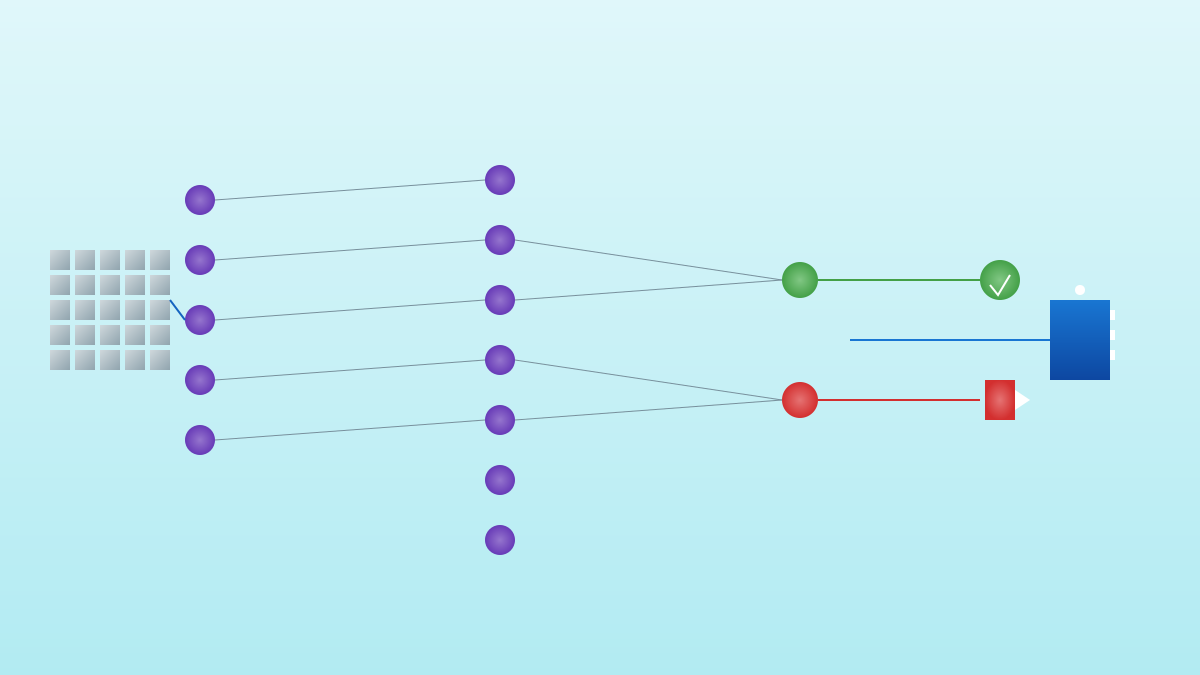
Data preparation includes various types of information: demographic features (age, gender), account information (account opening duration, balance), transaction behavior (frequency, amount), and interaction history (number of customer service contacts, complaints). Data cleaning needs to handle missing values (mean/median imputation or removal) and outliers; categorical variables are converted using one-hot encoding or embedding layers. In terms of feature engineering, time-series features (such as transaction change rates in the past 3/6/12 months), ratio features (balance to monthly income ratio), and interaction features (young customers + high balance, etc.) can improve model performance. The neural network architecture usually includes an input layer (feature dimension), 2-3 hidden layers (neurons decreasing layer by layer, e.g., 128→64→32), and an output layer (Sigmoid activation to output probability). The hidden layers use ReLU to alleviate gradient vanishing.

4

Section 04

Model Training and Optimization Strategies

Model training uses the binary cross-entropy loss function and Adam optimizer (combining momentum and adaptive learning rate). Learning rate scheduling strategy: initial large learning rate for fast convergence, then gradually decrease; early stopping to prevent overfitting. For class imbalance (low proportion of churned customers), SMOTE oversampling, majority class undersampling, or loss function weighting can be used.

5

Section 05

Model Evaluation, Deployment, and Ethical Considerations

Evaluation metrics should avoid relying on accuracy and instead use precision, recall, F1 score, and AUC-ROC. In business, the cost of false negatives is higher, so adjustments are needed to improve recall. Interpretability tools (SHAP, LIME) help understand the prediction logic. Deployment methods: real-time prediction (risk score displayed in the customer service center), batch prediction (generating high-risk lists). It is necessary to continuously monitor model performance and retrain regularly. Ethically, strictly comply with privacy regulations (differential privacy), ensure model fairness and avoid discrimination; explain decision-making basis to customers to build trust.

6

Section 06

Conclusion and Future Outlook

ANN provides a powerful tool for bank customer churn prediction, but successful implementation requires the combination of technology and business, as well as continuous optimization. In the future, combining natural language processing to analyze customer feedback and graph neural networks to identify social influence nodes can further improve prediction capabilities and help financial institutions compete digitally.

