Zing Forum

Reading

High-Precision Social Bot Detection System Integrating Language Models and Graph Neural Networks

This article introduces a multimodal social bot detection system combining LightGBM, Transformer language models, and graph neural networks, achieving a detection accuracy of over 97% and providing a complete visual analysis platform.

社交机器人检测图神经网络TransformerLightGBM机器学习社交媒体安全多模态融合
Published 2026-05-03 21:15Recent activity 2026-05-03 21:26Estimated read 6 min
High-Precision Social Bot Detection System Integrating Language Models and Graph Neural Networks
1

Section 01

【Main Floor】Guide to the High-Precision Social Bot Detection System Integrating Language Models and Graph Neural Networks

This article introduces a multimodal social bot detection system combining LightGBM, Transformer language models, and graph neural networks. The system achieves a detection accuracy of over 97% and provides a complete visual analysis platform. It aims to address the problem that traditional single-model detection methods struggle to handle complex bot behavior patterns, comprehensively evaluating account authenticity from three dimensions: content, relationships, and statistical features.


2

Section 02

Background and Motivation: Harm of Social Bots and Limitations of Traditional Detection Methods

Automated bot accounts (Social Bots) in social media affect the online ecosystem and can be used to spread false information, manipulate public opinion, and interfere with elections, etc. Traditional detection methods based on rules or single machine learning models struggle to handle increasingly complex bot behavior patterns. Therefore, developing a high-precision detection system that comprehensively utilizes text content, behavioral features, and social relationships has important practical significance.

3

Section 03

System Architecture and Key Technology Implementation

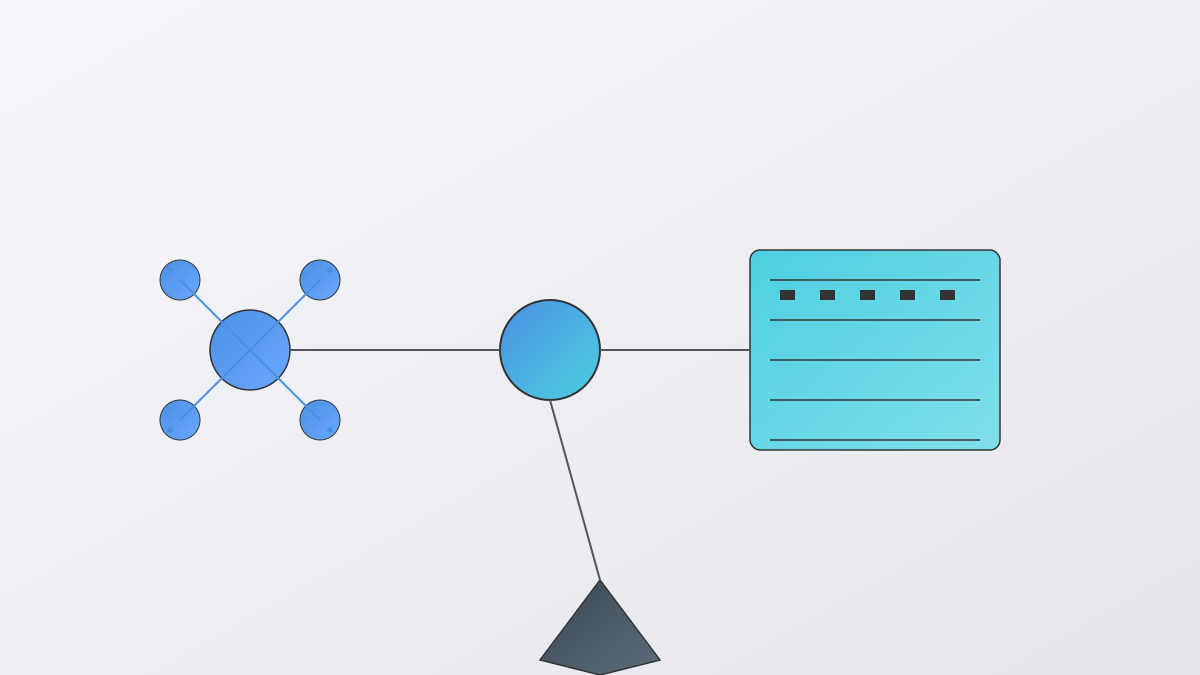
The system is named LGB, and its core innovation is the integration of three technologies: Transformer language model (deeply understanding the semantic features of user content), Graph Neural Network (GNN, modeling user social relationship networks), and LightGBM gradient boosting framework (integrating multi-source features for final classification decisions). The technical implementation includes: using pre-trained Transformer to extract deep semantic features of text; learning user node embeddings through GNN to transform social network structure information; extracting more than 25 traditional features (account metadata, behavioral patterns, content statistics) and fusing them with deep learning features to input into LightGBM.

4

Section 04

Application System Functions: Complete Web Application Toolchain

The project builds a complete web application, including: user dashboard (visualizing detection results, risk scores, historical tracking); real-time analysis (instant detection of specified Twitter accounts and returning reports); batch processing (importing account lists for large-scale screening); management backend (model performance monitoring, false positive feedback collection, system configuration management).

5

Section 05

Performance: Verification and Optimization of Over 97% Accuracy

The system's accuracy has remained stable at over 97% in tests on multiple public datasets, significantly outperforming single-model baselines. The results are attributed to: refined feature engineering to mine human-machine difference signals; multi-model integration to reduce the bias and variance of single models; and a continuous feedback learning mechanism to support model self-iteration.

6

Section 06

Practical Application Scenarios: Multi-Domain Risk Control and Analysis Tool

The detection system can be deployed in various scenarios: social platform risk control (account registration and activity monitoring); public opinion analysis (filtering bot interference in hot events to obtain real public opinion); academic research (data cleaning in computational social sciences); brand protection (identifying malicious bot attacks against brands).

7

Section 07

Technical Insights and Future Outlook

The practice of this project shows that multimodal fusion (language model + GNN + traditional ML) can achieve an effect of 1+1+1>3, and the layered collaborative architecture is worth learning from in other fields. In the future, with the evolution of large language models and GNN technologies, the detection accuracy and robustness will be further improved, and at the same time, it is necessary to explore effective detection topics under the premise of privacy protection.

