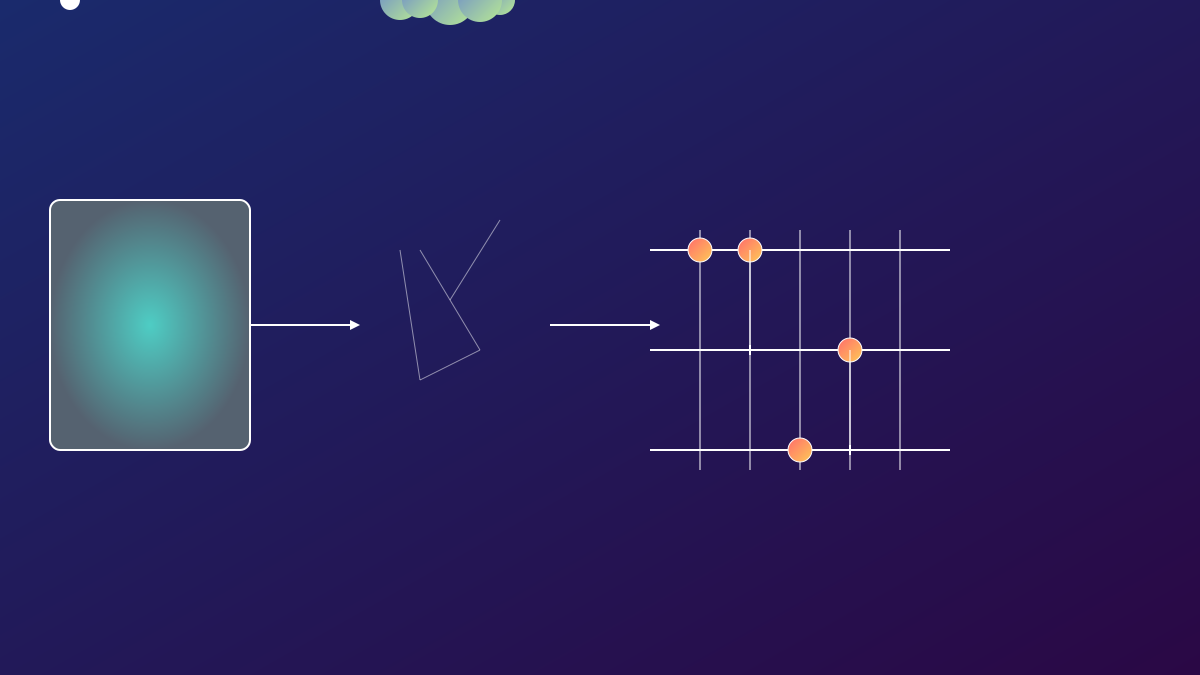
QCV Project Architecture and Technical Route
Advantages of Multimodal Large Language Models
Traditional large language models (such as GPT-3) mainly process text input, while multimodal models (such as GPT-4V, Gemini Pro Vision) can understand both images and text. These models are trained on large amounts of image-text paired data, possessing strong visual understanding capabilities to recognize objects, text, structures, and relationships in images.
In the task of understanding quantum circuit diagrams, MLLM needs to:
- Recognize quantum gate symbols: Distinguish standard graphical representations of various quantum operations such as H gates, X gates, CNOT gates, RZ gates, etc.
- Understand topological structure: Analyze the connection relationships and control dependencies between qubit lines.
- Extract parameter information: Read numerical information such as angle parameters in rotation gates.
- Map to code syntax: Convert the recognition results into API calls for specific quantum frameworks.
System Workflow
The workflow of QCV can be divided into the following stages:
Stage 1: Image Preprocessing and Enhancement
The input quantum circuit image first undergoes preprocessing, including resolution adjustment, contrast enhancement, and noise removal. For hand-drawn sketches, the system may also perform line regularization and symbol standardization to improve the accuracy of subsequent recognition.
Stage 2: Visual Feature Extraction and Understanding
The preprocessed image is fed into the multimodal large language model. The model extracts image features through a visual encoder, then combines language understanding capabilities to generate a textual description of the circuit structure. This step is equivalent to "describing what you see", converting visual information into a structured textual representation.
Stage 3: Code Generation and Optimization
Based on the textual understanding of the circuit structure, the system generates corresponding quantum programming code. QCV supports multiple mainstream quantum computing frameworks, including IBM's Qiskit, Google's Cirq, and Xanadu's PennyLane. The generated code not only includes basic gate operations but also automatically adds necessary import statements, circuit initialization code, and measurement operations.
Stage 4: Verification and Feedback
The generated code can be verified through a quantum simulator to ensure that the circuit's function is consistent with the original image. If inconsistencies are detected (such as incorrect gate operation order or mismatched parameters), the system can iteratively optimize the generated results.
Technical Challenges and Solutions
Challenge 1: Accuracy of Symbol Recognition
Quantum circuit diagrams contain a large number of similar symbols (such as various single-qubit rotation gates), and hand-drawn circuits may have deformations and style differences. QCV improves the accuracy of the model's recognition of quantum gate symbols by combining Few-shot Learning and domain-specific Prompt Engineering.
Challenge 2: Hierarchical Understanding of Complex Circuits
Practical quantum circuits often contain multiple sub-circuit modules and hierarchical structures. QCV adopts a divide-and-conquer strategy: first recognize the overall structure of the circuit, then recursively parse each sub-module, and finally combine the results into complete code.
Challenge 3: Cross-Framework Code Adaptation
Different quantum computing frameworks have their own API designs and naming conventions. QCV maintains a framework mapping table, converting abstract quantum operations into specific function calls for the target framework. Users can choose to generate Qiskit, Cirq, or PennyLane code according to the target platform.