Zing Forum

Reading

Prediction of Solar Irradiance at the Top of the Atmosphere Using Artificial Neural Networks: A Comparative Study of Three Neural Network Models

A study that uses feedforward neural networks, cascade feedforward neural networks, and Elman neural networks to predict Global Horizontal Irradiance (GHI), improving prediction accuracy through correlation analysis of satellite data and ground-measured data.

太阳辐照度预测人工神经网络前馈神经网络级联神经网络Elman网络可再生能源GHI预测机器学习
Published 2026-05-02 20:13Recent activity 2026-05-02 20:20Estimated read 6 min
Prediction of Solar Irradiance at the Top of the Atmosphere Using Artificial Neural Networks: A Comparative Study of Three Neural Network Models
1

Section 01

[Introduction] Core Summary of Comparative Study on GHI Prediction Using Three Neural Networks

This study focuses on the prediction of Global Horizontal Irradiance (GHI). By comparing three architectures—Feedforward Neural Network (FFNN), Cascade Feedforward Neural Network (CFNN), and Elman Neural Network—and combining satellite data with ground-measured data, it improves prediction accuracy. The aim is to address the intermittency issue of solar power generation and provide support for grid dispatching, energy management, etc. Through systematic experiments, the study optimizes model structures, identifies key prediction parameters, and provides empirical references for the field of renewable energy prediction.


2

Section 02

Research Background: Necessity and Challenges of Renewable Energy Prediction

Against the backdrop of global energy transition, solar energy, as a clean and renewable energy source, has received much attention, but the intermittency and uncertainty of its power generation restrict its application. Accurate solar irradiance prediction is crucial for grid dispatching and photovoltaic operation. GHI is a key indicator of solar radiation received at the Earth's surface. Traditional physical/statistical methods have limitations in handling complex meteorological conditions, and artificial intelligence technology provides a new approach for GHI prediction.

3

Section 03

Research Methods: Analysis of Three Neural Network Architectures

This study uses three neural network architectures for comparative analysis:

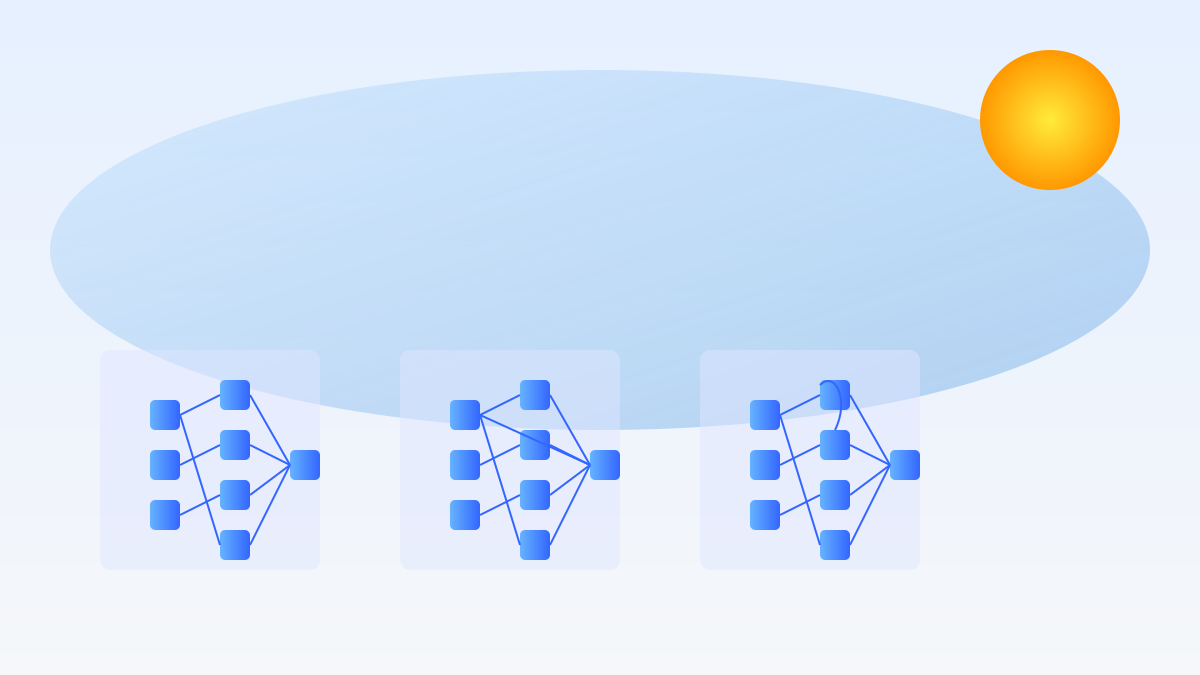
  1. Feedforward Neural Network (FFNN):Information propagates unidirectionally, suitable for static input-output mapping, learning the nonlinear relationship between satellite parameters and GHI;
  2. Cascade Feedforward Neural Network (CFNN):Hidden layer outputs are directly connected to the output layer, capturing multi-scale data patterns and adapting to multivariable interactions;
  3. Elman Neural Network:Recursive structure with a context layer, preserving the state of the previous moment, handling the temporal dynamic dependencies of GHI.
4

Section 04

Data and Experimental Design: Key Elements Supporting the Study

Data Sources: Integrate satellite data (cloud cover, aerosol optical depth, etc.) and ground-measured GHI data; Input Variables: Design 10 different input combinations to evaluate parameter impacts; Structure Optimization: Test configurations with 1-60 neurons, use different random seeds to ensure stability, switch network types via code; Evaluation Metrics: Use MAPE (relative error), RMSE (overall accuracy), and MBE (systematic bias) to measure model performance.

5

Section 05

Research Results: Model Performance Comparison and Value

Through experiments comparing the three models, the optimal configuration is automatically identified. The research value includes:

  • Providing empirical basis for GHI prediction model selection;
  • Identifying the most critical satellite parameters for prediction;
  • Determining a reasonable range of neuron counts to avoid overfitting/underfitting.
6

Section 06

Application Value and Technical Implementation: From Code to Real-World Scenarios

Technical Implementation: Provide complete MATLAB code with a concise process (save file → load data → select model → test configuration → view results); Application Scenarios: Photovoltaic power station power prediction, energy storage system management, energy trading decision-making, agrometeorological services, etc.

7

Section 07

Future Research Directions and Conclusion

Future Directions: Explore deep learning models such as LSTM/GRU, multi-site data fusion, ultra-short-term prediction, and uncertainty quantification; Conclusion: This study demonstrates the potential of neural networks in GHI prediction and provides references for the renewable energy field. As AI technology develops, such methods will play a more important role in energy transition.

