Zing Forum

Reading

Convolutional Neural Network Image Classification: Enabling Machines to Understand the World

Explore how Convolutional Neural Networks (CNNs) achieve automatic image classification, from edge detection to feature learning, and understand the core applications of deep learning in computer vision.

卷积神经网络CNN图像分类深度学习计算机视觉Python神经网络
Published 2026-06-02 16:45Recent activity 2026-06-02 16:55Estimated read 8 min
Convolutional Neural Network Image Classification: Enabling Machines to Understand the World
1

Section 01

Introduction: CNN Image Classification — The Core Technology for Machines to Understand the World

Project Overview

Original Author/Maintainer: navyasrigongu Source Platform: GitHub Release Date: June 2, 2026

Core Introduction

This article explores how Convolutional Neural Networks (CNNs) achieve automatic image classification, from edge detection to feature learning, demonstrating the core applications of deep learning in computer vision. The project covers the basic principles of CNNs, core components, classification processes, classic architectures, practical applications, technical challenges, and future trends, helping readers understand the key technologies that enable machines to "see" the world.


2

Section 02

Background: Challenges in Computer Vision and the Birth of CNNs

Challenges in Computer Vision

The human brain can quickly recognize objects and scenes, but computers only see images as collections of pixels. How to make machines "understand" images is a core challenge in the AI field.

Revolutionary Significance of CNNs

The emergence of Convolutional Neural Networks (CNNs) has completely changed this situation. Designed specifically for processing grid-structured data (such as images), CNNs automatically learn hierarchical features (from edge textures to object structures) through convolution operations. Their core idea is derived from the local receptive field characteristics of the biological visual system.

3

Section 03

Methods: Core Components of CNNs and Image Classification Process

Core Components of CNNs

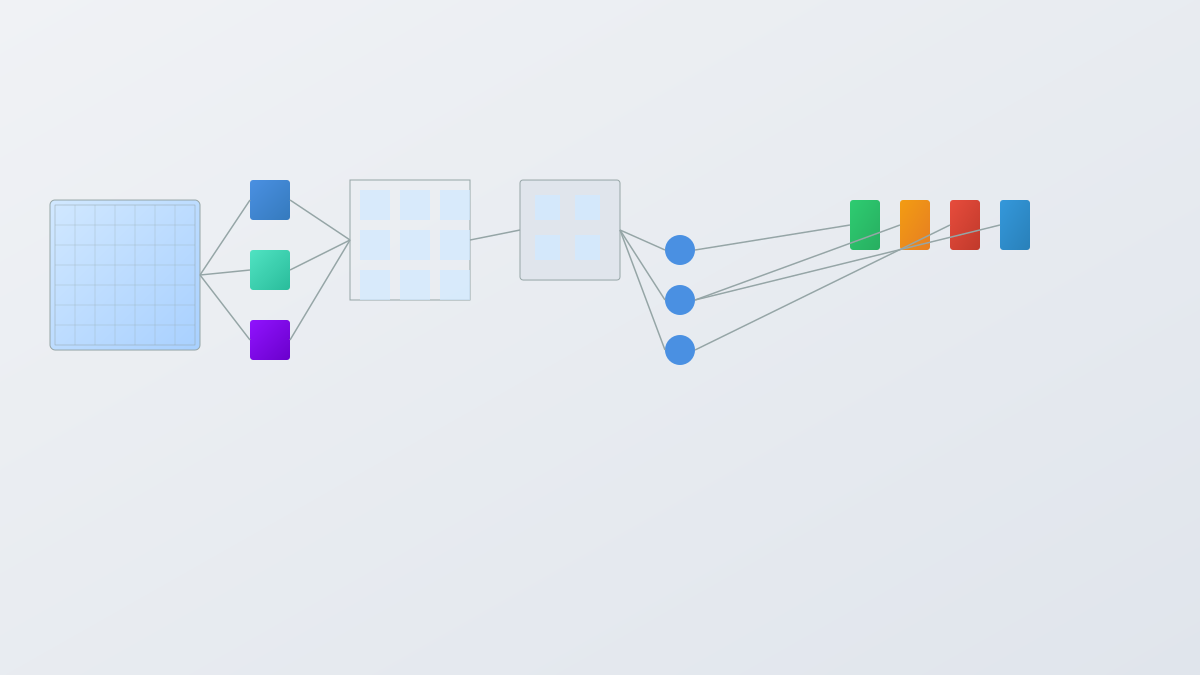
  1. Convolutional Layer: Detects local features via sliding convolution kernels, with advantages of local connection, weight sharing, and translation invariance.
  2. Activation Function: ReLU (f(x)=max(0,x)) is commonly used to introduce non-linearity.
  3. Pooling Layer: Downsamples to reduce dimensions and enhance translation invariance (e.g., 2x2 max pooling).
  4. Fully Connected Layer: Flattens features and maps them to category predictions; the final layer uses Softmax to output probabilities.

Image Classification Process

  • Data Preparation: Collect labeled data, clean, augment (rotation/flip, etc.), split into training/validation/test sets.
  • Model Construction: Choose an architecture (simple network or pre-trained models like VGG/ResNet).
  • Training: Forward propagation → loss calculation (cross-entropy) → backpropagation → iterative optimization (SGD/Adam).
  • Evaluation: Assess performance using accuracy, precision, recall, F1 score, and confusion matrix.
4

Section 04

Evidence and Applications: Classic Architectures and Practical Scenarios

Evolution of Classic CNN Architectures

  • LeNet (1998): The earliest successful CNN, used for handwritten digit recognition.
  • AlexNet (2012): A breakthrough in the ImageNet competition, using ReLU, Dropout, and GPU acceleration.
  • VGGNet (2014): Stacked small convolution kernels; VGG-16/19 have become benchmark models.
  • ResNet (2015): Residual connections solve the gradient vanishing problem, supporting deep networks.
  • Subsequent: DenseNet, SENet, EfficientNet, ViT (Transformer).

Practical Application Scenarios

  • Medical Image Diagnosis: Lung nodule detection, skin cancer classification.
  • Autonomous Driving: Recognition of road signs, pedestrians, vehicles.
  • Industrial Quality Inspection: Product defect detection.
  • Agriculture: Crop pest and disease recognition, agricultural product grade classification.
  • Content Moderation: Inappropriate image recognition.
5

Section 05

Technical Key Points and Challenges

Technical Implementation Key Points

  • Frameworks: TensorFlow (production-friendly), PyTorch (flexible for research), Keras (easy to use).
  • Preprocessing: Uniform size, pixel normalization, data augmentation.
  • Regularization: Dropout, batch normalization, L2 regularization, early stopping.
  • Transfer Learning: Fine-tune pre-trained models to improve performance on small datasets.

Challenges Faced

  • Adversarial Examples: Minor perturbations lead to incorrect predictions.
  • Interpretability: The "black box" nature of models requires visualization techniques like Grad-CAM.
  • Data Dependency: Requires large amounts of labeled data; limited in scenarios with scarce data.
  • Computational Resources: Large models need GPUs, which have a high threshold.
6

Section 06

Future Trends and Conclusion

Future Development Trends

  • Self-Supervised Learning: Learn representations from unlabeled data (SimCLR, MoCo).
  • Neural Architecture Search (NAS): Automatically design optimal architectures.
  • Multimodal Learning: Combine modalities like vision and language (CLIP).
  • Edge Deployment: Quantize models for deployment on mobile/IoT devices.

Conclusion

Although this project is concise, it covers core topics in computer vision. CNNs enable machines to have the ability to "understand" the world. With technological progress, computer vision will play a valuable role in more fields, and understanding CNNs is a necessary path to enter this field.