Zing Forum

Reading

Five Practical Projects in the Artificial Intelligence Course at the University of Tehran: A Complete Learning Path from Search Algorithms to Machine Learning

An in-depth analysis of the five core projects in the University of Tehran's Artificial Intelligence course, covering key AI technologies such as search algorithms, game theory, and machine learning. It demonstrates a complete learning path from theory to practice, providing AI learners with a systematic knowledge framework and practical experience.

人工智能教育搜索算法机器学习博弈论约束满足问题深度学习项目驱动学习算法实现AI课程德黑兰大学
Published 2026-05-03 08:44Recent activity 2026-05-03 10:17Estimated read 7 min
Five Practical Projects in the Artificial Intelligence Course at the University of Tehran: A Complete Learning Path from Search Algorithms to Machine Learning
1

Section 01

Five Practical Projects in the University of Tehran's AI Course: Guide to the Core Learning Path

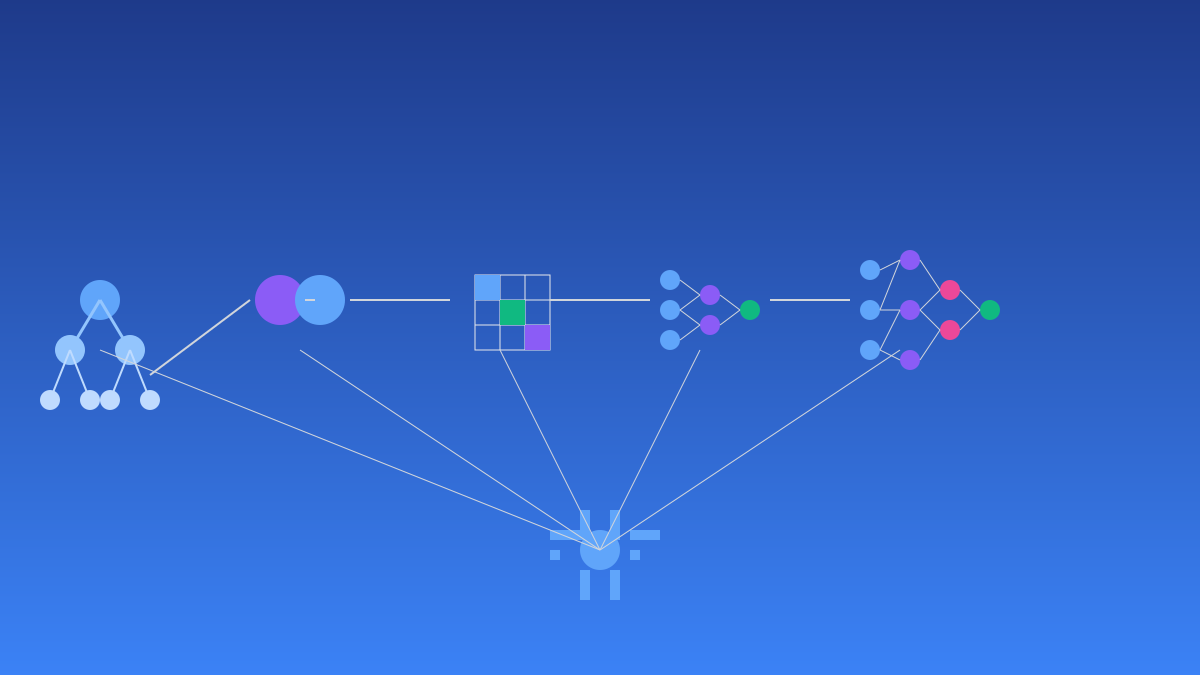
The Artificial Intelligence course at the University of Tehran constructs a complete learning path from basic algorithms to complex applications through five carefully designed projects. The projects cover core AI fields such as search algorithms, constraint satisfaction problems, game theory, machine learning, and deep learning/comprehensive applications. It adopts a project-driven teaching method that deeply integrates theory and practice. This article will analyze these projects and the course design, providing references for AI educators and self-learners.


2

Section 02

Course Background and Design Philosophy

The course follows the design principles of progressing from easy to difficult and from classic to modern. The project selection reflects the trends in the AI field: from symbolic AI to statistical learning, and from single algorithms to system integration. Each project has clear learning objectives and evaluation criteria, requiring students to implement algorithms, analyze performance, and solve practical problems. It complements theoretical assignments and final exams, encouraging in-depth thinking rather than simple code copying.

3

Section 03

Analysis of Symbolic AI Projects

Project 1 (Search Algorithms):Implement breadth-first search, depth-first search, A* and other search strategies, apply them to maze solving or the 8-puzzle problem, and compare the completeness, optimality, and complexity of the algorithms. Project 2 (Constraint Satisfaction Problems):Implement backtracking search and optimization techniques (forward checking, arc consistency, heuristic ordering), solve map coloring, Sudoku, or scheduling problems, and address the combinatorial explosion challenge in large-scale instances. Project 3 (Game Theory):Implement the minimax algorithm with Alpha-Beta pruning, design evaluation functions, build AI that can play games like Tic-Tac-Toe or Othello, and experience the core logic of adversarial search.

4

Section 04

Statistical AI and Comprehensive Application Projects

Project 4 (Fundamentals of Machine Learning):Implement supervised learning algorithms such as decision trees, K-nearest neighbors, and Naive Bayes, complete tasks like Iris classification and handwritten digit recognition, and master the processes of data preprocessing, feature engineering, and model evaluation (cross-validation, confusion matrix, etc.). Project 5 (Deep Learning/Comprehensive Applications):Use TensorFlow/PyTorch to build neural networks to solve problems like image classification, or integrate multiple technologies to solve complex tasks (e.g., intelligent agent navigation), fostering systems thinking and innovation capabilities.

5

Section 05

Teaching Methods and Learning Outcomes

The course adopts project-based learning; the progressive difficulty arrangement helps students build confidence. It integrates collaborative elements such as peer learning, code reviews, and project presentations. The evaluation methods are diverse, focusing on code correctness, algorithm efficiency, document completeness, and innovation level. Through the course, students master the implementation and optimization of core AI algorithms, acquire problem abstraction and experimental design capabilities, establish an overall understanding of the AI field, and lay a foundation for career development or academic further study.

6

Section 06

Implications for AI Education and Advice for Self-Learners

Implications for AI Education:Need to balance classic and modern technologies, emphasize hands-on practice, and adopt evaluation methods that promote deep learning. Advice for Self-Learners:Study in the order of the projects, use resources like open-source code, academic papers, and video tutorials; participate in community exchanges (Stack Overflow, Kaggle); record the learning process and build a personal portfolio.

7

Section 07

Summary of Course Value

The University of Tehran's AI course provides solid AI foundation training through five projects and is a successful case of project-driven learning. Its core concepts and methods have lasting value, providing references for educators, offering a systematic learning roadmap for self-learners, and helping students meet the challenges in the AI field.

