Zing Forum

Reading

Sonar Target Recognition: A Machine Learning-Based Classification System for Subsea Rocks and Mines

This project uses sonar sensor data and supervised learning techniques to analyze reflected acoustic wave patterns and accurately classify underwater objects (rocks vs. mines), demonstrating the practical application of machine learning in defense and maritime navigation systems.

声纳机器学习目标识别二分类监督学习国防应用信号处理海洋技术
Published 2026-06-12 14:16Recent activity 2026-06-12 14:28Estimated read 6 min
Sonar Target Recognition: A Machine Learning-Based Classification System for Subsea Rocks and Mines
1

Section 01

Introduction: Machine Learning-Based Sonar Target Recognition System (Rock vs. Mine Classification)

This project was published by mayankdhall on GitHub (project name: Rock-vs-Mine-Prediction-under-water). Its core is to use sonar sensor data and supervised learning techniques to analyze reflected acoustic wave patterns for accurate classification of underwater rocks and mines. This project demonstrates the practical application value of machine learning in defense and maritime navigation systems.


2

Section 02

Project Background and Principles of Sonar Technology

Underwater target recognition is a core issue for naval operations and maritime safety. Traditional manual recognition relies on operators' experience, which has problems such as fatigue, subjective differences, and data processing bottlenecks. Machine learning provides a possibility for automated solutions.

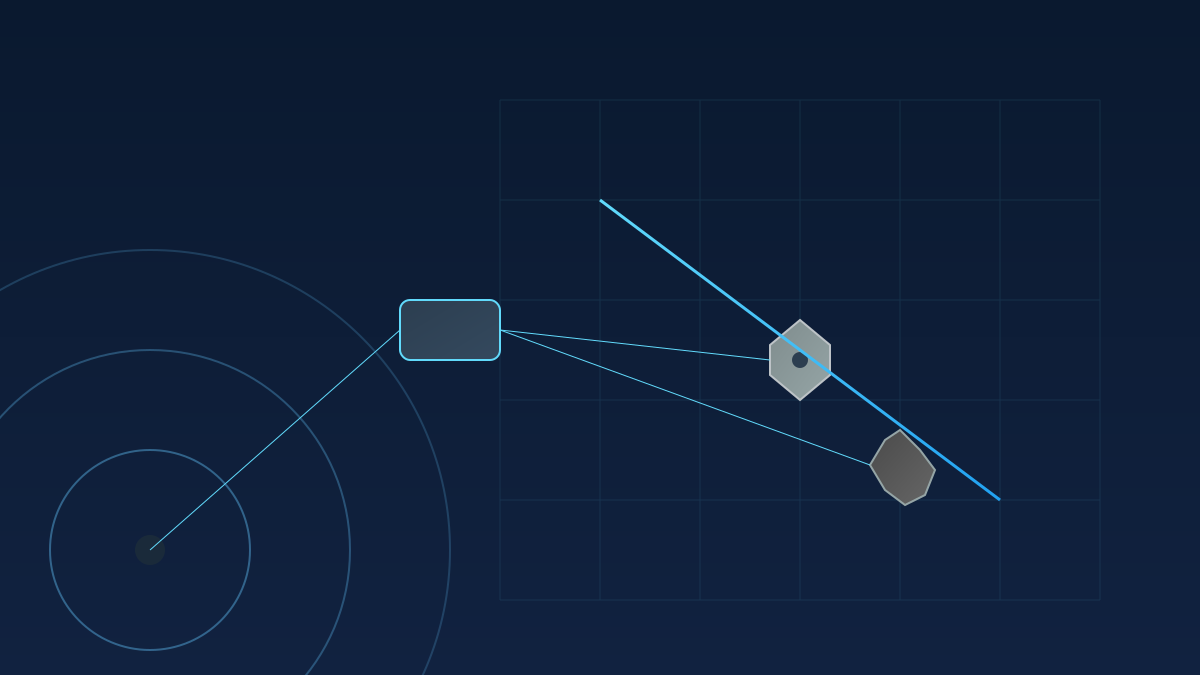
Principles of sonar technology: Active sonar emits sound waves and receives echoes (to obtain distance and shape information), while passive sonar only receives target sounds (without exposing itself). This project uses active sonar data. Rock reflection signals are scattered and stable, while mine (metal shell) reflection signals are stronger and regular. These differences can be distinguished through ML learning.

3

Section 03

Dataset and Feature Engineering Methods

The dataset comes from the Sonar dataset in the UCI Machine Learning Repository, containing 208 samples. Each sample has 60 spectral energy features (different frequency bands) and 1 label (R=rock, M=mine).

Feature analysis: Spectral features reflect the structure and details of objects; statistical features such as mean, variance, and spectral centroid can be derived. Preprocessing includes standardization (unifying scales) and dimensionality reduction (PCA or feature selection) to reduce redundancy.

4

Section 04

Machine Learning Model Selection and Evaluation

The problem type is binary classification (rock vs. mine). Possible models include:

  1. Logistic Regression (baseline model with strong interpretability);
  2. SVM (good performance in high-dimensional space, supports kernel functions for non-linear processing);
  3. Random Forest (captures non-linear relationships and provides feature importance);
  4. Neural Networks (strong expressive power, automatically learns feature combinations).

Evaluation metrics: Accuracy, Precision, Recall, F1-score, ROC-AUC. Cross-validation (K-fold, stratified sampling) is used to make full use of data and robustly evaluate performance.

5

Section 05

Practical Application Scenarios

Military field: Mine sweeping operations, submarine navigation, port defense; anti-submarine warfare (extended to submarine recognition).

Civilian field: Seabed mapping (oil exploration, cable laying), marine science research (fish detection, ecological monitoring, shipwreck archaeology), underwater robots (autonomous obstacle avoidance, target recognition).

6

Section 06

Technical Challenges and Solutions

  1. Data scarcity: Transfer learning (pre-training on simulated data + fine-tuning on real data), data augmentation, active learning;
  2. Environmental noise: Signal filtering and denoising, robust feature extraction, multi-sensor fusion;
  3. Target diversity: Multi-class extension, hierarchical classification, continuous learning;
  4. Real-time requirements: Model lightweighting, hardware acceleration, edge computing.
7

Section 07

Summary and Expansion Directions

Although this project is a binary classification problem, it touches on the core of ML applications in defense and marine fields. Its value lies in transforming ML from academia to practical applications.

Expansion directions: Multi-modal fusion (magnetometer, optical imaging), deep learning upgrade (CNN/LSTM/attention mechanisms), real-time system integration (embedded optimization), 3D sonar imaging applications.

Learning suggestions: Understand sonar principles, master signal processing basics, practice multiple models, focus on data quality, and explore extended applications.

