Zing Forum

Reading

Multimodal Fake News Detection System: A Deep Learning Solution Integrating Visual, Textual, and Social Contexts

This article introduces a multimodal fake news detection system that integrates Vision Transformer, BERT/RoBERTa, and Graph Neural Networks, exploring the application of cross-modal attention mechanisms and dynamic fusion techniques in real-time interpretable prediction.

假新闻检测多模态学习Vision TransformerBERTRoBERTa图神经网络跨模态注意力深度学习可解释AI实时推理
Published 2026-05-12 01:56Recent activity 2026-05-12 01:59Estimated read 6 min
Multimodal Fake News Detection System: A Deep Learning Solution Integrating Visual, Textual, and Social Contexts
1

Section 01

Core Introduction to the Multimodal Fake News Detection System

This article introduces a multimodal fake news detection system integrating Vision Transformer (ViT), BERT/RoBERTa, and Graph Neural Networks (GNN). It achieves real-time interpretable prediction through cross-modal attention mechanisms and dynamic fusion techniques, aiming to address the challenge of rampant fake news in the digital age.


2

Section 02

Trust Crisis Caused by Fake News and Limitations of Traditional Detection

The proliferation of fake news has become a severe social challenge in the digital age, affecting personal decisions and the foundation of society. Traditional manual review is slow, and single-modal automatic detection struggles to handle carefully forged multimedia content (e.g., tampered images + ambiguous text), making a multimodal fusion solution urgently needed.

3

Section 03

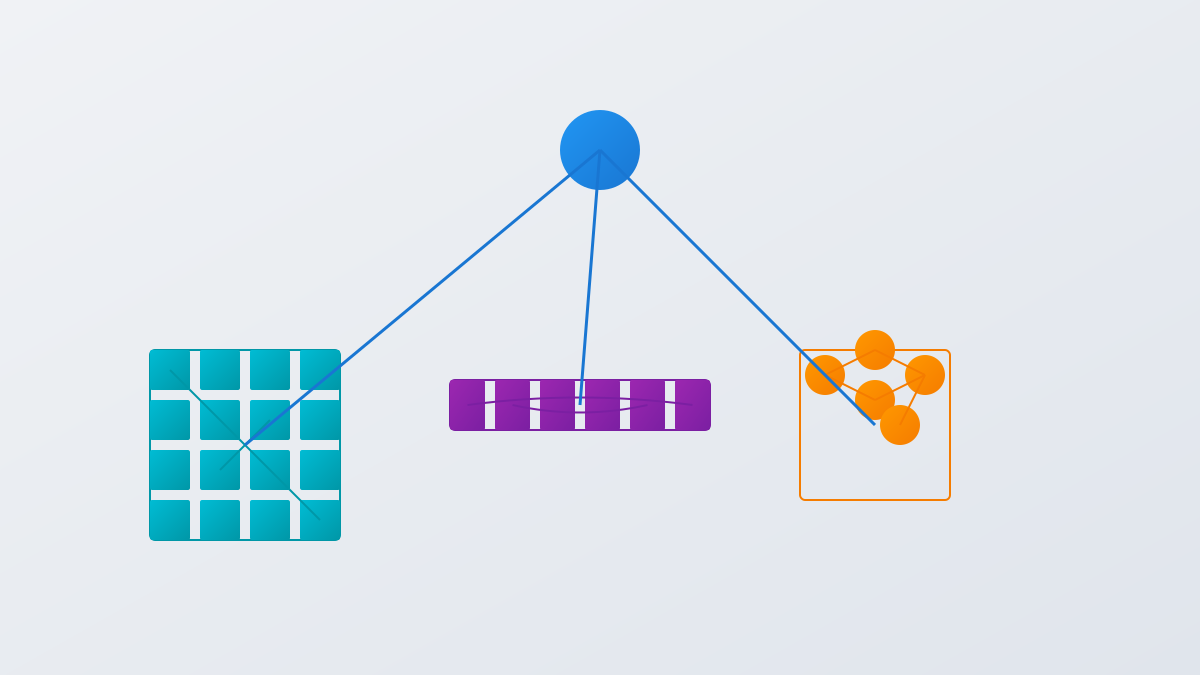
Analysis of the Three Core Technical Pillars of the System

The system's core consists of three key technologies:

  1. Vision Transformer (ViT):Splits images into patches, detects tampering traces, deepfakes, image-text semantic consistency, and style features via self-attention;
  2. BERT/RoBERTa:Uses pre-trained language models for text semantic representation, style analysis, fact-checking, and stance detection. RoBERTa performs better due to its superior training strategy;
  3. Graph Neural Networks (GNN):Models the propagation structure of social networks, analyzes propagation paths, user behavior, community structure, and temporal dynamics to capture complex social information.
4

Section 04

Cross-modal Attention and Dynamic Fusion Mechanism

The key to multimodal fusion lies in adaptively processing information from different modalities:

  • Cross-modal Attention:Dynamically calculates the weight of features from each modality (e.g., prioritizes visual analysis when fake images are paired with real text);
  • Dynamic Fusion Strategy:Supports early (raw data), middle (high-level features), late (decision layer), and hybrid fusion to adapt to different types of fake news.
5

Section 05

Interpretability and Real-time Inference Optimization

The system emphasizes interpretability and real-time performance:

  • Interpretable Prediction:Enhances trust through attention visualization, contribution analysis, and presentation of evidence chains (e.g., "splicing traces detected in the image");
  • Real-time Inference:Reduces latency by using model lightweighting, a combination of batch and stream processing, edge computing deployment, and caching mechanisms.
6

Section 06

Application Scenarios and Social Value

The system can serve multiple scenarios:

  • Social media platforms: Assists in content moderation, risk warning, or labeling of suspicious content;
  • News aggregation apps: Provides credibility scores to purify the information environment;
  • Government public opinion monitoring: Responds promptly to large-scale spread of false information;
  • Fact-checking organizations: Improves the efficiency of manual verification and prioritizes high-risk content.
7

Section 07

Technical Challenges and Future Research Directions

Current challenges include adversarial attacks, new forms of fake news (e.g., deepfake videos), cross-language transfer, and ethical considerations. Future directions: Introduce audio/video temporal modalities, develop robust adversarial training, explore federated learning (privacy protection), and build continuous learning mechanisms to adapt to the evolution of fake news.

8

Section 08

Conclusion: Integration of Technology and Social Governance

Multimodal deep learning provides a powerful tool for fake news detection, but it needs to be combined with public media literacy training, improvement of platform content governance mechanisms, and establishment of a rapid rumor-refutation system. A multi-pronged approach is required to curb the proliferation of fake news, and the proper use of technology requires joint efforts from the entire society.

