Zing Forum

Reading

Optimization Scheme for IoT Network Congestion Control Based on Deep Reinforcement Learning

This article introduces an intelligent congestion control platform integrating Deep Q-Network (DQN) with IoT network simulation, exploring the application principles, system architecture, and practical value of reinforcement learning in solving IoT network congestion problems.

物联网强化学习深度Q网络网络拥塞控制DQNIoT网络优化机器学习
Published 2026-05-05 21:45Recent activity 2026-05-05 21:47Estimated read 5 min
Optimization Scheme for IoT Network Congestion Control Based on Deep Reinforcement Learning
1

Section 01

Guide to the Optimization Scheme for IoT Network Congestion Control Based on Deep Reinforcement Learning

This article introduces an intelligent congestion control platform that integrates Deep Q-Network (DQN) with IoT network simulation, exploring the application principles, system architecture, and practical value of reinforcement learning in solving IoT network congestion problems. Targeting the characteristics of IoT networks such as high device density and heterogeneous connections, this scheme enables automatic optimization of network performance through the DQN agent's autonomous learning of optimal strategies, and has open-source and engineering practical value.


2

Section 02

Background: Unique Challenges of IoT Network Congestion

With the explosive growth of IoT devices, network congestion has become a key bottleneck in the development of smart cities, industrial IoT, and smart homes. Traditional algorithms like TCP Reno and CUBIC struggle to adapt to IoT's unique features—high device density, heterogeneous connections, resource constraints, periodic traffic bursts, and dynamic topology changes. Static rule-based strategies fail to handle complex environments.

3

Section 03

Method: DQN-Driven Intelligent Congestion Control Scheme

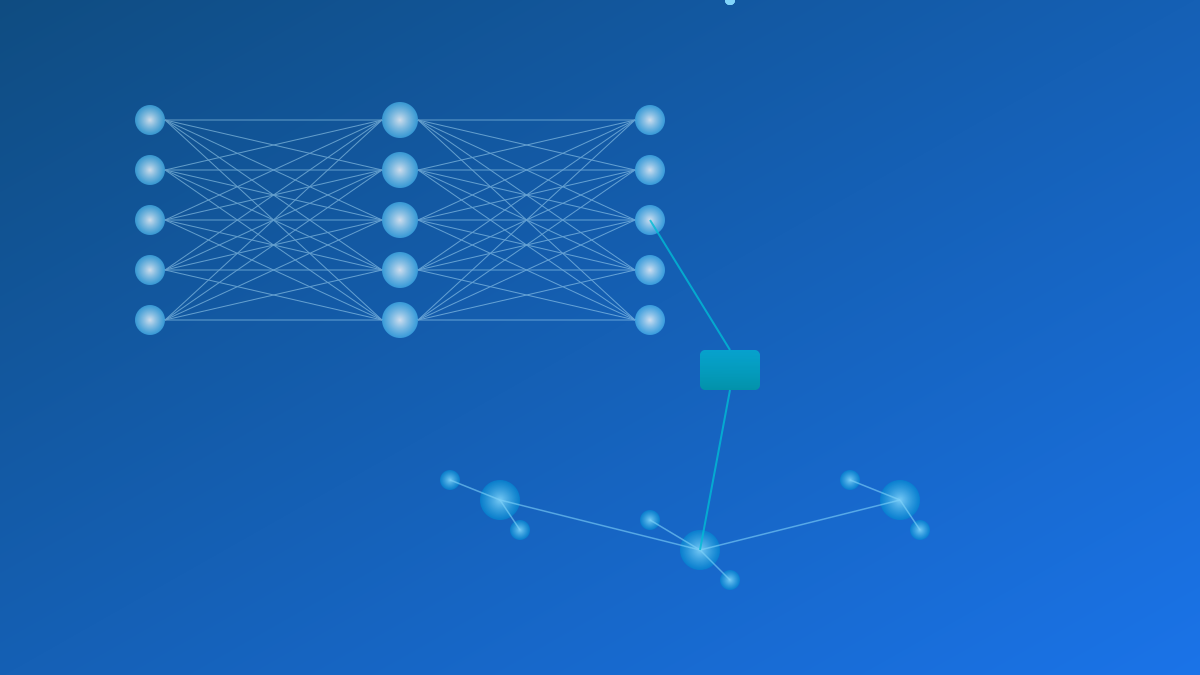
Reinforcement Learning (RL) allows agents to autonomously learn optimal strategies via interaction with the environment. DQN combines deep neural networks with Q-learning, making it suitable for handling multi-variable coupling issues in IoT. The system architecture has three layers:

  1. Network Simulation Layer: Discrete event simulation supporting star/mesh/tree topologies, calculating metrics like latency and throughput.
  2. Intelligent Decision Layer: DQN agent with state inputs including queue length, packet loss, and link quality; uses experience replay and target network for stable training.
  3. Visualization Monitoring Layer: Web dashboard displaying network status and decision-making processes. Core mechanisms include: state space covering IoT-specific features (e.g., queue occupancy), action space as discrete rate adjustment, reward function for multi-objective optimization (latency/throughput/packet loss rate), neural network with convolution + fully connected layers, and ε-greedy exploration strategy.
4

Section 04

Experimental Verification: Performance Advantages of the DQN Scheme

Evaluated in smart home, industrial sensor network, and smart city traffic monitoring scenarios, the DQN scheme outperforms TCP CUBIC and heuristic algorithms in:

  • Adaptability: Quickly adjusts strategies when topology or traffic changes abruptly.
  • Fairness: More equitable bandwidth allocation across multiple devices.
  • Resource efficiency: Reduces energy consumption while ensuring service quality, extending battery life of devices.
5

Section 05

Conclusion and Prospects: Value of the Open-Source Platform and Future Trends

This open-source project provides a complete engineering implementation. Researchers can verify new RL algorithms, and engineers can integrate RL modules into IoT gateways or edge nodes. With the future development of 5G/6G and edge intelligence, RL-driven network autonomy is a trend. This project promotes the paradigm shift from manual configuration to self-evolution, offering important reference value for engineers in fields like network protocols and edge computing.

