Zing Forum

Reading

Multi-Layer Defense Image Deduplication System: A Precise Recognition Scheme from Hashing to Neural Networks

This project builds a production-grade duplicate image detection system using a three-level detection strategy: SHA-256 exact matching, pHash perceptual hashing, and siamese neural networks. The system can identify completely duplicate, edited, and cropped/deformed images, and is suitable for scenarios such as logistics, e-commerce, and cloud storage.

图像去重感知哈希孪生神经网络FAISSFastAPIPyTorch相似度搜索计算机视觉
Published 2026-04-30 16:45Recent activity 2026-04-30 16:55Estimated read 5 min
Multi-Layer Defense Image Deduplication System: A Precise Recognition Scheme from Hashing to Neural Networks
1

Section 01

【Main Floor/Introduction】Multi-Layer Defense Image Deduplication System: A Precise Recognition Scheme from Hashing to Neural Networks

This project builds a production-grade duplicate image detection system using a three-level detection strategy (SHA-256 exact matching, pHash perceptual hashing, siamese neural networks). It can identify completely duplicate, edited, and cropped/deformed images, and is suitable for scenarios like logistics, e-commerce, and cloud storage. The system balances detection accuracy and efficiency through a layered architecture, providing a comprehensive solution to the problem of duplicate images in the digital age.


2

Section 02

【Background】Practical Challenges of Image Deduplication

In the digital age, image data is growing explosively, and duplicate images consume storage resources and management efforts (20%-40% duplicates in ordinary users' albums, higher for enterprise-level). Traditional file hashing is ineffective against approximate duplicates (rotation, brightness adjustment, cropping, compression), and pure visual comparison faces the challenge of balancing performance and accuracy. This project designs a multi-layer defense solution for this complex scenario.

3

Section 03

【Methodology】System Architecture and Tech Stack

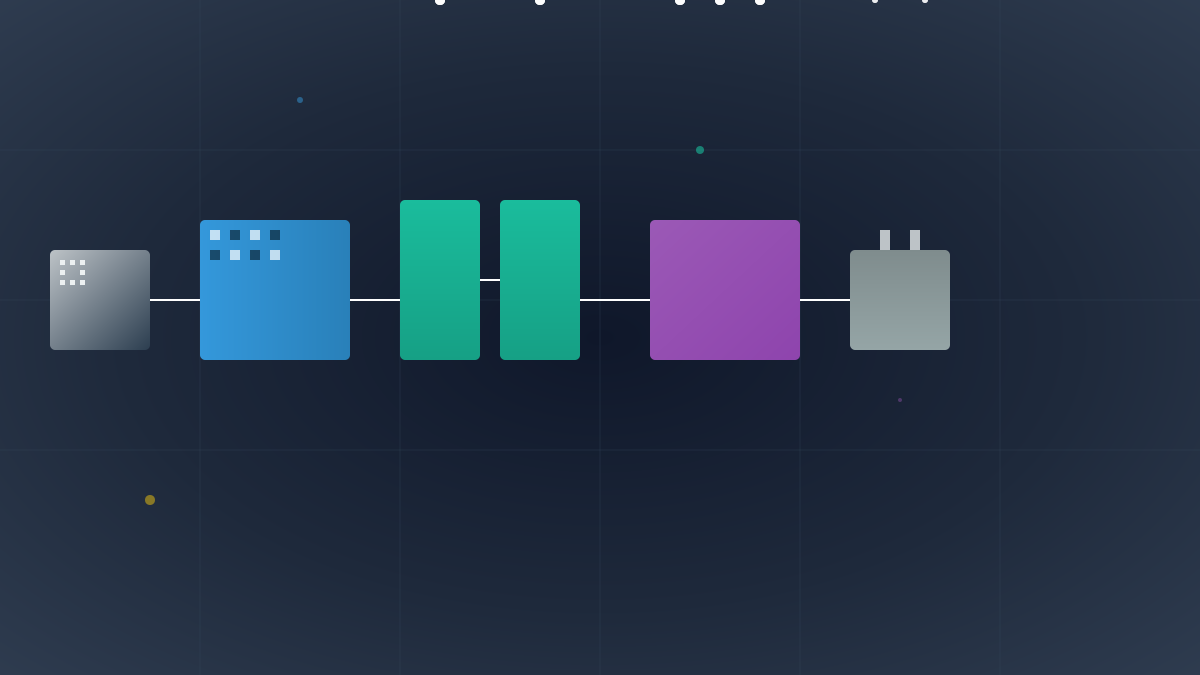
The system uses a three-layer defense architecture:

  1. SHA-256 Exact Matching: Quickly filters completely duplicate files, zero false positives but sensitive to modifications;
  2. pHash Perceptual Hashing: Resists minor image changes (brightness, compression, small cropping), generates hashes via Discrete Cosine Transform;
  3. Siamese Neural Network: Handles large transformations and semantically similar images, implemented through shared CNN encoders and metric learning. The tech stack includes FastAPI (asynchronous backend), PyTorch (deep learning), FAISS (vector retrieval), and Streamlit (interactive interface).
4

Section 04

【Application Validation】Business Scenario Value of the System

The system's effectiveness is verified in multiple scenarios:

  • Logistics Delivery: Detects fake delivery photos to prevent fraud;
  • E-commerce Platform: Manages product images and optimizes search diversity;
  • Cloud Storage: Backend deduplication to free up space;
  • Content Moderation: Tracks variants of violating content. These scenarios reflect the practical value of the system.
5

Section 05

【Conclusion】Significance of Balancing Layered Architecture

This project demonstrates an engineering solution combining classic hashing algorithms with modern deep learning. The layered architecture (simple and fast filtering → complex and precise processing) achieves a good balance between accuracy and efficiency. This design idea has universal reference value, and the project's tech stack is complete, which can be directly deployed or used as a learning reference.

6

Section 06

【Improvement Directions】Limitations and Optimization Suggestions

Current limitations: Adversarial attacks may bypass detection, extreme transformations (large rotation, occlusion) fail, and the neural network layer requires GPU support. Future improvements: Multi-modal fusion (combining EXIF and text), active learning to optimize the model, edge deployment (model compression, mobile inference).

