Zing Forum

Reading

Smartphone Price Prediction: A Machine Learning-Based Pricing Decision Support System

This article introduces the Mobile-Price-Prediction project, a machine learning-based smartphone price prediction tool that helps users and businesses make informed pricing decisions by analyzing hardware features such as RAM, battery, camera, and storage.

机器学习价格预测智能手机Scikit-learn分类算法定价决策Python数据科学MIT协议开源项目
Published 2026-06-01 16:15Recent activity 2026-06-01 16:25Estimated read 8 min
Smartphone Price Prediction: A Machine Learning-Based Pricing Decision Support System
1

Section 01

[Introduction] Mobile-Price-Prediction: A Machine Learning-Based Smartphone Price Prediction Tool

This article introduces the open-source project Mobile-Price-Prediction (author: kevinromany, GitHub link: https://github.com/kevinromany/Mobile-Price-Prediction, MIT License, released on June 1, 2026). By analyzing hardware features like RAM, battery, camera, and storage, the project predicts smartphone price ranges, providing pricing decision support for manufacturers, retailers, consumers, and data science learners.


2

Section 02

Project Background and Application Scenarios

Complexity of Pricing Decisions

Smartphone pricing involves multiple factors such as hardware costs, brand premium, market competition, and target users. It is also difficult for consumers to judge cost-effectiveness. Machine learning can learn the relationship between prices and features from historical data and provide objective references.

Target User Groups

  • Smartphone Manufacturers: Evaluate the expected price positioning of configuration combinations before new product launches
  • Retailers: Develop competitive sales strategies
  • Consumers: Assist in purchase decisions
  • Data Science Learners: Use as an introductory project for machine learning classification tasks
3

Section 03

Technical Implementation and Core Features

Prediction Model

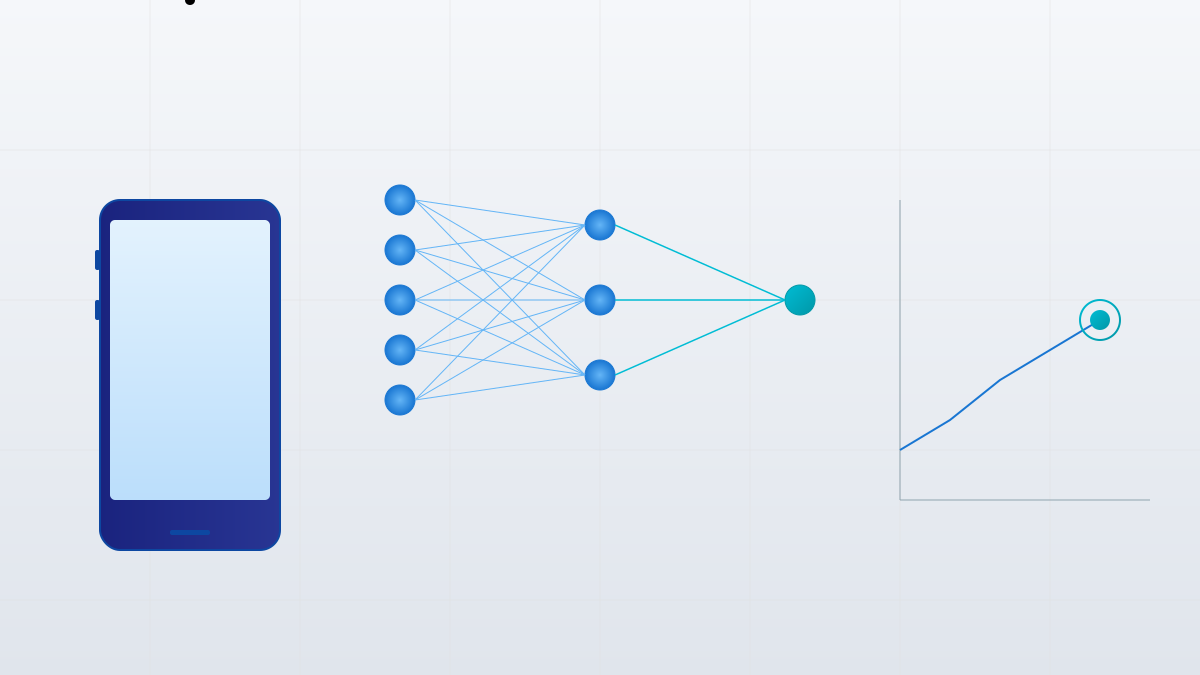
Uses classic machine learning classification algorithms to divide prices into ranges like low, medium, high, and flagship. Input features include RAM, battery capacity, camera parameters, storage space, and connectivity features such as 4G/5G/WiFi.

User-Friendly Interface

An intuitive interface: enter hardware parameters and click 'Predict Price' to get results, lowering the technical barrier.

Fast and Accurate Prediction

The trained model can return results in milliseconds with high prediction accuracy.

4

Section 04

Technology Stack and Usage Methods

Technology Stack

  • Core: Python, Scikit-learn (classification algorithms), Jupyter Notebook (development environment)
  • Visualization: Matplotlib, Seaborn

Usage Methods

  1. Obtain: Download from the Releases page, supporting Windows/macOS/Linux
  2. System Requirements: 4GB RAM, 100MB space, Python/Jupyter environment
  3. Process: Enter hardware parameters → Click predict → View price range results
5

Section 05

Model Training and Data Details

Data Source

Typically based on public datasets (e.g., Kaggle's Mobile Price Classification dataset), containing thousands of mobile phone records with labeled price ranges (the project does not disclose detailed datasets).

Feature Engineering

  • Standardization of numerical features
  • Encoding of categorical features
  • Feature interaction (e.g., RAM × storage)

Model Selection

Multi-classification algorithms: Decision Tree, Random Forest, Support Vector Machine, Gradient Boosting Tree (XGBoost/LightGBM)

Model Evaluation

Uses accuracy, confusion matrix, F1 score, and cross-validation to ensure performance and generalization ability.

6

Section 06

Project Limitations and Improvement Directions

Current Limitations

  • Limited feature coverage: Does not consider soft factors like brand, software ecosystem, and market supply and demand
  • Time sensitivity: Needs to be retrained regularly with new data
  • Regional differences: Does not fully consider price differences across regions

Improvement Directions

  • Expand feature set (brand, design score, release time, competitor pricing)
  • Introduce deep learning (for large-scale datasets)
  • Real-time data updates (automatically train with data scraped from e-commerce platforms)
  • Enhance visualization (feature importance, price trends)
7

Section 07

Open-Source Contribution and Learning Value

Open-Source Contribution

MIT License. Contribution process: Fork the repository → Create a branch → Submit changes → Initiate a Pull Request. Contribution directions: Optimize models, add algorithm comparisons, improve UI, supplement documentation/tests.

Learning Value

  • End-to-end ML process practice (data preprocessing → model training → deployment)
  • Application of multi-classification tasks
  • Interpretability of traditional ML algorithms
  • Understanding of real business scenario applications
8

Section 08

Summary

Mobile-Price-Prediction demonstrates the application value of machine learning in commercial pricing decisions. By predicting price ranges through hardware features, it provides references for multiple parties. Although it has limitations such as feature coverage and timeliness, it lays the foundation for subsequent expansion. For data science learners, it is an excellent case to practice classification algorithms and ML processes. In the future, with the progress of data and algorithms, such systems are expected to play a role in more pricing scenarios.