Zing Forum

Reading

Deep Learning-Based Plant Leaf Disease Detection System

leaf-disease-detector is a deep learning web application built with Streamlit, which uses a trained Convolutional Neural Network (CNN) model to detect plant leaf diseases from images.

植物病害检测深度学习卷积神经网络CNNStreamlit农业AI图像分类
Published 2026-05-18 17:14Recent activity 2026-05-18 17:22Estimated read 7 min
Deep Learning-Based Plant Leaf Disease Detection System
1

Section 01

[Introduction] Core Introduction to the Deep Learning-Based Plant Leaf Disease Detection System

leaf-disease-detector is a deep learning web application built with Streamlit, which uses a Convolutional Neural Network (CNN) model to detect plant leaf diseases from images. This project aims to address the problems of traditional plant disease diagnosis, such as reliance on expert experience, time-consuming and subjective processes, and shortage of professionals. It enables fast and accurate disease identification to support the development of agricultural modernization.


2

Section 02

Background: Current Status and Challenges of Plant Disease Detection

Agriculture is a crucial pillar of the global economy. Plant diseases cause 20% to 40% of crop yield losses annually. Traditional diagnosis relies on experts' visual observation, which is time-consuming, labor-intensive, and prone to subjective factors. The shortage of professional technicians in many regions leads to the spread of diseases and increased losses. Fast and accurate identification of plant diseases has become a key issue for agricultural modernization.

3

Section 03

Technical Approach: Integration of CNN Model and Streamlit Framework

Tech Stack and Architecture

  • Deep learning framework: Convolutional Neural Network (CNN) for image classification
  • Web framework: Streamlit to build a simple and intuitive user interface

CNN Principles

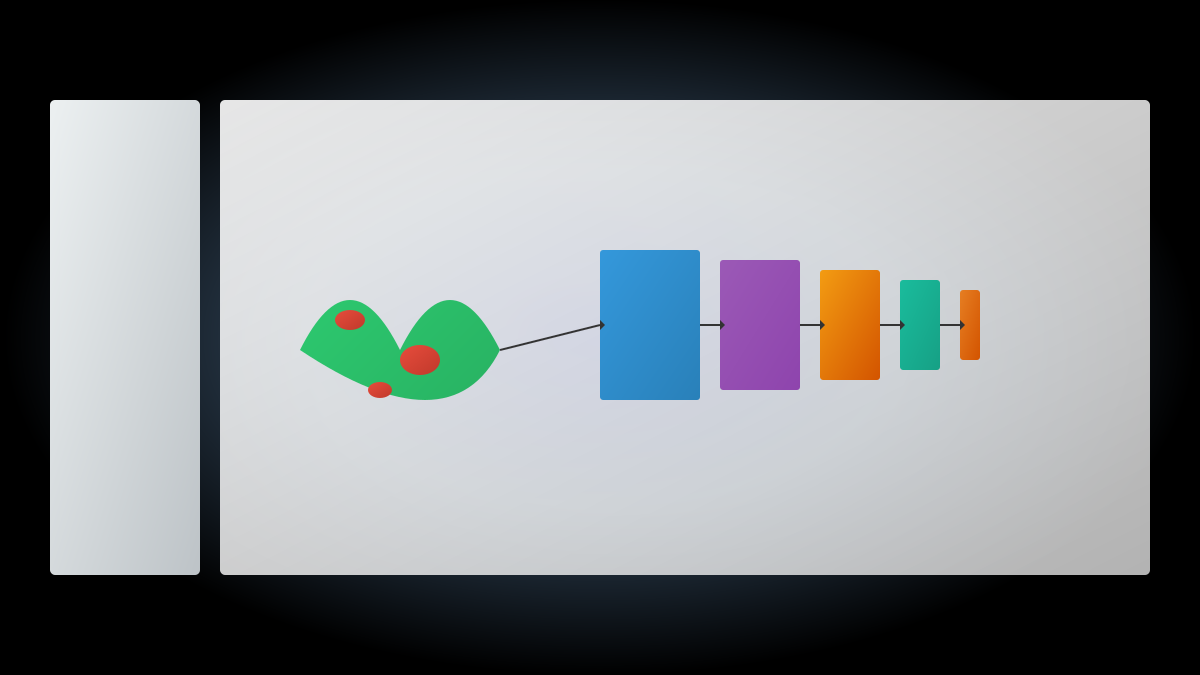
CNN is a deep learning model for processing grid-structured data. Its core components include convolutional layers (extracting edge/texture features), activation functions (introducing non-linearity), pooling layers (reducing dimensionality), and fully connected layers (mapping classification results). It can automatically learn leaf disease features such as lesion color, shape, and texture changes.

Streamlit Application

Advantages of Streamlit: Minimalist API, real-time preview, no front-end knowledge required. In this project, it implements functions like file upload, image display, and result output.

4

Section 04

Application Value: Multi-faceted Significance for Farmers, Research, and Enterprises

For Farmers

  • Instant diagnosis: Get disease results anytime, anywhere
  • Early warning: Identify diseases in the early stage and take measures
  • Cost reduction: Precise pesticide application reduces waste
  • Knowledge popularization: Understand disease characteristics and prevention methods

For Research

  • Data collection: Accumulate disease image data
  • Model optimization: Improve accuracy through feedback
  • Cross-variety research: Expand the model to support more crops

For Enterprises

  • Large-scale application: Deploy to large-scale production
  • Intelligent decision-making: Provide management suggestions by combining agricultural data
  • Supply chain optimization: Predict yields and optimize arrangements
5

Section 05

Technical Challenges and Solutions

Data Quality and Quantity

Challenge: Need a large amount of high-quality labeled data; Solution: Data augmentation (rotation/flip, etc.), transfer learning to accelerate training.

Model Generalization Ability

Challenge: Good performance on training data but poor effect in real scenarios; Solution: Diversified training data (different lighting/angles), regularization to prevent overfitting.

Computational Resource Constraints

Challenge: Training and inference require strong computing power; Solution: Lightweight networks, model compression and quantization, cloud/edge deployment.

6

Section 06

Future Outlook: Function Expansion and Technical Upgrades

Function Expansion

  • Multi-crop support: Cover more crops
  • Severity assessment: Identify disease types and evaluate severity
  • Treatment recommendation: Provide prevention and control suggestions based on disease types
  • Mobile application: Develop a mobile App for convenient field use

Technical Upgrades

  • Advanced model architecture: Adopt Vision Transformer, etc.
  • Multi-modal fusion: Combine meteorological/soil data for comprehensive judgment
  • Edge computing: Implement offline diagnosis
  • Continuous learning: Continuously improve the model from new data
7

Section 07

Conclusion: Potential and Contribution of AI in Agricultural Disease Detection

The leaf-disease-detector project demonstrates the great potential of artificial intelligence in the agricultural field. By combining deep learning and web technology, it provides a low-cost and efficient disease diagnosis solution. With technological progress and data accumulation, such intelligent systems will play an important role in smart agriculture and contribute to ensuring global food security.

