Zing Forum

Reading

Employee Attrition Prediction: A Complete Machine Learning Practice from Data Cleaning to Production Deployment

An end-to-end employee attrition prediction project that fully demonstrates the entire workflow from data exploration, feature engineering, model training to Streamlit deployment, including key technologies such as SMOTE for class imbalance handling and hyperparameter tuning.

员工流失预测机器学习SMOTE类别不平衡Streamlit超参数调优特征工程数据清洗人力资源分类模型
Published 2026-05-12 04:56Recent activity 2026-05-12 04:59Estimated read 5 min
Employee Attrition Prediction: A Complete Machine Learning Practice from Data Cleaning to Production Deployment
1

Section 01

Guide to the Full Workflow Practice of Employee Attrition Prediction

This article introduces an end-to-end employee attrition prediction project, fully demonstrating the entire workflow from data cleaning, feature engineering, model training to Streamlit deployment. It includes key technologies such as SMOTE for class imbalance handling and hyperparameter tuning, helping enterprises identify resignation risks in advance, optimize HR decisions, and reduce talent attrition costs.


2

Section 02

Project Background and Business Value

Employee attrition refers to employees leaving the company voluntarily. High attrition rates affect recruitment costs, team morale, and knowledge accumulation. Traditional early warning relies on experience and lacks systematicity. Machine learning learns attrition patterns by analyzing historical data. The project's value includes: early warning of high-risk employees, precise formulation of retention strategies, optimization of HR resource allocation, and revealing key factors affecting employee satisfaction.

3

Section 03

Technical Workflow and Core Steps

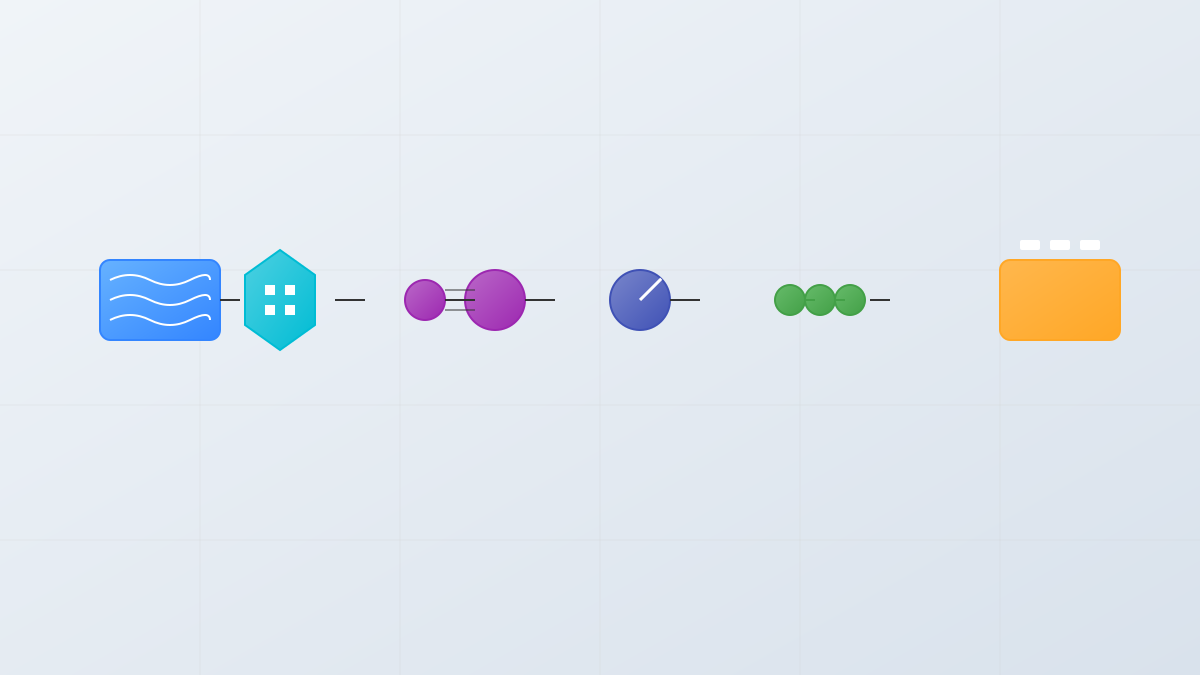
The project adopts an end-to-end architecture with core steps: 1. Data cleaning and preprocessing: handle missing values and outliers to ensure data reliability; 2. Exploratory Data Analysis (EDA): understand the relationship between feature distribution and target variables through visualization and statistics; 3. Feature engineering: category encoding, feature combination, scaling, and selection; 4. Model training and hyperparameter tuning: use grid/random search to find the optimal configuration.

4

Section 04

Analysis of Key Technical Highlights

  1. SMOTE for class imbalance handling: synthesize new samples through interpolation between minority class samples to balance the dataset and avoid overfitting from simple oversampling; 2. Hyperparameter tuning: use cross-validation to evaluate parameter combinations and select the best configuration on the validation set; 3. Streamlit deployment: quickly encapsulate the model into an interactive web application, which HR can use without programming.
5

Section 05

Expansion of Practical Application Scenarios

The project architecture can be applied to multiple scenarios: recruitment screening to predict candidates' willingness to stay, onboarding care to identify early attrition risks of new employees, promotion planning to evaluate key employees' satisfaction, and team health monitoring to scan team attrition risks.

6

Section 06

Summary and Learning Insights

This project embodies the engineering thinking of machine learning, covering aspects such as data quality, class balance, and deployment convenience. It is an excellent reference case for beginners with clear code structure, practical technology stack, covering common challenges and solutions, and has learning and reference value.

