Zing Forum

Reading

Speech Emotion Recognition: Using Deep Learning to Understand Emotions from Sound

Explore speech emotion recognition technology based on MFCC feature extraction and neural networks, and learn how to capture the subtle changes of human emotions from audio signals.

语音情感识别MFCC深度学习神经网络语音处理人机交互情感计算
Published 2026-06-12 00:44Recent activity 2026-06-12 00:51Estimated read 7 min
Speech Emotion Recognition: Using Deep Learning to Understand Emotions from Sound
1

Section 01

Speech Emotion Recognition: Using Deep Learning to Understand Emotions from Sound (Introduction)

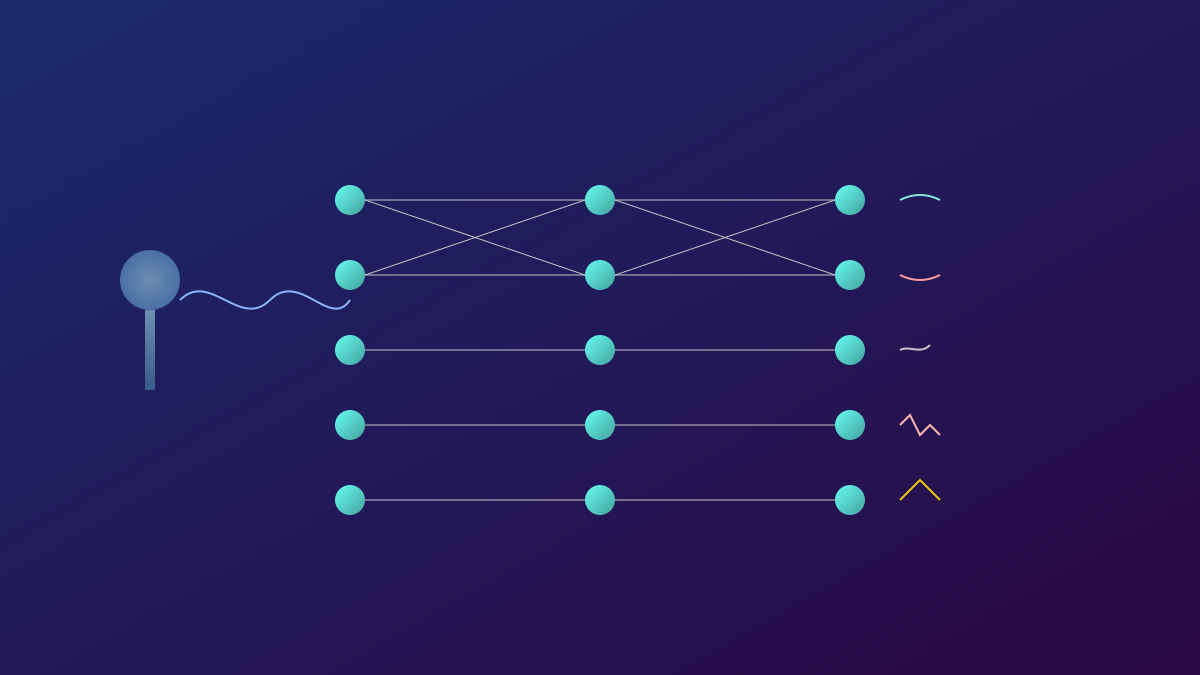
This open-source project was released by Haritha-2006-gif on GitHub on June 11, 2026 (link: https://github.com/Haritha-2006-gif/Emotion-Recognition-from-Speech). Its core is to explore speech emotion recognition technology based on MFCC feature extraction and neural networks, aiming to decode the emotional code in sound and enable machines to "understand" emotions like humans. The project demonstrates the basic implementation process of capturing subtle emotional changes from audio signals and is beginner-friendly.


2

Section 02

Technical Background and Application Value of Speech Emotion Recognition

Speech Emotion Recognition (SER) is an important direction in the field of human-computer interaction. Traditional speech recognition (ASR) only focuses on text content, while SER captures emotional features such as intonation, speech rate, and timbre—for example, the emotion expressed by "I'm fine" in a calm or trembling tone is completely different. Its application prospects are broad: in customer service, it can analyze customer emotions in real-time to adjust strategies; in mental health, it can assist in depression screening; in human-computer interaction, it makes voice assistants respond more thoughtfully.

3

Section 03

Core Technologies: MFCC Feature Extraction and Neural Network Architecture

MFCC Feature Extraction

MFCC (Mel-Frequency Cepstral Coefficients) are core features that simulate human auditory perception characteristics. The extraction steps include pre-emphasis, framing, FFT, Mel filtering, logarithmic operation, and DCT. Usually, 12-13 coefficients plus first/second-order differences form the feature vector.

Neural Network Architecture

The project uses neural network classification, with typical architectures including:

  • MLP: Basic fully connected network, unable to capture time dependencies;
  • CNN: Treat MFCC as images to learn local spectral patterns;
  • RNN/LSTM/GRU: Model time dynamics of sequence data;
  • Hybrid architecture (CNN+LSTM): Combine local features with temporal modeling, one of the mainstream solutions.
4

Section 04

Dataset and Emotion Classification Explanation

Speech emotion recognition relies on annotated datasets. Common public datasets include RAVDESS, SAVEE, TESS, etc., which contain emotional samples read by actors. Typical emotion categories are neutral, happy, sad, angry, fear, surprise, disgust, etc. Note: Emotion is a continuous subjective concept, and discrete classification is a simplification; cross-cultural differences and annotation subjectivity pose challenges to the system.

5

Section 05

Technical Challenges and Limitations of Speech Emotion Recognition

SER faces multiple challenges:

  1. Feature instability: Speaker differences (acoustic feature differences between different people or the same person at different times) affect generalization;
  2. Ambiguous and overlapping emotions: In reality, emotions are mostly mixed, making simple classification difficult to handle;
  3. Lack of context: It is difficult to judge situations like irony without context;
  4. Data scarcity: Emotional annotation costs are high, and high-quality datasets are limited.
6

Section 06

Application Scenario Outlook

SER application scenarios include:

  • Intelligent customer service: Identify dissatisfied customers in real-time and adjust strategies promptly;
  • Online education: Monitor students' confusion/boredom emotions and dynamically adjust teaching;
  • Medical health: Long-term monitoring of speech emotions to assist early warning of mental illnesses;
  • In-vehicle systems: Detect driver's anger/fatigue and issue reminders;
  • Entertainment creation: Provide personalized music recommendations and game interactions based on user emotions.
7

Section 07

Conclusion and Future Outlook

This project provides an entry-level SER implementation, demonstrating the basic process of MFCC + deep learning, which is a good starting point for beginners. SER is an interdisciplinary field (signal processing, machine learning, psychology, etc.). With the progress of deep learning and the increase of high-quality datasets, more accurate and robust systems will appear in the future, making human-computer interaction more natural and empathetic.

