Zing Forum

Reading

End-to-End Autonomous Driving System Based on Behavioral Cloning: Enabling Neural Networks to Learn Human Driving

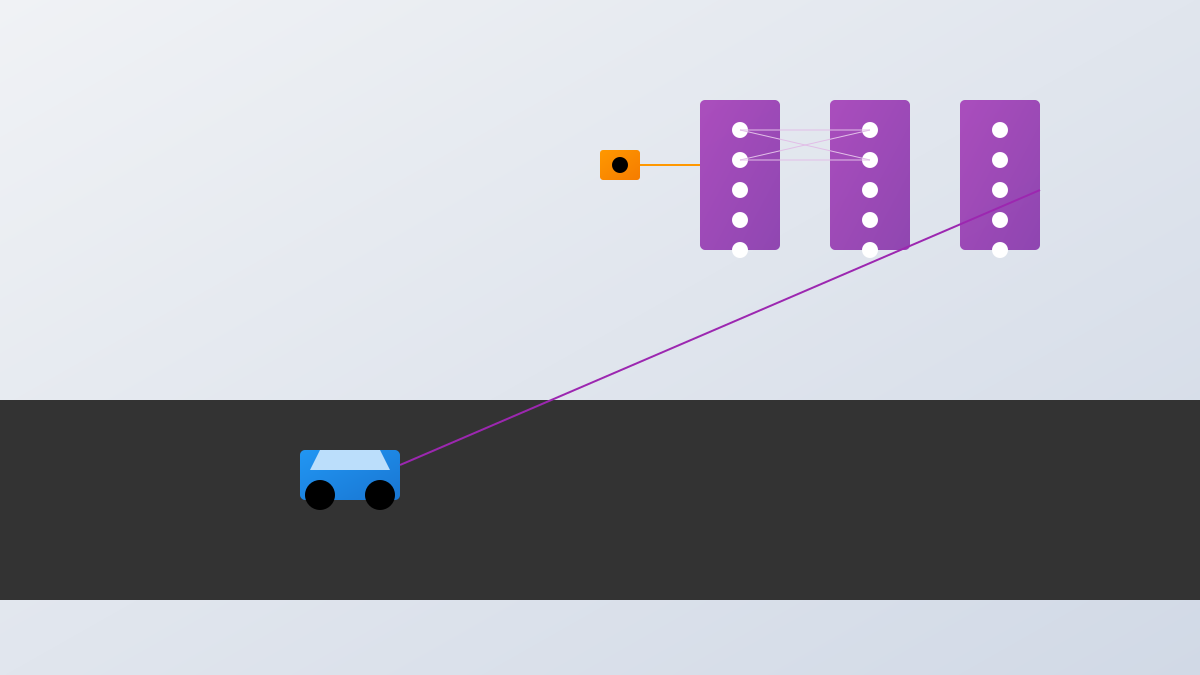
This article introduces an open-source project that implements end-to-end autonomous driving using Convolutional Neural Networks (CNN). The system learns steering control from human driving data via behavioral cloning technology and achieves autonomous navigation in the Udacity Self-Driving Car Simulator.

自动驾驶行为克隆卷积神经网络深度学习端到端学习机器学习Udacity模拟器计算机视觉
Published 2026-06-06 22:43Recent activity 2026-06-06 22:48Estimated read 7 min
End-to-End Autonomous Driving System Based on Behavioral Cloning: Enabling Neural Networks to Learn Human Driving
1

Section 01

[Introduction] Core Introduction to the Open-Source End-to-End Autonomous Driving Project Based on Behavioral Cloning

The open-source project introduced in this article was published by hardikchoudharyhc on GitHub. It implements end-to-end autonomous driving using behavioral cloning technology and Convolutional Neural Networks (CNN), learning steering control by imitating human driving data and achieving autonomous navigation in the Udacity Self-Driving Car Simulator. The project draws on NVIDIA's 2016 paper "End to End Learning for Self-Driving Cars" and eliminates the need for traditional complex multi-module design, directly predicting steering angles from camera images.


2

Section 02

Project Background and Source Information

End-to-end learning for autonomous driving is an important research direction in the transportation field. This project simplifies the multi-module design of traditional autonomous driving systems by imitating human driving behavior.

3

Section 03

Technical Architecture and Core Methods

1. Data Collection Module (trainingSim.py)

Collects left, middle, and right camera images along with steering angle, throttle, and brake values in the Udacity simulator. The multi-camera setup helps the model learn trajectory recovery from different perspectives.

2. Data Preprocessing and Augmentation (utils.py)

  • Image preprocessing: Resizing, normalization, cropping irrelevant areas
  • Data balancing: Sampling strategy to solve steering data imbalance issues
  • Data augmentation: Random flipping, brightness adjustment, translation, and shadow addition to expand the dataset

3. Neural Network Model

Uses NVIDIA's classic CNN architecture. Convolutional layers extract features from low to high levels, and fully connected layers perform regression to predict continuous steering angles (not a classification problem).

4. Real-Time Control Module (testSim.py)

Communicates with the simulator, receives images in real time, predicts steering angles, and sends control commands.

4

Section 04

Technology Stack and Workflow

Technical Stack

Depends on TensorFlow/Keras, OpenCV, NumPy/Pandas, Flask/Socket.IO, Eventlet. Provides multiple trained model versions such as model.h5 and model_v3.0.h5.

Workflow

  1. Collect images and steering data by human driving in the simulator
  2. Preprocess and augment data to form the training set
  3. Train the CNN model to learn the mapping from images to steering angles
  4. Save model weights
  5. Real-time control of the simulated vehicle for autonomous driving during the testing phase

This workflow follows the supervised learning paradigm, with human steering operations as labels.

5

Section 05

Practical Significance and Application Prospects

Advantages

  • Simplified system architecture: No need to manually design perception or planning modules
  • Natural handling of uncertainty: Learns edge cases from data
  • Easy to expand: Add data to cover new scenarios

Limitations

Difficult to handle unseen situations in training data; often combined with traditional methods in actual deployment.

Applications

Already applied in Advanced Driver Assistance Systems (ADAS). In the future, with improved computing power and expanded datasets, it will promote safer and smarter transportation.

6

Section 06

Learning Insights and Resource Value

This project is an excellent resource for getting started with autonomous driving or deep learning:

  • Demonstrates the process of converting a paper (NVIDIA 2016) into runnable code
  • Shows how to handle data imbalance issues
  • Presents a complete machine learning workflow

The code has a clear structure and sufficient comments, making it suitable for course assignments or personal learning. Developers can modify the network architecture, data augmentation strategies, or hyperparameters to deeply understand the key factors affecting model performance.

7

Section 07

Conclusion: The Future of End-to-End Autonomous Driving

End-to-end autonomous driving represents the cutting-edge application of AI in the transportation field. Although fully autonomous driving is still in development, the technology demonstrated in this project has been implemented in ADAS. With improved computing power and expanded datasets, the ability of neural networks to understand complex driving scenarios will continue to enhance, promoting transportation toward a safer and smarter direction.

