Zing Forum

Reading

Neural Occupancy Network: 3D Spatial Perception and Uncertainty Quantification in Autonomous Driving

GPU-accelerated implementation of neural occupancy network using four-state uncertainty modeling, identifying critical points for safe planning at the 40-meter boundary, with a 3D CNN architecture trained on 400,000 KITTI samples

occupancy networkautonomous driving3D perceptionuncertainty quantificationKITTI datasetGPU acceleration
Published 2026-06-15 11:15Recent activity 2026-06-15 11:19Estimated read 6 min
Neural Occupancy Network: 3D Spatial Perception and Uncertainty Quantification in Autonomous Driving
1

Section 01

Neural Occupancy Network: Project Guide to 3D Perception and Uncertainty Quantification in Autonomous Driving

This article introduces the neural occupancy network project released by GVK-Engine on GitHub (release date: June 15, 2026). Its core is GPU-accelerated 3D spatial occupancy prediction, using four-state uncertainty modeling, discovering the critical point for safe planning at 40 meters, with a 3D CNN architecture trained on 400,000 KITTI samples, aiming to improve the reliability of environmental perception in autonomous driving. Original link: https://github.com/GVK-Engine/day-010-occupancy-network


2

Section 02

Project Background and Basic Information

Neural occupancy network is one of the core technologies in autonomous driving perception systems. This project is maintained by GVK-Engine and released on the GitHub platform, with the original title 'day-010-occupancy-network'. Traditional occupancy networks only distinguish between occupied/free binary states, making it difficult to handle perceptual uncertainty. This project addresses this issue by introducing fine-grained state modeling.

3

Section 03

Four-State Uncertainty Modeling Method

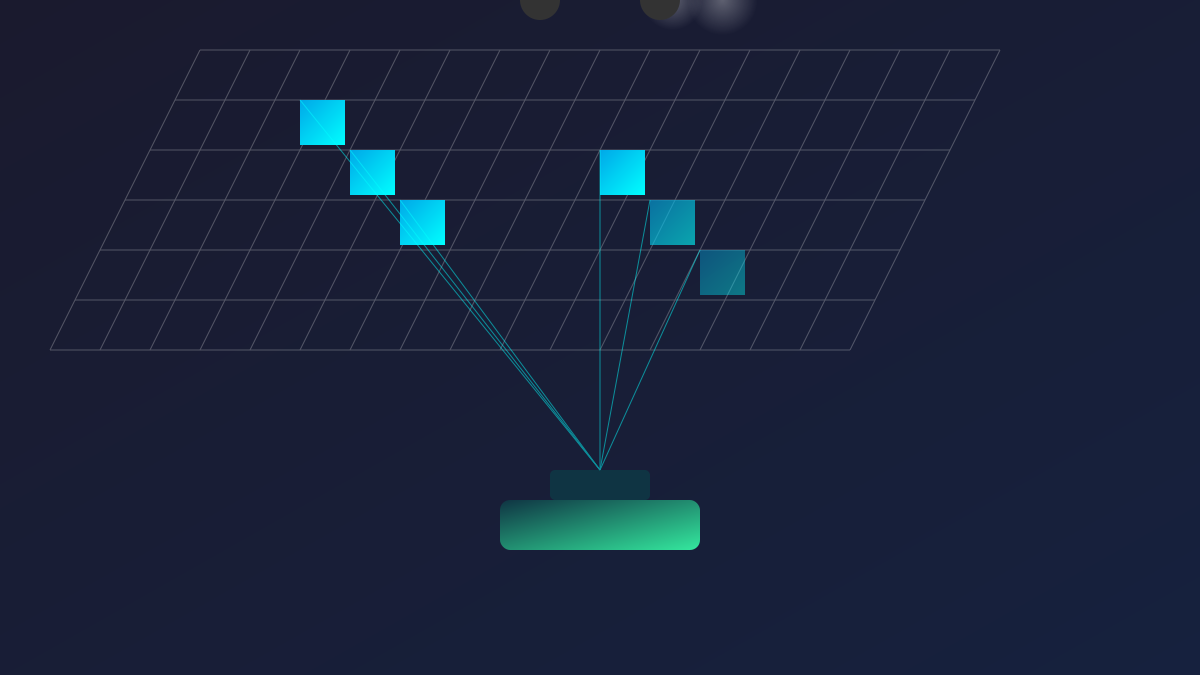
The project innovatively adopts a four-state model, different from traditional binary division:

  1. FREE_CONFIRMED (Confirmed Free): Fully observed by sensors, no obstacles
  2. FREE_ASSUMED (Assumed Free): Inferred to be free via geometric reasoning, no direct observation
  3. OCCUPIED_CONFIRMED (Confirmed Occupied): Obstacles clearly detected by sensors
  4. OCCUPIED_ASSUMED (Assumed Occupied): Inferred to possibly have obstacles via prior knowledge This model can distinguish between known and inferred free areas, facilitating more conservative and safe planning decisions.
4

Section 04

Discovery of the 40-Meter Critical Point for Safe Planning

Through large-scale data analysis, the project found that at a distance of 40 meters, the number of FREE_ASSUMED states equals the number of FREE_CONFIRMED states, which is defined as the "unsafe planning boundary". Beyond this distance, the proportion of inferred free areas is too high, making it unsuitable for high-speed path planning. Based on this, the decision-making basis is given:

  • Within 40 meters: Fine planning can rely on the occupancy network
  • Beyond 40 meters: Should reduce speed or switch to a conservative perception mode
5

Section 05

Technical Implementation Details

3D CNN Architecture

Uses a 3D convolutional neural network to process point cloud data, with input as a voxelized 3D spatial representation and output as the occupancy probability distribution of each voxel.

Training Data

Trained on 400,000 samples from the KITTI dataset, covering urban, highway, suburban and other scenes to ensure generalization ability.

GPU Acceleration

Optimized the inference pipeline for real-time performance, enabling real-time inference on in-vehicle computing platforms.

6

Section 06

Practical Application Value

  1. Improve Safety: Uncertainty quantification identifies perceptual blind spots, avoiding dangerous decisions caused by overconfidence
  2. Optimize Path Planning: The 40-meter boundary provides a clear switching threshold for speed planning
  3. Reduce Computational Cost: The four-state model is more concise than probability distributions, suitable for embedded deployment
7

Section 07

Demonstration and Validation Status

The project includes 108 frames of demonstration videos, showing the network's prediction effects in different scenarios such as dynamic obstacles, static environments, and edge cases, verifying the model's effectiveness.

8

Section 08

Summary and Outlook

Neural occupancy networks represent the direction of autonomous driving perception technology—shifting from binary classification to fine-grained uncertainty modeling. This project not only provides a usable technical solution but also reveals the key parameter of "safe planning distance", providing valuable reference data for the industry.

