Zing Forum

Reading

Using Artificial Neural Networks to Predict Bank Customer Churn: A Complete Guide from Data to Practice

This article delves into a bank customer churn prediction project based on Artificial Neural Networks (ANN), covering data preprocessing, model construction, training optimization, and practical application scenarios, providing financial institutions with actionable customer retention strategies.

人工神经网络客户流失预测机器学习金融科技深度学习数据挖掘银行风控分类算法客户关系管理神经网络调优
Published 2026-05-05 12:12Recent activity 2026-05-05 12:22Estimated read 7 min
Using Artificial Neural Networks to Predict Bank Customer Churn: A Complete Guide from Data to Practice
1

Section 01

[Introduction] Core Value and Practical Guide to Predicting Bank Customer Churn Using Artificial Neural Networks

In the highly competitive financial services industry, customer churn is one of the core challenges banks face—acquiring new customers usually costs 5 to 10 times more than retaining existing ones. This article provides an in-depth introduction to a bank customer churn prediction project based on Artificial Neural Networks (ANN), covering data preprocessing, model construction, training optimization, and practical application scenarios, offering financial institutions actionable customer retention strategies.


2

Section 02

Project Background and Business Value

Customer churn prediction is essentially a binary classification problem: determining whether a customer will churn in the future based on their historical behavior and demographic information. Traditional statistical methods (such as logistic regression) have limited performance when dealing with high-dimensional nonlinear features, while ANN has become an ideal choice due to its strong feature learning and nonlinear modeling advantages. The core business values of the project include: cost optimization (focusing budgets on high-risk customers), improved customer experience (avoiding disturbing loyal customers), and revenue protection (retaining high-value customers).

3

Section 03

Data Features and Preprocessing Strategies

Data Feature Classification

  • Demographic features: Age, gender, geographic location, etc., related to customer lifecycle and needs
  • Account behavior features: Account balance, transaction frequency, credit card usage, number of products held, etc., reflecting the depth of interaction
  • Transaction history features: Deposit, withdrawal, transfer records, capturing signals of decreased activity or capital outflow

Preprocessing Flow

  1. Missing value handling: Mean imputation or similar sample interpolation
  2. Categorical encoding: One-hot encoding to convert categorical variables
  3. Feature scaling: Standardization/normalization to balance the impact of dimensions
  4. Outlier detection: Identify and handle outliers
4

Section 04

Neural Network Architecture Design and Training Optimization

Architecture Design

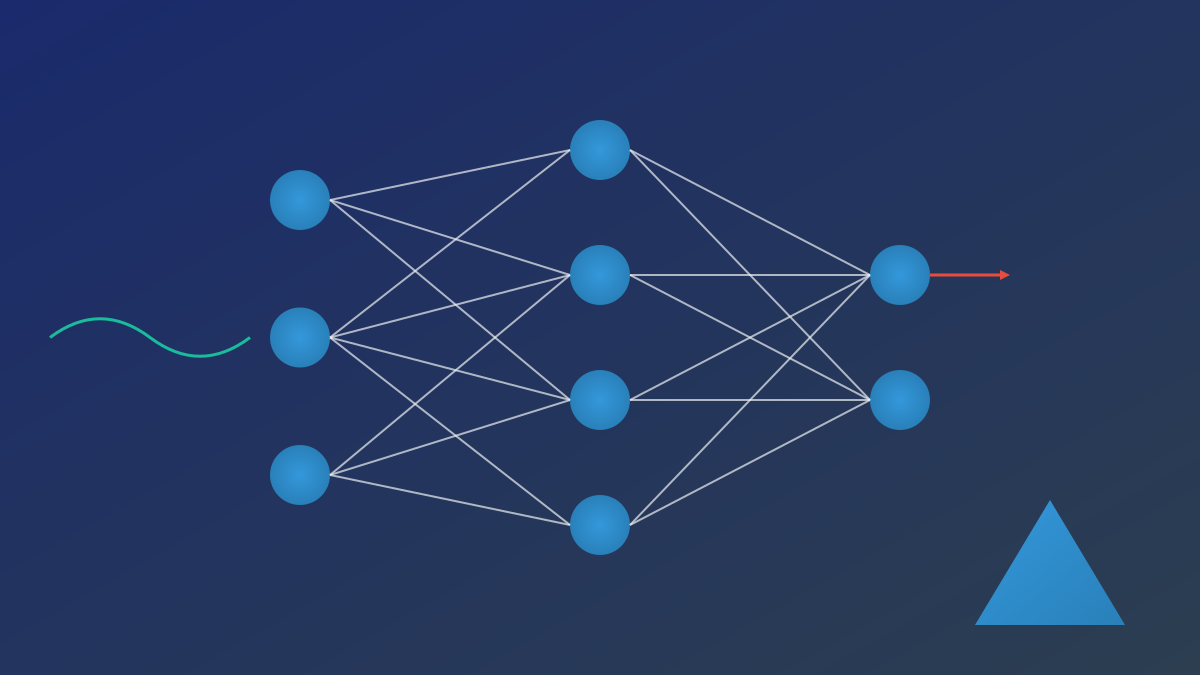
  • Input layer: Number of neurons corresponds to the dimension of preprocessed features (10-30)
  • Hidden layers: 2-3 layers with 64-128 neurons each; ReLU activation function to mitigate gradient vanishing
  • Output layer: Single neuron + Sigmoid activation, outputting churn probability
  • Regularization: Dropout layers, L2 regularization, and early stopping mechanism to prevent overfitting

Training Optimization

  • Loss function: Binary cross-entropy
  • Optimizer: Adam (combining momentum method and adaptive learning rate)
  • Dataset split: 80/20 for training/testing; training set further split into training/validation subsets
  • Hyperparameter tuning: Grid/random search to explore the number of hidden layers, learning rate (0.001-0.01), Dropout rate (0.2-0.5), etc.
5

Section 05

Model Evaluation and Business Application Scenarios

Evaluation Metrics

Focus on recall rate (to avoid missing high-value churn customers), and comprehensively use accuracy, precision, F1 score, and AUC-ROC

Feature Importance

Key influencing factors: Recent changes in account balance, number of products, age and account tenure, changes in transaction frequency

Application Scenarios

  • Real-time prediction: Deploy API services integrated into CRM systems
  • Tiered intervention: High-risk customers are contacted proactively by account managers; medium-risk customers receive preferential offers; low-risk customers get regular marketing
  • Continuous learning: Retrain the model regularly with new data
6

Section 06

Technical Challenges and Solutions

  • Class imbalance: Use SMOTE oversampling/undersampling and adjust class weights
  • Data privacy compliance: Data desensitization, access control, audit logs
  • Model interpretability: Combine SHAP/LIME techniques to provide decision-making basis
7

Section 07

Summary and Outlook

ANN provides a powerful tool for bank customer churn prediction. Proper preprocessing, architecture design, and optimization can build accurate and practical models, with the core being to convert outputs into executable strategies. In the future, we can explore Transformer/GNN architectures and time-series analysis to capture dynamic behaviors, with the goal always being to retain the right customers at the right time using the right methods.

