Zing Forum

Reading

Customer Lifetime Value Analysis Pipeline: A Complete Solution from Raw Data to Business Intelligence

This is an end-to-end retail data analysis project that builds a Customer Lifetime Value (CLV) prediction pipeline using SQL modeling and machine learning, and presents business insights via a Power BI dashboard.

客户终身价值数据分析零售Power BI机器学习客户分群商业智能
Published 2026-05-21 03:45Recent activity 2026-05-21 03:51Estimated read 6 min
Customer Lifetime Value Analysis Pipeline: A Complete Solution from Raw Data to Business Intelligence
1

Section 01

Customer Lifetime Value Analysis Pipeline: A Complete Solution from Raw Data to Business Intelligence (Introduction)

This is an end-to-end retail data analysis project that builds a Customer Lifetime Value (CLV) prediction pipeline using SQL modeling and machine learning, and presents business insights via a Power BI dashboard. The project provides a complete workflow from raw transaction data cleaning, modeling, segmentation, prediction to visualization, serving as both a technical implementation and a reusable business analysis methodology.


2

Section 02

Core Proposition in Retail: The Key Role of CLV

In the highly competitive retail industry, understanding customer value is a strategic foundation. Many retailers have massive transaction data but lack systematic mining methods; Customer Lifetime Value (CLV) is the key bridge connecting raw data and business decisions, representing the total revenue a customer brings during the relationship lifecycle.

3

Section 03

Data Architecture: Supported by Star Schema

The project core uses a star schema data model, dividing data into a central fact table (recording transaction events) and surrounding dimension tables (describing contexts like customers, products, time, etc.). This architecture ensures query performance, simplifies report development, is intuitive and easy to understand, and is suitable for scenarios requiring cross-time and cross-dimensional aggregation calculations in CLV analysis.

4

Section 04

Customer Segmentation and Prediction: Value Leap from Group to Individual

The project first uses the RFM model (Recency, Frequency, Monetary) to segment customer groups (such as high-value loyal customers, potential churn customers, etc.), then predicts each customer's future value via machine learning algorithms, realizing the leap from descriptive analysis to predictive analysis, and shifting decisions from "past-based" to "future-oriented."

5

Section 05

Technical Implementation: Collaborative Division of Labor Between SQL and Python

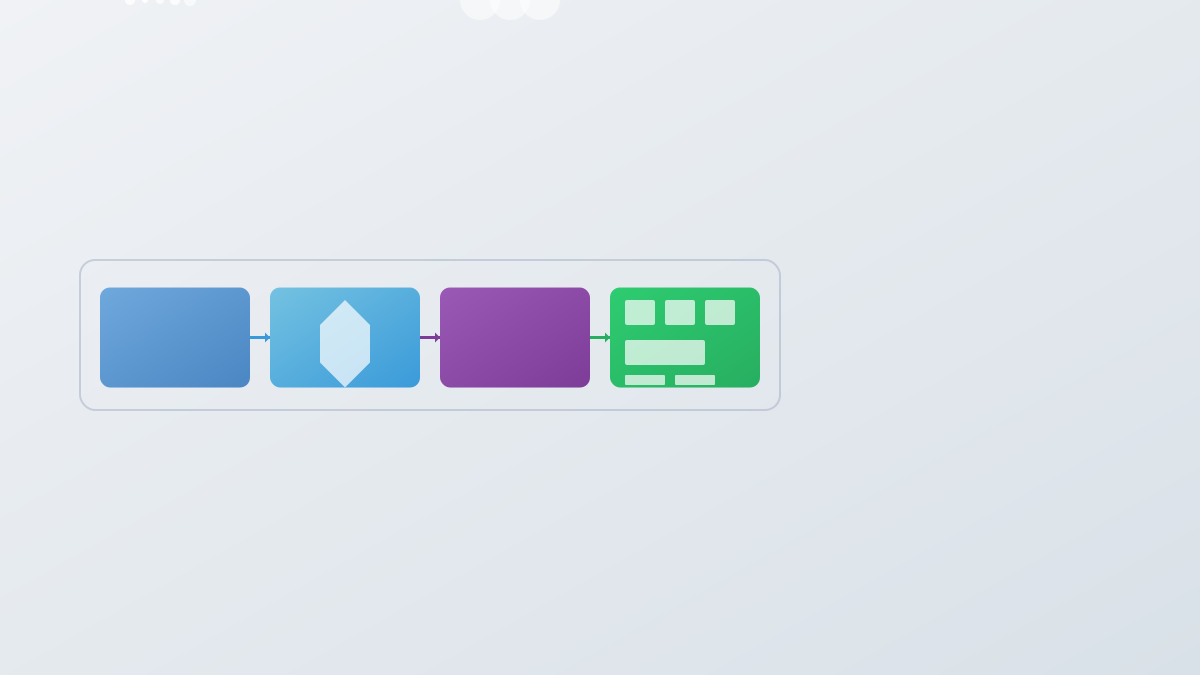
The tech stack combines SQL and Python: SQL is responsible for data modeling and metric calculation (such as revenue, order volume, average order value); Python handles customer segmentation and machine learning prediction. The workflow includes data cleaning (missing value and outlier handling), modeling (building star schema), segmentation (RFM), and prediction (training CLV models to estimate future value).

6

Section 06

Power BI Dashboard: Interactive Insight Presentation

The final deliverable is an interactive Power BI dashboard, including top Key Performance Indicator (KPI) cards (total number of customers, total revenue, average CLV, etc.), trend charts (temporal changes in sales and customer value), and segmentation views (comparing characteristics of different groups). Users can filter by date range and customer groups, update data in real time, and independently explore hidden patterns.

7

Section 07

Practical Application Scenarios and Value

This pipeline supports decision-making in multiple scenarios: marketing teams identify high-value customers to develop retention strategies; product teams analyze group purchase preferences to optimize product portfolios; finance teams evaluate marketing ROI based on CLV predictions. Additionally, it is an excellent learning resource for data analysts and BI developers, demonstrating the systematic processing from raw data to business insights.

8

Section 08

Conclusion: Core Value of CLV Analysis

Customer Lifetime Value analysis is a core capability for data-driven retail operations. This project provides a complete framework covering all links from data engineering to machine learning, and whether as a practical business application or a learning case, it demonstrates the powerful value of data analysis in business decision-making.

